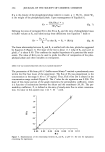
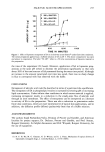
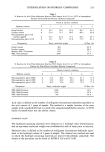
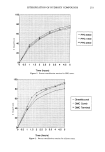
pH AND IRRITANCY 243 7 8 9 10 11 Study 1 + Study 2 ß Study 3 ß Study 4 x Study 5 Slurry pH See Results and Materials and Methods sections for description details of studies. Figure 1. Mean survival time as a function of slurry pH. of 4 higher. (This calculation assumes an average molecular weight of 286 daltons, which corresponds to a 1:1 mixture of a sodium and a potassium soap having an average chain length of 16 carbon atoms.) Although the above discussion indicates that there might in fact be some intrinsic contribution of pH, a more important effect is probably the influence of pH on the chemistry of complex personal washing compositions of the type studied here. Both bars A and B contain alkyl carboxylates and alkyl carboxylic acids, i.e., soaps and fatty acids. However, the concentrations of these species are not independent of pH and are related to pH by the simple chemical equilibrium: HA + H20 = A- + H3 O+ (1A) Log ([A-l/[HAl) -- pH + Log Ka (lB) where [A-] and [HA] are the equilibrium concentrations of dissolved alkyl carboxylate anion, i.e., soap and fatty acid, respectively, and Ka is the acidity constant of HA. Thus, the ratio of [A]-/[HA] at equilibrium can not be varied independently of pH. An increase in pH would lead to an increase in the relative proportions of soap in the slurry. Since fatty acids are known to be milder to the skin than their corresponding soaps of the same chain length, an increase in pH should therefore lead to a decrease in mildness. Although a change in [A-l/[HAl ratio with pH based on Eq. 1A qualitatively agrees with our mildness results, it can not be the entire explanation for the effect of pH on carboxylate-containing systems. The bulk acidity constant, pKa, of a long-chain fatty acid has been determined by a variety of workers and is about 5.0 at 25 øC (see reference 22 for a comprehensive review of this work). This value is similar to the value of 4.8 found for short-chain carboxylic acids (23). Based solely on the equilibrium condition expressed by Eq. lB, we are led to the conclusion that over 99% of the fatty carboxylate would be in the form of soap at both pH 7 and 10. Thus, there would not be any practical difference in level of soap between these two pH values. This conclusion does

244 JOURNAL OF THE SOCIETY OF COSMETIC CHEMISTS not agree with numerous titration studies reported in the literature (24) and with our own measurements described below. It might be concluded that the discrepancy is due to the value taken for the equilibrium constant in Eq. 1A. However, this is not the case. Rather, as Jung (22) and others (25,26) have discussed in considerable detail, the flaw in the above argument is that the equilibrium expressed by Eq. 1A is only one of the equilibria that govern the physical chemistry of alkyl carboxylate solutions. Other relevant equilibria are the formation of a complex of fatty acid and soap, the so called "acid-soap," the precipitation of this complex, the precipitation of fatty acid, and the precipitation of sodium and calcium soaps. The dependence on pH of the equilibrium state of dilute to moderately concen- trated soap solutions (up to a few wt% in water) is fairly complicated and was worked out in detail for several fatty acids by Lucassen (27). He concluded that these additional equilibria lead to a significant portion of the total fatty carboxylate existing as a com- bination of fatty acid and fatty acid soap at pH 7. The situation becomes even more complex at higher soap concentrations because of the possible formation of liquid crystal phases. In any case, the limited solubility of fatty acid and acid soap effectively drives the equilibrium to the left and leads to a higher proportion of fatty acid being formed than would be predicted based on Eq. 1 alone. For bar B, based on the amount of HC1 consumed, it is estimated that about 40 wt% of the soap was converted to fatty acid in adjusting the pH from about 10 to 7. It is likely that the enhanced mildness observed at neutral pH is not only due to a lower level of residual soap but also to formation of fatty acid-soap complexes that have a lower tendency to interact with proteins in the stratum corneum. The influence of fatty acid in increasing the mildness or reducing the drying potential of both soap and syndet formulations has been noted in several studies (14,27,28). The level of fatty acid-soap complexes is in turn controlled by the pH of the formulation. It has been shown that fatty acid also enhances the mildness of purely non-soap deter- gents such as acyl isethionates (28). In this case the addition of stearic acid has a perceptible effect in decreasing the zein dissolution produced by lauryl isethionate. Increasing the pH of such a composition from 7 to 10 would not only eliminate the stearic acid as a mildness enhancer but would convert it into a relatively harsher material, sodium stearate. Thus we can readily see why pH can play a significant role simply by its effect on the chemistry of the formulation. The above discussion also indicates that the intrinsic harshness of soap as an ingredient in a cleansing formulation also depends to some extent on the pH of the formulated skin cleanser in which it is used. For example, "stearate creams" are well known as ointment bases utilized in the treatment of skin. These compositions contain appreciable levels of soap (30), and this soap is actually required to achieve desirable in-use properties. Another example is the experiments with bar B described above. Bar B neutralized to pH 7 is comprised of about 60 wt% soap, yet this composition is relatively mild to the skin. However, the same level of soap would be quite harsh if it were present without fatty acid (i.e., at pH 10). Thus, the addition or removal of soap to a neutral pH formulation within reasonable limits may have no effect at all on the mildness of the composition, while the same change could have a significant effect on mildness of a highly alkaline composition.
Purchased for the exclusive use of nofirst nolast (unknown)
From: SCC Media Library & Resource Center (library.scconline.org)