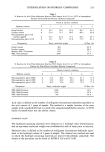
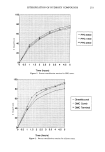
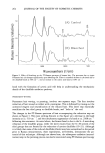
pH AND IRRITANCY 245 SUMMARY The above studies give a consistent picture of the contribution of pH to the mildness and harshness of the soap/detergent and soap-based compositions described. It can be con- cluded that the lower irritation potential of bar A compared to bar B is directly related to the difference in alkalinity as measured by pH. The pH, therefore, has a significant effect on the irritation potential of soap-based cleansers. This is consistent with infor- mation appearing in the recent patent literature and is in accord with the intrinsic chemistry of these ingredients (29). Alkaline soap-based cleansers are harsher to the skin than soap-based compositions that are formulated to a neutral pH. ACKNOWLEDGMENTS The authors wish to thank G. Nicoll, M. F. Petko, M. MoreIll, T. Farrell, J. Wong, D. Borowski, and A. P. Greene for their technical assistance and contributions to this article. REFERENCES (1) (2) (3) (4) (5) (6) (7) (8) (9) (lo) (11) (12) (13) (14) (15) (16) R. I. Murahata, R. Touton-Quinn, and M. B. Finkey, Effect of pH on the production of irritation in a chamber irritation test, J. Am. Acad. Dermatol., 18, 62-66 (1988). D. Spruit, Evaluation of skin function by the alkali application techniques, Curr. Probl. Dermatol., 3, 148-263 (1970). K. Bucher, K. E. Bucher, and D. Walz, Irritant actions of unphysiological pH values. A controlled procedure to test for topical irritancy, Agents and Actions, 9, 124-132 (1979). R. Bechor, A. Zlotogorski, and S. Dikstein, Effect of soaps and detergents on the pH and casual lipid levels of the skin surface, J. Appl. Cosmetol., 6, 123-128 (1988). G. Sauermann, A. Doerschner, U. Hoppe, and P. Wittern, Comparative study of skin care efficacy and in-use properties of soap and surfactant bars,J. Soc. Cosmet. Chem., 37, 309-327 (1986). H. C. Korting, M. Kober, M. Mueller, and O. Braun-Falco, Influence of repeated washings with soap and synthetic detergents on pH and resident flora of forehead and forearm, Acta Derm. Venereol. (Stockh.), 67, 41-47, (1987). H. C. Korting, M. Megele, S.C. C. Mehringer, et al., Influence of skin cleansing preparation acidity on skin surface properties. Int. J. Cosmet. Science, 13, 91-102 (1991). M. Rieger, The apparent pH on the skin, Cosmet. Toiletr., 104, 53-60 (1989). P. J. Frosch, "Irritancy of Soap and Detergent Bars," in Principles of Cosmetics for the Dermatologist, P. Frost, Ed. (Mosby, St. Louis, 1982), pp. 5-12. W. G. Van Ketel, D. P. Bruynzeel, P. D. Bezemer, and H. I. Stamhuis, Toxicity of handcleaners, Dermatologica, 168, 94-99 (1984). P. G. M. van der Valk, M. C. Crijns, J. P. Nater, and E. Bleumink, Skin irritancy of commercially available soap and detergent bars as measured by water vapour loss, Dermatosen, 37, 87-90 (1984). B. Komp, Skin compatibility tests--Importance in skin cleansing product development, Cosmet. Toiletr., 102, 89-95 (1987). J. H. Hassing, J. P. Nater, and E. Bleumink, Irritancy of low concentrations of soap and synthetic detergents as measured by skin water loss, Dermatologica, 164, 314-321, (1982). M. O. Visscher, S. E. Michaels, and B. H. Keswick, A clinical test method for assessing the irritation potential of skin cleansing products. Presented at the 48th Annual Meeting of the American Academy of Dermatology, 1989. W. Gehring, M. Gehse, V. Zimmerman, and M. Gloor, Effects of pH in a specific detergent multicomponent emulsion on the water content of stratum corneum, J. Soc. Cosmet. Chem., 42, 327-333 (1991). J. L. Antoine, J. L. Contrerras, and D. J. Van Neste, pH influence of surfactant-induced skin irritation, Dermatosen, 37, 96-100 (1989).

246 JOURNAL OF THE SOCIETY OF COSMETIC CHEMISTS (17) D. D. Strube, S. W. Koontz, R. I. Murahata, and R. F. Theiler, The flex wash test: A method for evaluating the mildness of personal washing products, J. Soc. Cosmet, Chem., 40, 297 (1989). (18) C. R. Robbins and K. M. Fernee, Some observations on the swelling human epidermal membrane, J. Soc. Cosmet. Chem., 34, 21-34 (1983). (19) G. N. Nicoll, R. I. Murahata, J. Barrows, D. Borowski, and G. L. Grove, The comparison of clinical test methods for evaluating personal washing product mildness (submitted for publication, 1994). (20) P. Frosch and A.M. Kligman, The soap chamber test--A new method for assessing the irritancy of soaps, J. Am. Acad. Dermatol., 1, 35--41 (1979). (21) P. Sharko, R. I. Murahata, J. J. Leyden, and G. L. Grove, Arm wash with instrumental evalua- tion--A sensitive technique for differentiating the irritation potential of personal washing products, J. Dermal Clin. Eval. Soc., 2, 19-27 (1991). (22) R. F. Jung, Oleic Acid Absorption at the Goethite Water Interface, M.S. Thesis, University of Melbourne (1976). (23) R. T. Morrison and R. N. Boyd, Organic Chemistry (Allyn and Bacon, Boston, 1959), p. 545. (24) H. Rosano and K. Breindel, Mechanisms of ionic exchange with carrier molecules through non- aqueous liquid membranes, J. Colloid Interface Sci,, 22, 58 (1966). (25) P. Ekwall, Constitution of dilute soap solutions, theory of hydrolysis, Colloid Z., 92, 141- ! 57 (1940). (26) J. W. McBain and H. McHan, Soap micelies that solubilize dimethyl phthalate, a liquid insoluble in water and hydrocarbon, J. American Chem. Soc., 70, 38--40 (1948). (27) J. Lucassen, Hydrolysis and precipitation in carboxylate soap solutions, J. Phys. Chem., 70, 1824- 1830 (1966). (28) M. Massaro, M. Rerek, and P. Sharko, Isethionate based systems as an alternative to soap in skin cleansing products. Presented at the Annual Meeting of the Society of Cosmetic Chemists, Atlantic City, 1992. (29) L. E. Small, P. H. Garrison, W. M. Winkler, S. A. Seaman, and A.J. Papa, Ultra mild skin cleansing composition, U.S. Patent 4,812,253, assigned to Procter & Gamble Co. L. E. Small, P. H. Garrison, W. M. Winkler, S. A. Seaman, and A. J. Papa, Ultra mild skin cleansing compo- sition, U.S. Patent 4,673,525, assigned to Procter & Gamble Co. (30) H. E. Junginger, "Pharmaceutical Emulsions and Creams," in Emulsions--A Fundamental and Practical Approach, Johan Sjoblom, Ed. (NATO ASI Series C, Vol. 363, Kluwer, Dordrecht, 1992). (31) M. L. Kacher, J. E. Taneri, D. G. Schmidt, and T. K. Wong, Skin pH freezer bar and process, U.S. Patent 5,225,097 (1993) M. L. Kacher, J. E. Taneri, D. G. Schmidt, et al., Neutral pH freezer bar and process, U.S. Patent 5,225,089 (1993) M. L. Kacher, J. E. Taneri, D. G. Schmidt, and T. K. Wong, Framed skin pH cleansing bar, U.S. Patent 5,227,086 (1993). All assigned to Procter & Gamble Co.
Purchased for the exclusive use of nofirst nolast (unknown)
From: SCC Media Library & Resource Center (library.scconline.org)