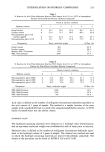
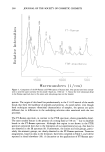
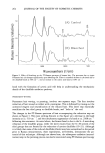
FT-RAMAN SPECTROSCOPY 261 Table I Tentative Assignments, Based on Data in the Literature, of the Vibrational Bands Observed in the FToRaman Spectra of Human Hair Frequency (cm- 2) Assignments 510 S•S stretch 646 Tyr 750 Trp 853/827 doublet Tyr 1003 Phe 1038 SO 3- • (cysteic acid) 1214 Tyr, Phe 1249 Amide III 1454 CH 2 deformations 1554 Trp 1586 Phe, Trp 1616 Tyr 1655 amide of I of ot helix 1665 amide I of disordered structure 2565 S•H stretch troscopy to probe structural changes in hair due to cosmetic chemical treatments and photodamage is presented below. HAIR BLEACHING This procedure is used both in salons and in the retail market to lighten the color of pigmented hair. A variety of products are available in the market, but the underlying basic chemistry is similar, and involves strong oxidizers to bleach the melanin pigment. Since the pigment is present in cortical cells, the oxidant has to diffuse inside the fiber to cause bleaching. An unwanted nuisance is the accompanying damage to the hair fiber itself during this process. The problem becomes more severe as the growing hair fibers undergo multiple bleaching (and possibly perming) treatments during their residence on the scalp. This has resulted in the need to characterize and monitor hair damage associated with the bleaching process. The ultimate desire is to develop a bleaching system that will selectively target melanin pigment, leaving hair fibers relatively un- scathed. The spectral changes associated with hair bleaching are shown in Figure 2. A noteworthy feature is a decrease in the intensity of the '" 510 cm- • band due to the disulfide bonds of cystine. This decrease is associated with an increase in the band intensity at ca. 1045 cm- •. This latter band has been previously seen in the FTIR spectra of oxidized keratin, and has been assigned to the sulfonic acid group of cysteic acid resulting from disulfide oxidation (9, 10). These data clearly show that disulfide bonds are damaged during hair bleaching and that cysteic acid is one of the resulting products. The ability to monitor the disulfide bond itself, rather than one of the oxidation products such as cysteic acid, as in FTIR analysis, allows quantitative determination of the damage to the disulfide bonds. Furthermore, a correlation of the loss of the disulfide

262 JOURNAL OF THE SOCIETY OF COSMETIC CHEMISTS 30 (A) Conirol •, I f• (B) Bleoche s'oo lo'oo Wavenumbers (l/cm) Figure 2. Effect of bleaching on the FT-Raman spectrum of human hair. The spectrum due to virgin Piedmont hair (A) changes significantly upon bleaching (B). There is a marked decrease in the band due to the disulfide bonds at 509 cm-• and an increase in the cysteic acid band at 1045 cm-• bond with the formation of cysteic acid will help in understanding the mechanistic details of the disulfide oxidation pathway. PERMANENT WAVING Permanent hair waving, or perming, involves two separate steps. The first involves reduction of hair wound on rollers with a mercaptan. This is followed by rinsing out the unreacted reagent and neutralization of the reduced hair. This latter step essentially reoxidizes the free thiol group to disulfide bonds, and "locks in" the curl. The changes in the FT-Raman spectrum of hair accompanying the reduction step are shown in Figure 3. The most striking features in this figure are a decrease in the band intensity at ca. 510 cm- •, and the simultaneous appearance of a band at ca. 2568 cm- • following the treatment. As noted above, the former band is due to the S--S stretching vibration of the disulfide group, while the latter results from the S•H stretch of the thiol groups that are formed by the reduction of cystine disulfides (19-21). Although it is likely that some of the reduced disulfides (thiols) may have autoxidized in the period prior to Raman measurements, these experiments, nevertheless, demonstrate the po- tential of this technique. Although not shown here, the subsequent oxidation (neutral- ization) step in the perming process can also be monitored using FT-Raman spectroscopy
Purchased for the exclusive use of nofirst nolast (unknown)
From: SCC Media Library & Resource Center (library.scconline.org)