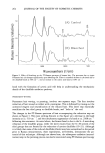
SQUAMOMETRY AND CORNEOSURFAMET RY 275 D-SQMI-2 % 30 - 25 20 15 10 -5 10 2o 0 4o 5o 6o CSMI-5 % Figure 4. Comparison of corneosurfametry index (CSMI) using 5% water dilutions and the differential squamometry index (D-SQMI) using 2% water dilutions. No correlation was found between these data. Most proprietary soaps (I) and syndets (&) had both D-SQMI and CSMI values comprised between those of mild surfactants [Tween 20 and CAPB (•) and SLS (•)]. Compared to these latter reference products, proprietary cleansing products influenced CSMI more than D-SQMI. Inter-individual variations were larger for SQMI than for CIM. When cleansing agents were tested, inter-individual variations in D-SQMI were also larger than for CSMI. These findings, added to the fact that individuals with sensitive skin had high SQMI values, would suggest that squamometry evaluations are more influenced by inter- individual differences in stratum corneum reactivity to cleansing agents than by cor- neosurfametry. This latter test, which combines evaluations of alterations in L* and Chroma C* by surfactants, is not valid when the product concentration is too high and when the duration of the test is too long. We found that valid conclusions may only be drawn when a linear relationship exists between L* and Chroma C* (5), i.e., when the L* value of a sample is both higher than 45 and superior to Chroma C*. The present study confirms these findings. For personal skin care products, dilutions at 1% and 5% seemingly provide the same information. In a previous study (5), we had used 10% solutions, such concentration appearing as the maximum for the harsh products in order to stand within the defined colorimetric standards. These refinements in our under- standing of squamometry and corneosurfametry are now included in the standard op- erating procedure followed in our laboratory. The inter-individual differences observed in these tests on stratum corneum are not so surprising when one considers the huge variability experienced in in vivo tests with sodium lauryl sulfate or with any other irritating agent. Clinical grading to identify

276 JOURNAL OF THE SOCIETY OF COSMETIC CHEMISTS normal stratum corneum is in fact often faulty, so that not all healthy skins may be regarded as equally "normal." In this study we considered two reference surfactants reputed to be mild for the stratum corneum (Tween 20 and CAPB) and another one, SLS, displaying strong reactivity with corneocytes. Such ranking was also found both by squamometry and corneosurfametry. Compared to the reference surfactants, all proprietary soaps and syndets induced more prominent changes in the corneosurfametry evaluations than the squamometry test. The final issue was a lack of correlation between data gained by these two tests conducted on stratum corneum. Our explanation for this seeming paradox relates to subtle differences in the nature of stratum corneum involved in the tests. Squamometry deals with the outer surface of the stratum disjunctum whereas corneosurfametry is performed on the inner face of the CSSB, i.e., on corneocytes located three to five layers deep. Moreover, for squamometry, the surface exposed to the test agents is not the same as the surface in contact with stains. For corneosurfametry, the surface exposed to the test agents and treated with stain are the same. In these respects, inter-individual differences in stratum corneum reactivity are more prominent at the surface of the skin (SQMI and D-SQMI) than in deeper locations inside the horny layer (CIM and CSMI). The paradox of low values of CSMI (as experienced, for instance, with So-A and So-E) could be explained by the cascade of corneocytes swelling (9,10), lysis, and removal of the loose stratum disjunctum. This was already suggested by microscopic evaluations made in a previous study (6). As a consequence, D-Squames collect fewer corneocytes because intercellular bindings increase in deeper locations inside the stratum corneum. In sum, both squamometry and corneosurfametry provide information concerning the interaction between cleansing agents and corneocytes. These simple and cheap methods are complementary and have the advantage of testing human stratum corneum reactiv- ity, and they therefore should bring sound information directly related to the consumer situation. Ranking of product irritancy may be established for most surfactants (5). Data correlate well with in vivo tests when anionic surfactants are concerned, but there is a possible underrating of some amphoteric products with our methods (personal unpub- lished data). With the present knowledge, we are, therefore, not warranted in ascribing a definite interpretation of the data in that specific situation. Further work is needed in the field of alternative methods. avoiding animal experiments to obtain objective prediction of the irritative potential of cleansing products. Corneo- surfametry and squamometry appear to be promising approaches when they are com- bined. Pitfalls in the interpretation of data are present and must be identified. Among them, the most prominent are the inter-individual variability in skin compatibility with cleansing agents and the paradoxically excellent SQMI rating of harsh products when destruction and removal of superficial corneocytes are achieved. The possibility of iden- tifying and rating sensitive skin by the presently reported methods is only suggested by our data and should be studied in depth in future works. REFERENCES (1) L. D. Rhein and A. Simion, Surfactant interactions with skin, Surf. Sci. Ser., 32, 33-49 (1991). (2) P. J. Frosch and A.M. Kligman, The soap chamber test. A new method for assessing the irritancy of soaps, J. Am. Acad. Dermatol., 1, 35-41 (1979).
Purchased for the exclusive use of nofirst nolast (unknown)
From: SCC Media Library & Resource Center (library.scconline.org)