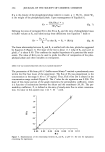
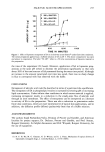
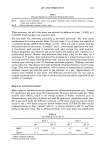
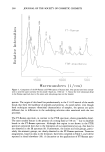
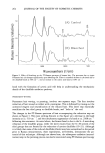
I I I 2700 2600 2500 Figure 5. Formation of the mercaptan groups in hair due to photodamage. The virgin hair spectrum (A) changes significantly (B) upon 165 h irradiation in a solar simulator. c c -- c Amide I I I 1700 1600 Wc•venumbers (1/cm) Figure 6. Effect of hair photodamage on the peptide backbone. The amide I region of virgin Piedmont hair (solid line) changes (dotted line) upon 165 h irradiation in the solar simulator (see text).

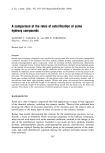
266 JOURNAL OF THE SOCIETY OF COSMETIC CHEMISTS c c -- c Amide I I I 1700 1650 Wavenumbers (1//cm) Figure 7. The amide I region of the Raman spectra (same data as in Figure 6) were enhanced using the second derivative (13-point) technique. The virgin hair spectrum is indicated by a solid line, and after 165 h irradiation in a solar simulator by a dotted line. proteins do not show the same vibrational frequency. This frequency is modulated by the nature of hydrogen bonding (inter- or intramolecular) as well as by the milieu of the amide bond. Thus, for a complex proteinaceous structure such as human hair, a variety of bands, with slightly differing frequencies, are likely to appear in this region. The overlap of these bands leads to a broad observed band that can be resolved using analytical procedures. Comparison of the spectra obtained for the virgin and the pho- todamaged hair shown in Figure 6 reveals slight but clear changes in the amide I region as a result of light-induced damage. These spectra have been resolved in Figure 7 to enhance these differences. The largest change appears in the ratio of the bands at ca. 1653 cm- • and 1663 cm- •. Based on the data available in protein literature, the 1653 cm- • band has been assigned to the or-helical protein conformation, while the band at ca. 1665 cm- • is likely due to the disordered form. These preliminary data suggest that under these irradiation conditions, the or-helical protein is relatively unaffected and that the damage occurs mainly to the cuticles and, perhaps, to the amorphous matrix proteins. A detailed study is needed to better characterize the changes observed in this preliminary study. In summary, a relatively new technique has been evaluated for its potential application in hair research. It is shown that the vibrational bands due to disulfide bonds and their
Purchased for the exclusive use of nofirst nolast (unknown)
From: SCC Media Library & Resource Center (library.scconline.org)