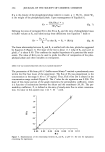
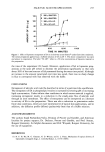
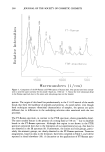
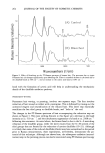
FT-RAMAN SPECTROSCOPY 263 4O 3O S--H (A) Control (B) Reduced 20'00 •o'oo Wavenumbers (1/cm) Figure 3. Effect of thioglycolate reduction on the FT-Raman spectrum of human hair. The spectrum due to virgin Piedmont hair (A) changes upon reduction (B). The mercaptan (S•H) band at 2568 cm- 1 is formed at the expense of the disulfide band at 509 cm-• (22). Comparison of the initial disulfide band intensity with that following the final oxidation (neutralization) step will be a measure of hair damage during the perming treatment. It has been reported that • 15% of cystines are lost in a "typical" perming process, and the fate of this lost sulfur is unclear (23). We feel that the ability to monitor cystine (disulfide) and its redox products provides an opportunity to understand the chemistry of cystine during cosmetic treatments. This, in turn, will help in designing milder, less damaging, cosmetic treatments. HAIR PHOTODAMAGE The effect of hair photodamage is shown in Figure 4. The intensity of the band at ca. 510 cm- • due to the disulfide bonds is reduced upon photoexposure, clearly indicating damage to these bonds. Concomitant changes appear in the 1030-1130 cm- • region, which contains vibrations from the disulfide oxidation products. Unlike chemical oxi- dation with strong oxidizers such as peroxide and persulfate, which predominantly lead to the formation of highly oxidized sulfur in the form of cysteic acid, photodamage is expected to result in the formation of a variety of oxidation states such as cystine monoxide, dioxide, etc. (1,11). Although Raman data on these compounds are not --1 available, an increase in the intensity of the bands in the 1030-1130 cm region suggests the formation of sulfur in different oxidation states. In particular, based on FTIR data, the band at ca. 1040 cm- • has been assigned to cysteic acid (see also the

264 JOURNAL OF THE SOCIETY OF COSMETIC CHEMISTS o ½'q to CiD IA , • II 1000 800 600 400 Wavenumbers ( 1/ern) Figure 4. Effect of photodamage on the FT-Raman spectrum of human hair. The most significant change in the virgin hair spectrum (A) upon 165 h irradiation in a solar simulator (B) is the reduction in the disulfide bond intensity at 510 cm- • (see text for details). section on bleaching above). There is also a large increase in the band at ca. 446 cm- • upon photodamage. A simple calculation, based on the harmonic oscillator approxima- tion, suggests that modification of the S--S bond to a SO 2 --S (thiosulfonate) bond will shift the frequency from 510 to 445 cm- •. Thus, an increase in the intensity of the band at --446 cm- • as seen here, has been tentatively interpreted as being indicative of the formation of thiosulfonate groups as products of disulfide photoxidation in hair. An unexpected finding of this study, although preliminary, is shown in Figure 5. The relatively weak band at ca. 2567 cm- • increases in intensity upon photoexposure. This band has been assigned to the S -- H vibration ofcysteine (20,21). We have also shown above that this band is formed upon reduction with thioglycolate of disulfide bonds in hair. Although meracaptans have been proposed previously as one of the many products that may form during oxidative hair damage (1), we are aware of only one report claiming the formation ofmercaptans in hair upon exposure to light (24). In this context it is worth noting that photodamaged hair, upon wetting, produces a strong odor, typical of reduced sulfur. The 1630-1690 cm-• region in the Raman spectrum of hair shows the characteristic features associated with the amide I vibrational band of proteins. The main contribution to this vibration is from the C--O stretch of the peptide bond. All peptide bonds in
Purchased for the exclusive use of nofirst nolast (unknown)
From: SCC Media Library & Resource Center (library.scconline.org)