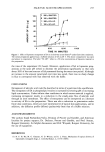
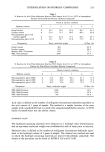
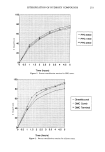
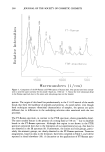
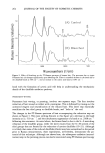
ESTERIFICATION OF HYDROXY COMPOUNDS 255 2,500 .............................................................................................................. .. : • 2,000 ß ,• 1,500 1,000 50O --'- Primary OH -+ Silicone OH -•-Sec OH (PPG) % Reaction Figure 5. Percent esterification reaction in four hours. We determined that not only is there a qualitative relationship between equivalent molecular weight of the hydroxyl-containing compound and the rate of reaction, but when you plot the % reaction at a given time (we chose three hours) vs equivalent molecular weight, a line is generated for each of the three classes identified above. Three distinct lines were found. The slope of the lines was also felt to be significant. In the case of the polyoxypropylene compounds a very dramatic slope was observed. This indicates that the fact that the alcohol is secondary is more important to rate than the molecular weight. Small amounts of rate reduction were observed with increasing molecular weight in this class of compounds. On the other hand, when one considers the other two lines, the molecular weight has a more dramatic effect upon reaction rates than is observed with the polyoxypropylene products. A very similar set of graphs could be established if the % reaction were compared at other times. A comparison at four hours is also included. The presence of multiple hydroxyl groups in a single molecule was not found to be a factor if one considers equivalent molecular weight rather than the molecular weight. The number of milliequivalents per liter was important, not the presence of both in the same molecule. REFERENCES (1) A. J. O'Lenick, Jr., and M. B. Fuergson, Fatty esters, Household and Personal Products Industry, 134 (1988).

256 JOURNAL OF THE SOCIETY OF COSMETIC CHEMISTS (10) (11) (2) U.S. Patent 5,051,489, September 1991. (3) U.S. Patent 5,070,168, December 1991. (4) U.S. Patent 5,136,063, August 1992. (5) U.S. Patent 5,180,843, January 1993. (6) U.S. Patent 5,210,133, May 1993. (7) U.S. Patent 5,226,923, July 1993. (8) U.S. Patent 5,260,401, November 1993. (9) A. J. O'Lenick, Jr., and Raymond E. Bilbo, Guerbet alcohols, versatile hydrophobes, Soap Cosmetic and Chemical Specialties, 63(7) (1987). M. Guerbet, Branched alcohols, Acad. Sci. Paris, 128(511) (1899). U.S. Patent 4,868,236, September 1989.
Purchased for the exclusive use of nofirst nolast (unknown)
From: SCC Media Library & Resource Center (library.scconline.org)