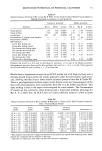
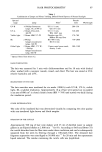
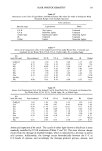
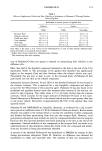
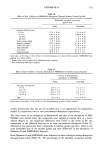
HAIR PHOTOCHEMISTRY 87 Table I Combination of Lamps and Filters Yielding Defined Partial Spectra of Natural Sunlight Spectral Results range Lamp Filter x (nm) Wavelength UV-B 14 Philips fluorescent UG 11/1 mm, 280-350 lamps, TC 20 W/12 GG 19/1 mm UV-A 2 Osram-Ultra-med, UG 11/1 mm, 320-400 400 W WG 320/! mm Visible light 2 Osram HMI 575 W Plexiglas type 201, 370-780 Blakers IR stop filter IR 2 Philips RG 780/3 mm, 750-2800 halogen-incandescent KG 4/2 mm lamps, 600 W Global light 2 Osram HMI, 575 W, 2 layers metal gauze mesh, 280-1100 1 Philips density 2 mm halogen-incandescent lamp, 600 W Optical filters from Schott Co. HAIR PURIFICATION The hair was extracted for 5 min with dichloromethane and for 30 min with diethyl ether, washed with a nonionic tenside, rinsed, and dried. The hair was stored at 65% relative humidity and 20øC. IRRADIATION OF THE HAIR The hair swatches were irradiated for six weeks (1008 h) with UV-B, UV-A, visible light, IR, or global irradiation. Approximately 10 g of hair were spread out in parallel in an area of 600 cm 2 in closed climatic boxes (RH 70%) and turned over daily during the irradiation period. COLOR DETERMINATION The color of the irradiated hair was determined visually by comparing the color quality with non-irradiated light-brown and black samples. ISOLATION OF THE CUTICLE Approximately 500 mg of hair were shaken with 25 ml of distilled water in sample glasses in an ellipsoid shaker at 2.800 min- • for 8 h. According to Swift and Bews (15) the cuticle detaches from the fiber stem under these conditions and can be subsequently separated from the stem by filtering through a 100-mesh filter. The obtained hair fragment suspension was centrifuged at 30.000 min-• for 20 min and the supernatant liquid removed. The residue containing the cuticle cells was lyophilized.

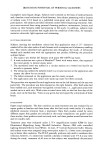
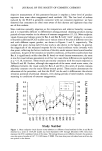
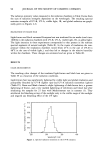
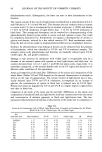
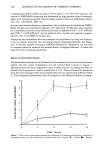
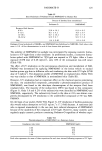
88 JOURNAL OF THE SOCIETY OF COSMETIC CHEMISTS AMINO ACID ANALYSIS AFTER TOTAL ACID HYDROLYSIS Approximately 10 mg of hair or isolated cuticle were placed into 4 ml of 5.7 M freshly distilled HCI and hydrolyzed in a glass tube at 105øC for 24 h. The subsequent amino acid analysis was performed according to Spackman et al. (16). CYSTINE OXIDES The cystine oxides of the outer cuticle layers were determined semiquantitatively by means of IR spectroscopy, using a technique of attenuated total internal reflection (FTIR/ATR) from a KRS-5-crystal (17). RADIATION EQUIPMENT AND IRRADIATION CONDITIONS RADIATION EQUIPMENT The arrangement of the radiation unit that simulates five different parts of the natural sunlight spectrum is sketched in Figure 1. The radiation installation consists of five open containers with inside dimensions of 50 cm x 50 cm x 60 cm. By the combination of special lamps with optical filters each radiation container produces a spectrum with defined ranges of wavelengths (Tables I and II) and emission intensities (Table II). UV-B, UV-A, visible light, IR, and global irradiation simulate the intensities of natural sunlight in summer months at central European latitudes (Table II). lamps optical filter quartz glass__ samples glyc./water air shaft sedir 1-1I.,/I • , .,,/ , air stream closed chamber irradiation compartment Figure 1. Sketch of the radiation installation with boxes for UV-B, UV-A, visible light, IR radiation, and global light. Each radiation unit contains two closed climatic chambers in which the human hairs are irradiated under controlled humidities and temperatures.
Purchased for the exclusive use of nofirst nolast (unknown)
From: SCC Media Library & Resource Center (library.scconline.org)