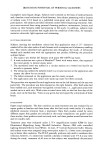
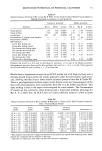
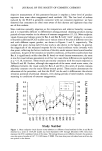
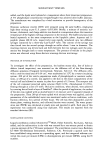
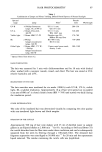
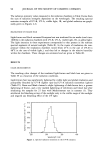
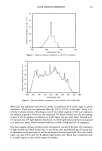
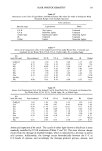
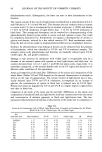
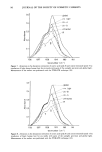
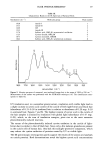
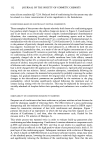
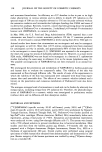
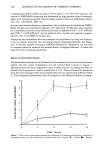
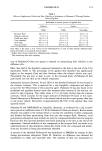
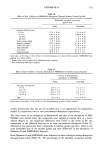
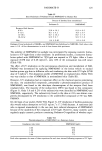
HAIR PHOTOCHEMISTRY 95 Table VIII Amino Acid Composition (AA) of Whole Black Hair, Untreated and Irradiated for Six Weeks With UV-B, UV-A, Visible Light, IR, or Global Light AA (mol/100 mol) Non-irradiated UV-B UV-A Visible light IR Global CySO3H 1.14 0.96 0.74 0.90 0.49 0.97 Cys 2 7.00 5.7 ! 8.95 9.02 9.22 8.32 Gly 7.34 7.77 6.39 6.08 5.85 5.72 Ala 5.47 5.95 4.56 4.83 5.84 4.54 Pro 8.26 8.68 8.53 7.72 8.13 7.67 Val 3.02 3.33 6.05 6.07 6.24 4.70 Tyr !. 96 2.00 2.63 2.24 2.24 !. 09 Phe 2.86 2.60 1.91 1.80 1.67 1.27 His 0.74 0.72 0.66 0.75 0.84 0.55 the cuticle is suggestive of the photoprotective effect of the melanin pigment, which resides predominantly in the fiber cortex of human hair (23). As the extent of changes in the amino acid composition of the cuticle of light-brown and black hair is similar, this can be readily explained by absence of pigment in these cells. It appears that the pigments of black hair protect the cortex proteins of the fiber better against photodam- age than does the melanin of light-brown hair. INFRARED SPECTROSCOPIC INVESTIGATIONS By means of infrared spectroscopic investigations (FTIR/ATR), photochemically created cystine oxides were determined semiquantitatively in the outer cuticle layers. The IR spectra were standardized using the amide-I band, allowing a semiquantitative comparison of the absorptions of the cystine oxides (17). In Figures 7 and 8 the --1 vibrations of cysteic acid and cystine monoxide are depicted in the range of 1136 cm to 940 cm-1 for both light-brown and black hair. In the spectra the bands 1042 cm- 1 of sulfonic acid R-SO3H (peak 8), 1073 cm- • of the cystine monoxide R-SOS-R (peak 7), and 1125 cm- • of cystine dioxide R-SO2S-R (peak 6) have been identified (Table IX and Figure 9). The IR spectrum of untreated, non-irradiated hair (Figure 9) is characterized by similar intensities of absorption at 1073 cm-1 (peak 7) and 1042 cm-1 (peak 8). In the untreated light-brown and black hair used in the present investigation (Figures 7 and 8, untreated sample) a markedly higher absorption of the sulfonic acid at 1042 cm- 1 (peak 8) than of the cystine monoxide (1073 cm- 1) is already seen, suggesting oxidative damage of the source material, e.g., by natural exposure to weather. IR irradiation of light-brown and black hair does not result in an increase in the cysteic acid peaks (Figures 7 and 8). The spectra even show decreased absorptions for cystine monoxide and cysteic acid (absorbance of peak 8 = 0.22) compared to the spectra of the untreated samples (absorbance of peak 8 = 0.29 in the case of black hair and 0.30 in the case of light-brown hair). Apparently the photooxidation is not the dominant mode of photodegradation in this case.

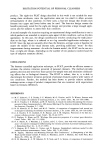
96 JOURNAL OF THE SOCIETY OF COSMETIC CHEMISTS 0,5 0,3- 0,2 0,1 i i i 1136 1097 1058 1019 980 9/,1 Wo, venumber [cm -• ] Figure 7. Alteration in the absorption intensities of cysteic acid (peak 8) and cystine monoxide (peak 7) by irradiation of light-brown human hair for six weeks with parts of the sunlight spectrum and global light. Measurement of the surface was performed with the FTIR/ATR technique (16). 0, s t 0,3. 0,2 0,1 0 1136 //• gtobo[ / • /•....•vis. I. ighf . ß i i 1097 1058 1019 980 9/+1 Wovenumber [cm -• ] Figure 8. Alteration in the absorption intensities of cysteic acid (peak 8) and cystine monoxide (peak 7) by irradiation of black human hair for six weeks with parts of the sunlight spectrum and global light. Measurement of the surface was performed with the FTIR/ATR technique (16).
Purchased for the exclusive use of nofirst nolast (unknown)
From: SCC Media Library & Resource Center (library.scconline.org)