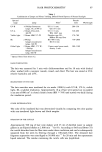
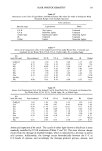
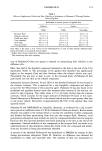
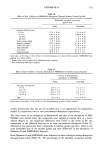
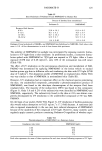
HAIR PHOTOCHEMISTRY 89 Table II Spectral Distribution in the Radiation Chambers and Radiation Intensities (E) of the Partial Ranges of the Sunlight Spectrum in Comparison With Natural Sunshine Global irradiation • E recommended 2 E measured 3 Spectral range h. (nm) (%) (W/m 2) (W/m 2) UV-B 280-350 0.4 4 2.5 UV-A 320-400 5.7 50 48 Visible-light 370-780 51.8 585 463 IR 750-2800 43.9 511 440 Global light 280-1100 100 1140 1037 Distribution of natural sunlight in summer in Central Europe. CIE recommended distribution of radiation intensities during investigations with artificial sunlight (18). Measured radiation intensities in the irradiation chambers, determined by G. Geutler, 1988 (19). The lamps of the irradiation containers are cooled by an airflow conducted through a pipe into hood shafts. The side walls of the radiation units are lined with aluminium sheets for uniform distribution of radiation. The radiation containers are open on one side. Since the photooxidative changes in hair are affected by humidity and temperature (4,11), the containers were supplemented by climatic boxes with closed gas space that allow the passage of visible light as well as UV radiation and in which the temperature and humidity can be regulated. For this pur- pose, steam-saturated air with a relative humidity of 74-94% is introduced into the climatic boxes with a tubing system (Table III: outer RH). A ventilator installed in the side of the boxes evenly distributes the humid air warmed by the lamps. The hair samples are irradiated while arranged in parallel over a 20-cm X 30-cm perforated table. Table II provides an overview of the energies in the individual radiation containers, which were intended and actually measured. In column 3 the radiation intensity values (E recommended) are given, which are proposed in a CIE recommendation for radiation experiments with artificial sunlight corresponding to the values occurring in natural sunlight (18). In column 4 (global irradiation) the values are listed as relative to the natural sunlight in summer at central European latitudes. The empirically determined wattage in the radiation chambers (19) in column 5 (E measured) shows an optimum matching of the simulated sunlight with the naturally occurring light. Table III Temperature and Relative Humidity in the Climatic Chambers During Irradiation With Artificial Sunlight Spectral range T inside (øC)• RH outside (%)2 Calc. RH inside (%)3 UV-B 31 74 52.2 UV-A 25 94 94 Visible light 48 77 22 IR 35 84 47.3 Global light 43 77 28.2 Temperature in climatic chambers. Relative humidity of the piped-in air. Calculated relative humidity in the climatic chambers applying the formula p H20/p H2Omax.

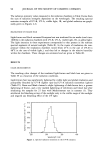
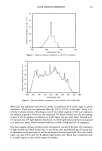
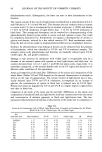
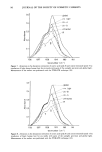
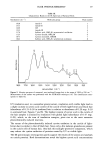
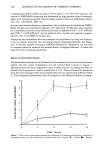
90 JOURNAL OF THE SOCIETY OF COSMETIC CHEMISTS The radiation intensity values measured in the radiation chambers in Table II arise from the sum of radiation strengths dependent on the wavelength. The resulting spectral emission strengths of UV-B, UV-A, visible light, IR, and global radiation are graph- ically given in Figures 2-6. IRRADIATION OF HUMAN HAIR Light-brown and black untreated European hair was irradiated for six weeks (total time: 1008 h) in the radiation chambers with UV-B, UV-A, visible light, IR, or global light. The light intensity in these experiments corresponded to that present in the relevant spectral segments of natural sunlight (Table II). In the course of irradiation the tem- perature within the irradiation chambers varied (from 25øC in the case of UV-B to 48øC in the case of visible light,), and thus led to changes in the relative humidity within the chambers. These changes are estimated and are given in Table III. RESULTS COLOR MEASUREMENTS The resulting color changes of the irradiated light-brown and black hair are given in Table IV as a function of the radiation conditions. Light-brown hair was significantly lightened by visible light and global irradiation and perceptibly bleached by UV-B (lighter tips) and UV-A radiation (somewhat lighter) (Table IV). Reese and Maak claimed a slight lightening of dark-brown hair, a greater lightening of brown, and a very marked lightening of red-brown and blond hair after irradiating the samples for 21 days with Mediterranean sun in summer (3). They attributed the bleaching action of the sunlight only to the visible range of the sunlight and negated any bleaching effect of the UV light. 0,12 . 0,10 r' • 0,08 c 0,06 ._ • 0.0/, -- •, o.o2 25O 400 Wovelength [nm] Figure 2. Spectral radiation intensities in the UV-B container.
Purchased for the exclusive use of nofirst nolast (unknown)
From: SCC Media Library & Resource Center (library.scconline.org)