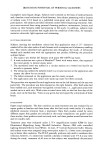
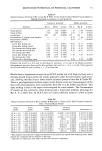
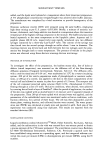
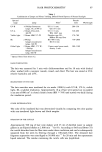
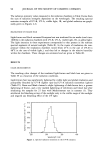
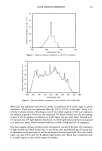
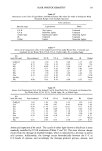
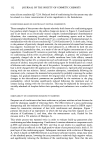
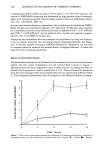
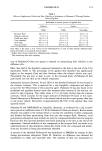
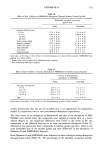
HAIR PHOTOCHEMISTRY 93 Table IV Alterations in the Color of Light-Brown and Black Human Hair After Six weeks of Irradiation With Simulated Ranges of the Sunlight Spectrum Color alteration Spectral range Light-brown Black UV-B Tips lighter Unaltered UV-A Somewhat lighter Unaltered Visible light Significantly lighter Somewhat lighter IR Unaltered Unaltered Global Lighter Somewhat lighter Table ¾ Amino Acid Composition (AA) of the Isolated Cuticle From Light-Brown Hair, Untreated and Irradiated for Six Weeks With UV-B, UV-A, Visible Light, IR, or Global Light AA (mol/100 mol) Non-irradiated UV-B UV-A Visible light IR Global CySO3H 1.32 1.40 1.70 1.96 1.15 1.62 Cys 2 8.73 5.36 9.19 8.23 9.70 7.54 Gly 9.73 10.82 9.14 9.58 9.41 10.71 Ala 5.53 6.71 5.29 5.83 5.82 5.59 Tyr 1.55 1.66 1.96 1.27 1.67 1.61 Phe 1.70 1.36 1.56 1.49 1.44 1.35 Orn 0.34 0.22 0.16 0.18 0.27 0.28 Lys-Ala -- 0.13 0.10 -- -- Traces His 0.89 0.41 0.44 0.48 0.53 0.37 Table ¾I Amino Acid Composition (AA) of the Isolated Cuticle From Black Hair, Untreated and Irradiated for Six Weeks With UV-B, UV-A, Visible Light, IR, or Global Light AA (mol/100 mol) Non-irradiated UV-B UV-A Visible light IR Global CySO3H 1.03 1.03 1.59 2.32 1.22 1.65 Cys 2 9.19 5.84 9.47 8.43 10.06 7.28 Gly 9.39 17.74 9.71 10.21 9.71 9.93 Ala 5.81 7.88 6.06 6.32 6.02 5.66 Tyr 1.55 1.32 1.65 1.10 1.78 1.77 Phe 1.74 1.35 1.33 1.48 1.38 1.46 Orn 0.30 0.20 0.18 0.41 0.31 0.27 Lys-Ala 0.05 -- -- Traces His 0.61 0.45 0.35 0.58 0.47 0.57 Amino acid composition of the cuticle. The cuticle of either light-brown or black hair is most markedly modified by UV-B irradiation (Tables V and VI). The most obvious change results from the cleavage of disulfide bridges, which is indicated by a decrease in amino acid cysteine. Additionally, the cleavage occurs heterolytically between the C-C or C-S bonds of cysteine, and accordingly the cleavage products glycine, alanine, and

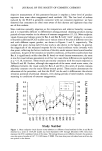
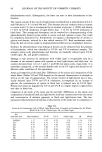
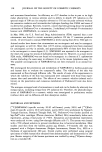
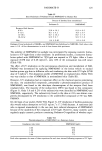
94 JOURNAL OF THE SOCIETY OF COSMETIC CHEMISTS dehydroalanine result. Subsequently, the latter can react to form lysinoalanine or lan- thionine. The cystine content of the cuticle of light-brown and black hair is reduced from 8.8-9.2 mol/100 mol to 5.4-5.8 mol/100 mol. This decrease does not correlate with an increase in cysteic acid (11), but is accompanied by an increase in glycine (q- 100%) and alanine (q- 12% by UV-B irradiation of light-brown hair, q- 13.5% by UV-B irradiation of black hair). This unexpected discrepancy can be resolved by a disproportioning of the photochemically formed cystine oxides to cysteic acid and cysteine in part, they could be completely destroyed (21). Furthermore, we support a decomposition of cystine to glycine and alanine, induced by a free radical reaction (22). Both mechanisms under- lying the lack of cystine oxides in irradiated keratin fibers are not established, however. Evidence for photochemical cross-linking of keratin can be deduced from the presence of lysinoalanine, which was identified in UV-B- and UV-A-irradiated samples. The aromatic amino acids phenylalanine and histidine are markedly reduced upon UV-B, visible light, IR, and global irradiation. Damage to hair proteins by irradiation with visible light is recognizable only by a decrease in the aromatic amino acid tyrosine in both light-brown and black hair. Its content decreases from 1.6 to 1.3 and 1.1 mol/100 mol amino acids, respectively. It is somewhat unexpected, as the tyrosine absorbs only in the UV region and should not be affected under conditions of the experiment. Amino acid composition of the whole fiber. Differences in the amino acid composition of the whole fibers (Tables VII and VIII) depend on the spectral characteristics of sunlight as well as on the type of pigmentation. The cystine content of light-brown hair is dras- tically reduced upon UV-B and UV-A irradiation, accompanied by an increase of glycine the concentration of cystine in black hair is reduced only by UV-B light. Proline and valine are degraded by UV-A and UV-B to a higher degree in light-brown hair than in black hair. Comparison of the results of the cuticle and the total fiber. Differences in the amino acid composition of irradiated black and light-brown total hair correlate both with the nature and concentration of melanin pigments in black and light-brown hair. The less- pronounced photochemical alterations of the proteins of the whole hair in comparison to Table VII Amino Acid Composition (AA) of Whole Light-Brown Hair, Untreated and Irradiated for Six Weeks With UV-B, UV-A, Visible Light, IR, or Global Light AA (mol/100 mol) Non-irradiated UV-B UV-A Visible light IR Global CySO3H 1.17 1.07 0.76 1.19 1.14 1.02 Cys 2 8.95 4.32 5.79 8.55 9.17 5.75 Gly 5.47 8.21 7.60 5.93 6.17 6.39 Ala 4.54 5.84 5.51 4.78 5.12 5.45 Pro 5.9 9.21 8.99 8.01 7.98 7.45 Val 5.08 3.43 3.39 5.93 6.37 6.70 Tyr 1.27 1.79 1.91 2.16 2.23 2.18 Phe 1.26 1.88 2.43 1.97 1.89 1.69 His 0.55 0.51 0.43 0.60 0.81 0.60
Purchased for the exclusive use of nofirst nolast (unknown)
From: SCC Media Library & Resource Center (library.scconline.org)