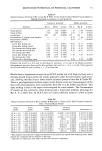
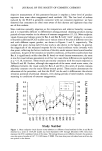
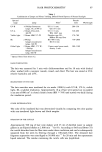
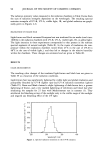
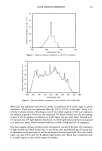
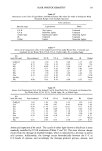
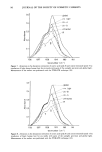
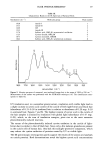
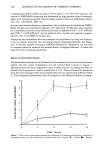
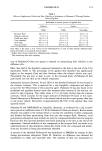
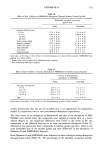
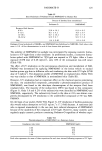
HAIR PHOTOCHEMISTRY 97 Table IX Characteristic Bands in the IR Spectrum of Keratin Fibers Oscillation (cm- •) Molecular group Peak number 1628 Amide-I 1 1513 Amide-II 2 1449 CH 3 1232 Amide-III 4 1176 Sulfonic acid, RSO3H , asymmetrical oscillation 5 1125 Cystine dioxide, RSO2SR 6 1073 Cystine monoxide, RSOSR 7 1042 Sulfonic acid, RSO3H , symmetrical oscillation 8 1850 1750 1650 1550 1/+50 1350 1250 1150 1050 950 Wovenumber [ cm -• ] Figure 9. Keratin spectrum of untreated, non-irradiated human hair in the range of 1850 to 950 cm- • Measurement of the surface was performed with the FTIR/ATR technique (16). The classification corre- sponds to Table IX. UV irradiation and, to a somewhat greater extent, irradiation with visible light lead to a slight increase in cysteic acid content of the cuticle of both light-brown and black hair (absorbance of 0.35-0.38 in irradiated hair in relation to absorbance of 0.29 resp. 0.30 in untreated hair, Figures 7 and 8). The highest content of cysteic acid in the cuticle of the hair samples is attained by irradiation with global light (absorbance of 0.47 resp. 0.49), which, as the sum of irradiation energies, gives rise to the most extensive photochemically induced reactions. The extent of the photochemically induced cystine oxidation in the cuticle of light- brown hair is similar to that of black hair. Since only a few melanin granules are present in the cuticle cells of human hair, they lack this sunlight-protective component, which may reduce the cystine oxidation of proteins caused by UV or visible light. The IR spectroscopic investigations partly support the results of the amino acid analyses on cuticle proteins. Both determinations reveal the highest cysteic acid concentrations

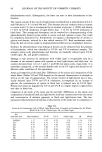
98 JOURNAL OF THE SOCIETY OF COSMETIC CHEMISTS in the samples irradiated with visible light, and no differences in the content of cystine oxidation of light-brown and black hair are discernible. SUMMARY Hair samples of two different melanin contents have been subjected to irradiation with selective ranges of sunlight. Their physical and chemical alterations brought about by the photoexposure have been evaluated and can be summarized as follows: 1. Sunlight-induced color changes in hair are more extensive in light-brown than in black hair. The most obvious photobleaching effect occurs within the visible range of sunlight. Furthermore, UV-A and UV-B also cause a lightening in light brown hair. 2. The proteins of the cuticle are especially impaired by UV-B and UV-A, but only slightly by visible light. The composition of the amino acids in the cuticle is more strongly altered than in the cortex since greater intensities of radiation can act in the outer cell layers. The changes in the cuticle proteins do not show any correlation with the hair color since only a small number of melanin granules are present here. In contrast, differences between the irradiated proteins of light-brown and black hair cortex are readily detectable (melanin-rich areas). In particular, the cystine, proline, and valine residues in whole light-brown hair are more markedly degraded by UV-A and UV-B than in whole black hair. 3. Infrared spectroscopic investigations (FTIR) support the conclusions drawn from the amino acid analyses with respect to the radiation-induced formation of cysteic acid in the cuticle. The highest contents are reached by irradiation with visible light and UV-A to the same extent in light-brown as in black hair cuticle layers. CONCLUSIONS The present results support the assertion that black hair is more photostable than blond hair. Black hair seems well protected against UV-light, and light-brown hair is obvi- ously damaged by a wide range of the natural sunlight. The protective action of melanin granules is limited to the melanin-rich cortex of black hair, which shows only a slight modification of fiber proteins under irradiation the melanin-poor cuticle proteins of black as well as of light-brown hair are modified to a similar extent. The photodegradation of cystine is the most conspicuous alteration in the amino acid residues of the whole fiber, to which additional consequences for the hair are attribut- able: loss of fiber strength and water infiltration that subsequently creates favorable conditions for further photooxidative reactions by the dissolved oxygen (11). For these reasons it would be very useful to employ sunscreens for all types of human hair, to preserve primarily the cuticle from extensive photodamage and also the whole fiber from photoinduced cystine and melanin degradation. REFERENCES (1) V. H. Price, "The Role of Hair Care Products," in Hair Research.' Status and Future Aspects, Orfanos, Montagna, and Stiittgen, Eds. (1981). (2) L. J. Wolfram and L. Albrecht, Chemical and photo-bleaching of brown and red hair, J. Soc. Cosmet. ½hem., 82, 179 (1987).
Purchased for the exclusive use of nofirst nolast (unknown)
From: SCC Media Library & Resource Center (library.scconline.org)