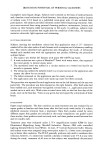
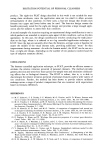
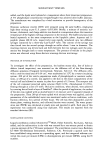
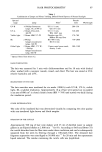
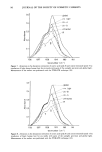
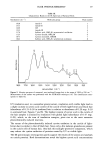
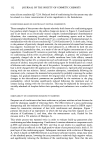
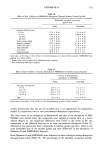
HAIR PHOTOCHEMISTRY 91 2.0 1.6 1.2 0.8 0.4. o , --I-F ]oo 3•o ' 400 Wo, ve[engt'h [ nm] Figure 3. Spectral radiation intensities in the UV-A container. 1.4 0.8- 0.6 0.4 _ o •5o 400 450 500 550 600 650 700 750 [ 8OO Wovelength [ nm] Figure 4. Spectral radiation intensities in the container with visible light. Black hair was lightened only after six weeks of irradiation with visible light or global irradiation. There was no lightening effect by UV-A, UV-B, or IR light. Leroy et al. (20) have already shown a bleaching action of the visible segment of the sun's radiation on melanin pigments. However, the employed UV filters allowed also for the passage of part of UV-A radiation in addition to visible light. On the other hand, Tatsuda et al. (5) claimed that UV light lightens black hair. In these experiments the hair was exposed to a xenon arc lamp, which emitted radiation in both visible and UV-A segments. Our data suggest strong correlation with the pigment content of the hair. By irradiation of light-brown and black human hair it was shown that photobleaching of human hair is dependent on the hair color as well as the range of the sun's spectrum. Not only visible light, but also UV-A and UV-B lighten light-brown hair. Black hair is bleached only to a small degree by the visible range of sunlight.

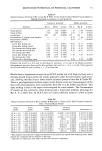
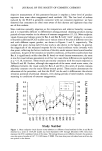
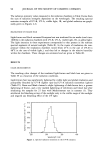
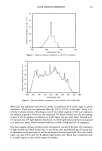
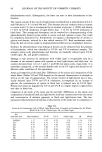
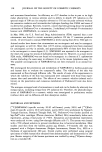
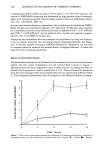
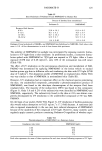
92 JOURNAL OF THE SOCIETY OF COSMETIC CHEMISTS 1.0 0.8 0.6 0.6 0.2 ,00 L 900 1200 1500 1800 2100 2/,00 2700 3000 WQve[engfh [nm] Figure 5. Spectral radiation intensities in the IR containerß 1.6 'E 1.2 ß '• 4.0 1,-,, -- 0.8 1,-,, ._o 0.6 -- 0.6 4--- • 0.2 0 200 •.00 600 800 Wc•veiengfh [nm] ' 10•0 1200 Figure 6. Spectral radiation intensities in the container with global light. AMINO ACID ANALYSES The cuticle cells, the outer shingle-like arranged cells of the hair are most exposed to weathering. Therefore, we pursued the question as to whether different extents of photooxidative alteration on the proteins in the cuticle and cortex can be established by analysis of the amino acids. For this purpose, amino acid analyses of the acid hydrolysate of isolated cuticle and complete hair fibers were compared with each other. The con- centrations of the photolabile amino acids are given separately for the cuticle and the whole fiber in Tables V-VIII. The results can be interpreted only qualitatively since the yield of proteins from the samples differed greatly with different types of radiation. A comparison of the values in Table V and VI reveals no essential differences between the protein composition of the cuticle of light-brown and black hair for either the untreated (column 1) or the irradiated (columns 2-6) samples.
Purchased for the exclusive use of nofirst nolast (unknown)
From: SCC Media Library & Resource Center (library.scconline.org)