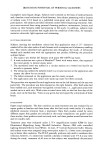
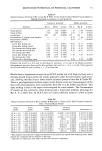
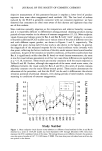
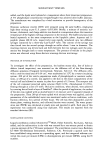
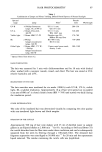
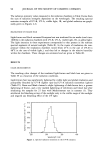
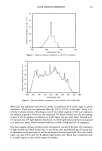
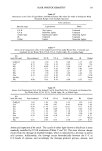
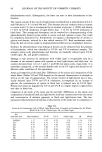
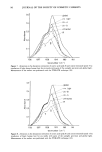
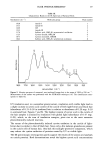
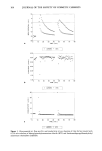
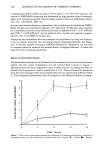
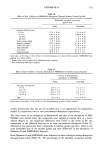
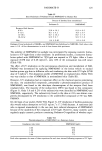
DYNAMIC ELECTROKINETIC AND PERMEABILITY ANALYSIS 105 LAEDES, since this material adsorbs as micelies or individual molecules, with the size of the order of tens of angstroms, unlike BTC, which probably deposits in the form of large, submicron-sized crystals. In addition to this, the flow rate and conductivity data suggest a slower rinse-off of the excess of BTC solution from the plug directly after the treatment, an effect brought about by its relatively high viscosity. One other result of significance is a decrease in the conductivity of the plug to an equilibrium value lower than that obtained for untreated hair. This effect is always observed for hair treated with cationic surfactants and silicone emulsions (compare Figures lc and 3c) and could be related to either lower surface conductivity of modified hair or to the barrier properties of an adsorbed layer that prevents the diffusion of conductive species from the fiber interior (11). The DEPA traces obtained for a fatty-chain amine (LAPDA) and an oligomeric poly- amine (Polyquart H) are presented in Figure 2. Both materials adsorb on the hair surface, as evidenced by changes in the streaming and zeta potentials, but are gradually removed by the test solution. It is also possible that amine-containing surfactants can penetrate into the bulk of the fiber to a larger extent than quaternary ammonium compounds. This hypothesis is based on the studies of the adsorption of long-chain amines and diamines on wool (12) and on the analogy to dyes with the corresponding functional groups cationic dyes with quaternary ammonium groups tend to produce a ring dyeing effect and remain confined to the areas close to the fiber periphery, unlike amine-containing dyestuffs, which diffuse deep into the cortex (13,14). The slope of the plot of zeta potential as a function of time is approximately constant for both LAPDA and Polyquart H over the 30-minute rinsing period, suggesting that the desorption or rearrangement processes are zero order, independent of the concentration of potential- determining, adsorbed species. The rate of variation in surface potential of 0.15 mV/min is slower for Polyquart H, which contains several amine functions capable of binding to the surface at multiple sites. The magnitude of reduction in zeta potential is signifi- cantly higher for LAPDA, with the rate of 0.59 mV/min. This probably reflects a more dramatic change in the orientation of the molecules of this surfactant, which could initially produce high positive charge density by adsorbing with hemi-micellar aggre- gation (12). In contrast to quaternary ammonium surfactants, the process of desorption/ rearrangement of both amines does not level off after 30 minutes, suggesting that a continued rinsing may lead to the complete disappearance of amine-containing surfac- tants from the hair surface. The traces obtained for three silicone emulsions, DC 347, DC Q2-7224, and DC 929, are presented in Figure 3. Emulsion DC 347, which is based on unmodified poly(di- methylsiloxane) emulsified by nonionic surfactants, shows the least extent of surface modification as reflected by a small reduction in zeta potential. The oil droplets of this system exhibit an isoelectric point at pH 6-7, with a slightly positive charge at the pH of the treatment solution employed in this study (6). They show little affinity toward negatively charged hair surface, as shown by the previous study of the kinetics of deposition. Thus, the coverage of only a fraction of the surface by the oil from this emulsion could lead to the observed small increase in the zeta potential of hair. Scant deposition is also suggested by a small reduction in plug conductivity following the treatment with this emulsion (Figure 3b). It is also evident that the second application of DC 347 magnifies the changes produced in the first treatment. In contrast to this, aminofunctional oil emulsified by a nonionic surfactant system, emulsion Q2-7224,

106 JOURNAL OF THE SOCIETY OF COSMETIC CHEMISTS 10 -20 4.50 10 20 30 40 50 60 TIME ( min ) [] LAPDA + Polyquart H 70 80 4.00- 3.50- • 3.00- v 2.50- m 2.00- o 1.5o- ._1 LL 1.00 0.50 +'*'m 0.00 o io •o $o go 5o •o Yo 8o TIME ( min ) [] LAPDA + Polyquart H ] 0- 0 1'0 2'0 3'0 40 5'0 6'0 7'0 80 TIME ( min ) [] LAPDA + Polyquart H Figure 2. Zeta potential (a), flow rate (b), and conductivity (c) as a function of time for hair treated with 0.5% solutions of linseedamidopropyldimethylamine (LAPDA) and PEG-15 tallowpolyamine (Polyquart H).
Purchased for the exclusive use of nofirst nolast (unknown)
From: SCC Media Library & Resource Center (library.scconline.org)