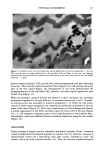
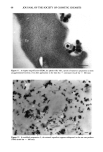
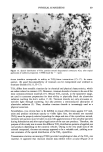
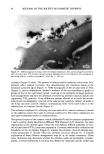
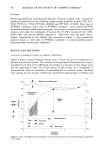
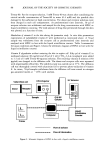
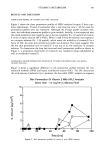
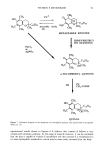
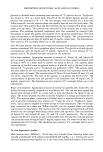
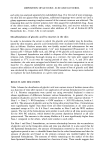
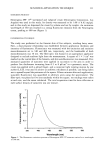
76 JOURNAL OF THE SOCIETY OF COSMETIC CHEMISTS Humidity Control Unit • • Cables to Computer Figure 1. Scheme of the experimental setup performing dynamic hairspray analysis. Dehumidification System For the measurements, the tress was weighed and then positioned under the texture analyzer's probe. It was fastened to a base plate, with the two plastic tabs set 1.2 cm apart, as shown in Figure 2. Each test was performed by oscillating a clear plastic probe (2.5 cm in diameter) between the fiber surface and the calibration height of 10 cm. After touching the surface of hair and sensing a 2.0 G force, the probe produces an additional 1-mm deformation of the loop before rising to the calibration height. Initially, the texture analyzer measures the stiffness of untreated hair. After a baseline value is established, the tress is sprayed for two seconds on each side with an aerosol hairspray formulation. The measurements are continued for 80 minutes, and then the tress is reweighed to determine the amount of deposited resin. The raw data from the experiment include the values of force and distance as a function of time collected at a frequency of 6.25 points/sec. The instrument software allows the presentation of data either as force (distance) as a function of time or force as a function of distance. For a hairspray drying experiment described above, the plot of force as a function of time is a series of peaks, with each peak corresponding to one deformation cycle of a hair loop. In order to facilitate the analysis and comparisons of experimental curves for different polymers, the maximum positive and negative values of force (peak force), together with the corresponding displacement values, were extracted from the whole dataset by using a Lotus macro. The peak forces were found to be proportional to the stiffness modulae of the fiber assembly, as indicated by the linear dependence of force as a function of distance. We have also used an alternative hair treatment procedure that consisted of an appli- cation of a hairspray solution to the fiber surface by using an Eppendorf pipette. The

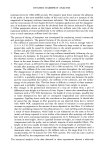
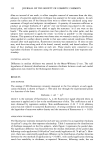
DYNAMIC HAIRSPRAY ANALYSIS 77 1.0 to1.1 cmwide• l [ I •1.5 in. J Overhead view of tress Texture Analyzer Acrylic Probe - 2.5 cm •'{ Hair Shaped into Omega Loop 0.4 cm Down 4 cm calibration height 1,4 to 1,6 cm Up 4 cm calibration height 1,0 mm penetration after 2.0 G L Figure 2. Scheme showing the geometry of hair samples shaped into omega loops. deposited amount (0.15 g of a hairspray solution at 5.71% w/w polymer concentration) was uniformly distributed over the tress surface, thoroughly saturating the fibers be- tween the plastic tabs. The drying process of wet loops was found to be critical to obtain reproducible results. While 100% alcohol-based compositions were found to dry on hair without distorting the original, omega-shaped configuration, other systems containing water produced significant change in the shape of the loop by extending it in the vertical direction. As a result, the tresses increased in height by a few millimeters, and the new shape proved to be unstable in subsequent stiffness measurements, which involved the application of much higher forces than in the case of untreated hair. Typically, an oblong omega loop would be characterized by a high compression force if its symmet- rical shape produced an even distribution of stress and deformation, and conversely, a significantly smaller force if distorted in an unsymmetrical fashion. To preserve the original shape of untreated hair, teflon-coated cylindrical rods were inserted into the loops immediately after treatment. This prevented them from changing their shape as a result of water absorption. The loops were dried and conditioned overnight in an atmosphere of 50% RH and 70øF prior to measurements by the texture analyzer.
Purchased for the exclusive use of nofirst nolast (unknown)
From: SCC Media Library & Resource Center (library.scconline.org)