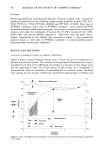
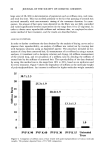
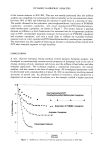
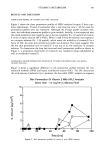
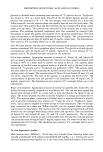
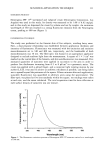
78 JOURNAL OF THE SOCIETY OF COSMETIC CHEMISTS POLYMERS Poly(vinylpyrrolidone) (International Specialty Products) samples were commercial products characterized by the following weight average molecular weights: PVP K15, 8100 PVP K30, 57500 PVP K60, 400000 and PVP K90, 1270000. Ethyl ester of PVM/MA copolymer, butyl ester of PVM/MA copolymer, vinyl caprolactam/PVP/ dimethylaminoethyl methacrylate copolymer, and acrylates copolymer were commercial products sold under the tradenames of Gantrez ES 225 (ISP), Gantrez ES 425 (ISP), Gaffix (ISP), and Luvimer (BASF), respectively. "Hard hold" and "soft hold" formu- lations, characterized by the stiffness data presented in Figure 5, were commercial products based on ethyl ester of PVM/MA copolymer or octylacrylamide/acrylates/ butylaminoethyl methacrylate copolymer. RESULTS AND DISCUSSION ANALYSIS OF HAIRSPRAY DRYING AT AMBIENT CONDITIONS Figure 3 shows a typical hairspray drying curve in which the force (G) (peak force) is plotted as a function of time. The variation of the geometrical dimensions of a loop is described by the plot of the differential tress height as a function of time (upper curve and the right-hand y axis). The initial portion of each drying curve corresponds to untreated hair. After the assessment of unmodified hair as a reference point, the fibers were sprayed for two seconds, followed by intermittent measurements of stiffness and 0.5 Stiffness •.• 40 of • untreated • hair 0 Differential Tress Height Increase -- ø0.5 - Pointof.Hai.rspray • 60 • Aplhcafiøn •• S6ffness -- -1 -- -1.$ 0 • Tack Duration •--• Maximum Stickiness -20 _ • Total Dry Time -40 I , -3.5 0 1 2 Thousands Time (sec) Fiõur½ 3. Force and diffcrcntia| tress height as • •u•cdo• o•ry]• dmc •o• • •ypic•[ h•irspr•y composition

DYNAMIC HAIRSPRAY ANALYSIS 79 tackiness forces for 1000-4000 seconds. The negative peak forces indicate the adhesion of the probe to the resin-modified surface of hair and can be used as a measure of the magnitude of hairspray tackiness (maximum tackiness). The duration of tackiness and and the total amount of time elapsed betweeen hairspray application and the disappear- ance of stickiness (dry time) can also be calculated from the data as indicated in Figure 3. Other parameters shown in this figure include the stiffness ratio (the ratio of the maximum stiffness of resin-modified hair to the stiffness of untreated hair) and the total time to reach maximum stiffness (total dry time). The process of drying of hairsprays was investigated by employing several commercial and prototype products. The general features of the process are as follows: 1. The stiffness of untreated tresses varied from 8 to 29.3 G, with an average value of 13.9 + 4.5 G (95% confidence limits). This relatively large scatter of the experi- mental data could be caused by imperfections in the sample geometry, unevenness of fiber and glue distribution, variation in tress weight, etc. 2. There was a 30-50% increase in the loop stiffness immediately following the ap- plication of a hairspray. At this point the formulation is still in the liquid form, and the observed increase is probably related to a "gluing effect" produced by capillary forces in the areas between the fibers filled with a hairspray solution. 3. The onset of tack, as reflected by the appearance of negative forces, occurred 50-100 seconds after spraying and lasted from 150 to 600 seconds for 55% VOC hairspray systems. The stiffness of the tress continued to increase throughout the tack period. The disappearance of adhesive forces usually took place at a relatively low stiffness ratio, in the range from 1.5 to 5. The maximum adhesive force, ranging from 3.17 to 6.60 G, is probably dependent primarily upon the contact area between the probe and the resin-modified hair surface, the stiffness of the substrate, and the surface energy of the polymer film. The first factor is difficult to control in these measure- ments and is probably changing in a random fashion from sample to sample. 4. The changes in the geometrical dimensions of a loop are evident from a plot of differential tress height as a function of time. Figure 3 shows that immediately after treatment with a 55 % VOC formulation, the height of a tress increases, possibly due to water absorption by hair and its consequent longitudinal and cross-sectional expansion. Capillary forces could also contribute to this phenomenon. It should also be noted that the changes in fiber geometry are not observed when hair is treated with 100% VOC compositions and that the extent of variation in tress geometry increases in proportion to the amount of water deposited on the fibers. It is believed that the underlying reasons for this phenomenon (i. e., hair swelling and softening as a result of water absorption, which leads to curl relaxation) are the same as for the initial curl droop reported to occur within a few minutes after spraying curl-shaped hair with water-containing hairspray compositions (4,5). Subsequent to this initial increase in tress height, there is a gradual decrease in height, as a result of repetitive compressions with the probe, and an inelastic response of resin-modified fibers. The height of the tress usually decreases below the starting height of untreated hair. 5. A gradual stiffness increase is continued after the disappearance of tackiness until a maximum value, corresponding to the stiffness ratio in the range from 6 to 20, is reached within 30-70 minutes for 55% VOC systems. The total dry time could be also affected by the temperature and humidity. The statistical analysis of the data obtained in these experiments showed a relatively
Purchased for the exclusive use of nofirst nolast (unknown)
From: SCC Media Library & Resource Center (library.scconline.org)