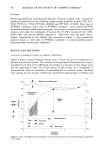
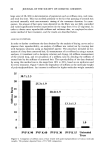
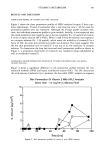
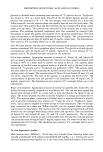
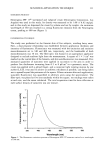
80 JOURNAL OF THE SOCIETY OF COSMETIC CHEMISTS large error of 20-30% in determination of parameters such as stiffness ratio, tack time, and total dry time. This was ascribed primarily to the fact that spraying of aerosols was activated manually with non-automatic timing of the treatment duration. In conse- quence, the amount of hair spray resin deposited on the fibers was not fully controlled and varied significantly between experiments (in the range from 10 to 25 mg/tress). In order to obtain more reproducible stiffness and tackiness data, we employed an alter- native method of hair treatment, and the results are described below. ANALYSIS OF STIFFNESS In order to further corroborate the data obtained by the analysis of drying curves and to improve their reproducibility, an analysis of stiffness was carried out by treating hair with hairspray solutions using an Eppendorf pipette. The procedure included (a) for- mation of a loop from untreated hair, (b) measurement of its stiffness by using a texture analyzer, (c) treatment with a hairspray solution and drying, (d) stiffness measurement of the treated loop, and (e) calculation of a stiffness ratio by dividing the stiffness of treated hair by the stiffness of untreated hair. The reproducibility of the data obtained by using this method was in the range from 10% to 20%, based on six replicates used for every treatment. Figure 4 shows the dependence of stiffness on the molecular weight of polyvinylpyrrolidone. An increase in stiffness for higher-molecular-weight materials 35 30 lO 30.7+2.3 25.34-1.9 20.4 q- 1.9 __13.14-1.3 .......... PVPK90 PVPK60 PVPK30 PVPK15 Untreated Tress Figure 4. Comparison of stiffness ratios of hair treated with poly(vinylpyrrolidone) of various molecular weights. The polymer deposited from a 55% VOC composition.

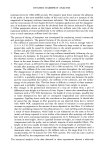
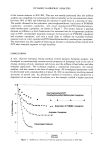
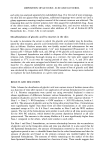
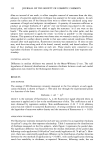
DYNAMIC HAIRSPRAY ANALYSIS 81 is evident from the data presented in Figure 4, and this result is consistent with the measurements reported by Hinz (3). The method was also employed to analyze a series of eight commercial compositions labelled as "soft" and "hard" holding formulations. The results are presented in Figure 5, which demonstrates a good differentiation in stiffness values between these two types of hairspray products. ANALYSIS OF TACKINESS The analysis of tackiness during drying of hairspray resins on the surface of hair was carried out by applying 0.07 g of a hairspray solution (polymer concentration 5.71% w/w) to a dry loop of hair and following the time dependence of adhesive forces by intermittent flexing in a texture analyzer. A typical example of this experiment is presented in Figure 6, which illustrates an increase in duration of adhesive forces for compositions, based on ethyl ester of PVM/MA copolymer, containing progressively higher levels of water. The observed average tackiness periods (three measurements) were 194 ñ 6 s, 292 ñ 28 s, and 540 ñ 100 s for 100% VOC, 80% VOC, and 55% VOC compositions, respectively. It is also noteworthy that the magnitude of the tack forces do not increase for water-containing hairspray solutions. On the contrary, the results of our experiments point to a progressive reduction in adhesion between the probe and the film of a drying hairspray solution for compositions of lower VOC content. STIEFNESS REDUCTION AT mGH HUmDrilY The ability of various resins to resist exposure to high humidity was tested by the use 35 { Hard Hold Soft Hold • 20 15 20.9:kl.3 20.14-0.9 20.14-1.4 17.84-4.1 ...................... 15.8 4-4.0 13.7+3.1 11.1+3.1 lO o Product 1 Product 2 Product 3 Product 4 Product 1 Product 2 Product 3 Product 4 Figure 5. Comparison of stiffness ratios for a series of commercial products labeled as "soft" and :'hard" holding formulations.
Purchased for the exclusive use of nofirst nolast (unknown)
From: SCC Media Library & Resource Center (library.scconline.org)