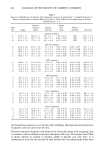
DEPOSITION OF GLYCOLIC ACID AND GLYCEROL 101 each strip was analyzed separately for radiolabeled drug. If at the end of nine strippings, the skin did not appear shiny and glossy, additional strippings were carried out until a glossy appearance ensuring complete removal of the stratum corneum was achieved. The remaining skin and the receiver solution were then assayed for radiolabeled drug. Assay of the donor rinses, surface swabs, strips, remaining skin, and receiver solution was carried out using a scintillation counter after addition of 15 ml of Ecolite (+) (ICN Biomedicals Inc., Irvine, CA) to each sample. Decarboxylation of glycolic acid by enzymes in the skin In order to determine the extent to which the glycolic acid marker may be decarbox- ylated by skin enzymes, glycolic acid formulations were incubated with freshly excised skin as follows: Hairless mouse skin was freshly excised and subcutaneous fat was removed. Skin pieces of approximately 2 cm 2 were homogenized (Tissumizer) in 1 ml isotonic pH 7.4 Hepes buffer each, and 200 p•l of 4% glycolic acid aqueous solution or Non-1 liposomal formulation was added to aliquots of the skin homogenate in scin- tillation vials. Following thorough mixing on a vortexer, the vials were capped and incubated at 37øC in an oven for varying periods of time. At 2, 4, and 20 h after incubation, the vials were uncapped and allowed to stand at room temperature in an air hood for 1 h. Assay for radiolabeled content was then carried out using a scintillation counter after addition of scintillation cocktail. The extent of loss of glycolic acid label was calculated by comparison with 200-p•l control formulations. Assays were conducted in triplicate for each formulation at a given time point. RESULTS AND DISCUSSION Table I shows the distribution of glycolic acid into various strata of hairless mouse skin as a function of time after topical in vivo application of various formulations for a period of 1 h. Pairwise comparisons were carried out using two-tailed Students's t-tests to obtain significance of differences between various formulations. In general, the accu- mulation of glycolic acid in the stratum corneum was in the order: aqueous solution = Non-1 = Non-2 W/O emulsion = O/W emulsion = 30% PG solution, both at 1 and 8 h. The amounts of glycolic acid in the living skin strata from Non-1 formulations were significantly higher than those from all other formulations at all time points examined except at 8 h. At 8 h Non-1 was similar to Non-2 and the W/O emlsion system. The rest of the formulations were similar to each other at all time points except for the 30% PG solution, which showed the poorest deposition behavior at all time points tested. The amounts in the urinary bladder at 8 h were significantly higher from Non-1 compared to the others, which were similar to each other. For Non-1 and Non-2 formulations, an inverse relationship between the accumulation of glycolic acid in the living skin strata and time was observed. It is also noted that for the liposomal formulations, the amount of formulation removed at the end of the 1-h application period is two- to threefold lower than for the other formulations and that the amount of glycolic acid found in the stratum corneum was twofold higher for the liposomal formulations. The amounts of vehicle remaining on the surface of the skin from liposomal formulations decreased as a function of time. These results suggest that

102 JOURNAL OF THE SOCIETY OF COSMETIC CHEMISTS Table I Kinetics of Distribution of Glycolic Acid (expressed as percent of applied dose + standard deviation) in Various Compartments of Hairless Mouse Skin After l-Hour Topical In Vivo Application of Various Formulations (n = 3) Stratum Living Time corneum Stratum skin Urinary (h) Swabs surface corneum strata excretion Recovery Aqueous solution 0 40.0 + 3.7 28.4 -+ 1.7 16. l -+ 3.7 1.04 -+ 0.14 ND 85.7 -+ 2.2 4 55.9 + 9.1 19.9 + 5.5 11.8 + 2.1 0.96 + 0.18 ND 88.5 + 3.8 8 40.1 + 7.9 17.0 + 1. l 16.3 + 0.9 0.32 + 0.01 ND 73.7 + 5.6 30% PG solution 0 62.8 -+ 4.0 24.6 + 3.2 5.3 + 1.6 0.36 + 0.05 0.09 + 0.05 93.1 + 1.2 1 68.0 + 5.5 16.4 -+ 2.2 7.2 -+ 3.5 0.29 -+ 0. ll 0.27 + 0.08 92.2 + 0.3 2 68.9 -+ 2.7 13.9 -+ 3.1 6.6 -+ 2.3 0.33 -+ 0.07 0.41 -+ 0.16 90.2 -+ 0.5 4 61.9 + 6.4 16.0 + 3.0 7.4 + 0.4 0.51 + 0.09 0.42 + 0.10 86.3 + 2.8 8 68.8 + 3.4 12.7 -+ 2.6 5.3 -+ 1.4 0.26 -+ 0.06 0.32 -+ 0.13 87.4 + 1.7 O/W emulsion 0 60.8 + 1.3 25.5 -+ 0.9 2.9-+ 0.7 0.85 -+ 0.28 0.04-+ 0.03 90.0-+ 2.0 1 56. l -+ 6.1 24.9 -+ 2.6 4.9 -+ 2.9 0.77 + 0.27 0.06 -+ 0.02 86.8 -+ 2.1 2 57.2 -+ 2.3 21.6 + 0.9 6.9 + 1.4 0.87 + 0.30 0.10 + 0.03 86.6 + 0.3 4 54.0 + 2.0 20.3 + 4.0 7.8 + 1.0 0.98 + 0.23 0.14 -+ 0.05 83.2 -+ 1.8 8 53.9 -+ 1.5 16.2 + 1.9 8.1 -+ 0.7 0.89 -+ 0.26 0.36 -+ 0.05 79.3 -+ 1.8 W/O emulsion 0 46.9 -+ 5.2 22.4 + 1.5 6.0 -+ 0.2 0.77 -+ 0.40 0.11 -+ 0.02 76.2 -+ 6.7 1 54.1 -+ 3.4 18.8 -+ 2.0 7.6 -+ 1.4 0.63 -+ 0.31 0.20 + 0.06 81.3 -+ 5.2 2 50.0 + 3.2 18.1 + 2.5 8.2 + 1.2 0.88 + 0.29 0.32 + 0.07 77.5 + 0.7 4 57.4 -+ 4.7 12.1 -+ 2.6 5.0 -+ 0.9 0.66 -+ 0.28 0.35 -+ 0.15 75.6 -+ 5.1 8 55.1 -+ 7.2 16.2 -+ 8.2 6.1 -+ 0.4 0.57 -+ 0.04 0.47 -+ 0.33 78.5 -+ 1.6 Non- l liposomes 0 18.4 -+ 4.2 49.7 -+ 4.5 17.2 -+ 4.0 2.59 -+ 0.90 0.22 + 0.07 88.1 -+ 3.2 1 23.1 + 4.9 32.1 + 3-5 20.6 + 3.4 2.83 + 0.84 0.40 + 0.07 79.0 + 3.6 2 23.4 -+ 5.0 26.0 -+ 4.2 19.8 -+ 5.8 2.95 + 0.82 1.15 -+ 0.11 72.5 -+ 7.0 4 19.7 -+ 4.5 29.8 + 6.0 17.5 -+ 8.1 2.02 -+ 0.80 1.81 -+ 0.49 69.0 -+ 8.0 8 16.3 + 2.0 28.0 + 5.3 I0.9 + 3.9 0.81 + 0.27 2.10 + 0.59 58.1 + 5.5 Non-2 liposomes 0 13.2 + 2.0 52.6 + 5.1 13.6 + 3.8 1.92 -+ 0.93 0.15 -+ 0.03 81.5 -+ 2.3 1 12.6 -+ 3.3 48.8 -+ 8.7 14.7 -+ 4.0 1.45 + 0.15 0.13 + 0.02 77.6 + 2.3 2 21.2 -+ 2.6 41.6 + 3.5 9.9 -+ 2.6 1.02 -+ 0.39 0.20 -+ 0.10 73.9 -+ 3.0 4 17.6 + 3.7 33.1 -+ 5.7 14.7 -+ 2.5 1.15 + 0.34 0.49 + 0.11 67.1 + 4.1 8 11.0 -+ 0.8 34.3 -+ 1.3 14.6 -+ 1.2 0.95 -+ 0.36 0.83 -+ 0.12 61.7 -+ 2.6 the formulations remain in or on the skin after swabbing, allowing sustained permeation of glycolic acid into and across the skin. The lower amounts of glycolic acid found in the living skin strata with increasing time is consistent with an increase in systemic absorption with time. The urinary data (Table I) clearly indicate an increase in systemic uptake of glycolic acid with time. It is interesting to note that the recovery of total radioactivity was substantially lower from
Purchased for the exclusive use of nofirst nolast (unknown)
From: SCC Media Library & Resource Center (library.scconline.org)