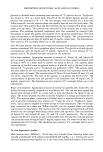
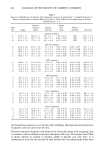
DEPOSITION OF GLYCOLIC ACID AND GLYCEROL 105 Table III Kinetics of Distribution of Glycerol (expressed as percent of applied dose -+ standard deviation) in Various Compartments of Hairless Mouse Skin After 1-Hour Topical In Vivo Application of Various Formulations (n = 3) Stratum Living Time corneum Stratum skin Urinary (h) Swabs surface corneum strata excretion Recovery Aqueous solution 0 76.6 + 2.9 13.5 -+ 1.5 5.3 + 0.4 0.60 + 0.29 ND 96.0 + 1.6 4 76.4 -+ 2.8 9.4 + 1.1 7.7 + 1.2 0.91 -+ 0.22 ND 94.4 + 0.5 8 72.7 + 2.3 11.3 -+ 1.4 5.9 -+ 1.0 0.47 -+ 0.04 ND 90.4 -+ 0.2 30% PG solution 0 69.9 -+ 9.7 22.0-+ 7.7 2.7 -+ 1.3 0.29 -+ 0.02 0.04 -+ 0.04 94.9 -+ 2.0 1 75.7 + 0.4 14.5 -+ 1.7 2.9 -+ 0.9 0.23 + 0.10 0.02 + 0.02 93.4 -+ 1.9 2 79.7 -+ 1.6 13.6 + 1.4 2.6 -+ 0.6 0.35 -+ 0.22 0.06 -+ 0.01 96.2 -+ 1.0 4 71.5 -+ 5.2 14.8 -+ 4.9 3.3 -+ 0.5 0.50 -+ 0.22 0.03 -+ 0.03 90.1 -+ 2.6 8 65.8 + 1.5 18.7 -+ 2.1 2.8 + 0.2 0.23 + 0.02 0.08 + 0.03 87.6 + 0.3 O/W emulsion 0 64.9 + 3.0 25.2 -+ 5.4 2.8 -+ 1.0 0.89 + 0.04 0.02 + 0.01 93.8 -+ 7.0 1 69.3 -+ 2.9 29.8 + 0.5 5.5 -+ 0.2 0.85 -+ 0.09 0.04 -+ 0.01 105.6 -+ 2.6 2 68.5 + 4.3 22.0-+ 4.4 4.4-+ 1.4 0.89-+ 0.15 0.03 -+ 0.01 95.8 + 2.1 4 66.8 -+ 0.7 19.1 -+ 1.4 4.3 + 0.5 0.61 + 0.06 0.17 + 0.08 91.0 + 1.3 8 63.9 -+ 2.9 11.6 + 3.3 5.9 + 0.4 0.63 -+ 0.11 0.09 -+ 0.02 82.0 -+ 6.3 W/O emulsion 0 84.8 -+ 2.5 13.0 + 1.6 1.4 + 0.2 0.11 -+ 0.02 0.03 -+ 0.02 98.9 + 1.7 1 83.6 + 2.3 13.5 -4- 0.7 2.1 --- 1.1 0.23 --- 0.09 0.02 --- 0.01 99.4 --- 1.0 2 80.7 --- 3.6 12.1 --- 2.6 3.3 --- 0.4 0.39 --- 0.07 0.01 --- 0.00 96.5 --- 1.6 4 79.5 -+ 7.7 12.6 -+ 0.5 3.8 + 0.2 0.68 + 0.09 0.04 + 0.02 96.6 -+ 7.1 8 82.7 + 4.3 8.8 + 1.1 4.2 -+ 0.0 0.39 -+ 0.01 0.21 -+ 0.06 96.3 -+ 5.4 Non- 1 liposomes 0 31.0 + 4.9 51.7 + 3.0 12.0 + 1.0 2.08 + 0.55 0.05 + 0.05 96.8 + 4.2 1 23.9 -+ 1.5 45.8 + 1.6 16.0-+ 2.3 1.44 -+ 0.36 0.08 -+ 0.06 87.3 + 2.2 2 22.9 + 9.8 40.0 -+ 4.1 20.3 -+ 4.1 1.41 -+ 0.13 0.10 -+ 0.00 84.7 -+ 0.3 4 32.3 -+ 4.4 30.0 -+ 0.9 20.1 -+ 2.4 1.07 + 0.21 0.15 + 0.06 83.7 + 2.6 8 34.5 -+ 6.0 19.6 + 6.7 19.0 -+ 4.0 1.37 -+ 0.30 0.35 -+ 0.24 74.8 + 8.6 Non-2 liposomes 0 17.2 -+ 6.1 65.3 + 6.3 14.9 + 1.8 2.13 + 0.09 0.02 + 0.01 99.6 -+ 4.5 1 17.7 -+ 0.9 59.1 -+ 3.0 14.8 -+ 1.3 2.16-+ 0.35 0.04 -+ 0.02 93.8 --- 0.6 2 18.5 + 5.1 47.0 + 3.5 19.2 -+ 3.5 2.78 -+ 0.02 0.08 -+ 0.03 87.5 -+ 1.9 4 22.0 -+ 2.8 36.9 -+ 3.2 20.9 -+ 5.7 2.19 -+ 0.75 0.31 + 0.17 82.4 + 3.9 8 21.0 -+ 4.4 30.1 -+ 4.2 19.0 + 3.3 1.98 + 0.33 0.56 + 0.37 72.7 + 2.4 Such a release of POE-10 or of GDS does not occur with Non-2 liposomes since neither GDS (m.p = 54øC) nor POE-10 (m.p = 36øC) will melt at the skin surface temper- ature of 32øC. Thus, Non-1 liposomal formulations are expected to be superior to Non-2 liposomes in facilitating transport into and across skin. It is not surprising, therefore, to find that Non-1 liposomes are better at faciltating transport of glycolic acid into and across skin. This scenario also explains why Non-2 liposomal preparations provide a better reservoir for the active and permit its sustained and steady release into the skin.

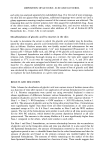
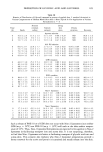
106 JOURNAL OF THE SOCIETY OF COSMETIC CHEMISTS Table IV Distribution of Glycerol (expressed as percent of formulation applied + standard deviation) in Various Strata of Hairless Mouse Skin 16 Hours After Topical In Vitro Application of Various Formulations (n = 3-6) Formulation Compartment Non- 1 Non-2 30% PG/AQ Total donor 0.5 +-- 0.1 1.6 +-- 0.8 0.1 +-- 0.1 Total swabs 41.6 + 6.5 2.7 + 4.3 66.3 + 0.2 Strips 1,2 17.7 + 3.1 51.8 + 11.2 19.6 + 0.5 Total strips 19.6 + 5.1 52.7 + 10.5 19.7 + 0.6 Living skin strata 2.6 + 0.7 1.5 + 0.5 0.8 + 0.4 Receiver 26.0 + 5.0 38.2 + 8.3 7.5 + 2.0 Recovery 90.3 -+ 1.6 96.6 + 3.6 94.4 + 1.2 The apparent reversal of deposition efficiency of glycerol from Non-1 and Non-2 lipo- somal formulations may appear to contradict the mechanism of action of these formu- lations outlined for glycolic acid. However, it is important to reiterate that the critical factor in determining relative potency of Non-1 liposomal formulations in facilitating deposition into and across skin is the release of GDL and POE-10 from the liposomal bilayers. Any alteration in the experimental conditions, such as lowered temperature and occlusion or the presence of additives that alter this release process, will alter the overall deposition behavior of the Non-1 formulation. Thus, additives that delay release by delaying melting will lower deposition extent. The addition of a humectant such as glycerol to Non-1 liposomes delays melting of the lipid components by slowing down dehydration of the formulation, similar to the effects of lowered temperature or occlu- sion reported earlier (9). Non-2 liposomes, on the other hand, are not affected by the presence of glycerol since neither melting nor release of its components occurs at the skin surface temperature of 32øC. In essence, overall deposition eficiency from Non-1 lipo- somes is lowered in the presence of glycerol to the extent that Non-2 liposomes appear to be superior. The effects of inclusion of a humectant such as glycerol on the deposition of glycolic acid from Non-1 and Non-2 formulations further underscore the mechanism of action of these systems. A comparison of the results in Tables I and V indicates the effect of glycerol on the kinetics of deposition of glycolic acid from Non-1 and Non-2 liposomal formulations. The combined amounts of glycolic acid found in the living skin strata and urinary bladder are significantly lower at 4 h (p 0.05) and at 8 h (p 0.01) when glycerol is included in the Non-1 glycolic acid formulation, compared to the Non-1 glycolic acid formulation without glycerol. The addition of glycerol to Non-2 glycolic acid formulations does not affect glycolic acid deposition significantly (p 0.1 at all time points). The effect of glycerol on glycolic acid deposition from Non-1 liposomes is consistent with the delaying of melting and subsequent release of Non-1 components. The deposition from Non-2 liposomes is unaffected by glycerol since none of the Non-2 components melt or are released at a skin temperature of 32øC. It is also clear that the presence of glycerol in formulations may influence deposition character- istics of other active ingredients. In conclusion, the results of deposition studies of glycolic acid and glycerol from a variety of test formulations indicate clearly that nonionic liposomal formulations are more efficient in facilitating enhanced association of glycolic acid and glycerol with the
Purchased for the exclusive use of nofirst nolast (unknown)
From: SCC Media Library & Resource Center (library.scconline.org)