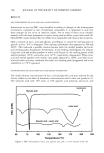
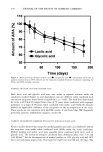
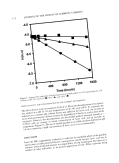
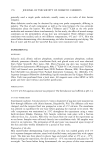
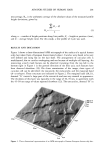
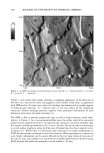
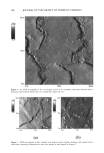
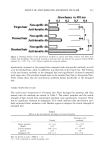
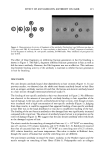
AFM FOR STUDIES OF HUMAN HAIR 203 The unprecedented high resolution of AFM offers the potential of investigating the effects of different hair-care products and treatments on the topography of human hair. For example, when the same hair sample as that shown in Figure 1 was treated with an alternative product containing the antimicrobial agent, 1% zinc pyrithione (24), a fine microgranular deposit was observed on exocuticle surfaces (Figure 4). This deposit was found in other similarly treated hair samples, including those from other subjects, and was very different in appearance to the endocuticular material observed in Figure 1. Such a deposit may reduce the luster of the hair. One of the most important advantages of AFM is its ability to image samples in various environments. The technique can not only image surfaces under atmospheric conditions, unlike SEM and TEM, which require high vacuum, but can also probe surfaces in an aqueous environment. Hair specimens can very easily be imaged in an environmental chamber, or "wet cell", offering the potential for real time, in situ studies of various phenomena such as cleansing, swelling, damage, and repair. Figure 5 shows the same hair sample as that shown in Figure 4, but imaged in distilled water. The image retains the same high resolution as that obtained in air, showing the woodgrain topography of the exocuticles. Almost all of the deposit thought to be zinc pyrithione is absent from the hair surface, although some remains of the endocuticle are still visible. This further supports the fact that the microgranular deposits observed in Figure 4 cannot be ascribed to endocuticular material. The distal ends of the exocuticles were found to be raised with respect to the underlying surface (1.2 pm compared to 0.2 pm in air for the same hair sample) due to swelling.

204 JOURNAL OF THE SOCIETY OF COSMETIC CHEMISTS -90.0 I I 20 p.m •CI Cr 10 prn 0 prn .•" •' .•1• CI p, rn 1CI p. rn 20 p.rn Figure 4. An AFM micrograph of scalp hair treated with a conditioner containing 1% zinc pyrithione same hair sample as that shown in Figure 1. Figure 6 shows an AFM micrograph of the mid-length region of unwashed scalp hair taken from a European brown-haired female, aged 25, with an average hair length of 20 cm. The cuticles were found to be poorly defined and, in some cases, damaged. Rough deposits were observed on hair surfaces, giving the hair an overall dull appearance. Washing the hair with a conventional sodium lauryl sulphate shampoo, followed by treatment with a conditioner containing dimethicones, resulted in improved cuticle definition and a smoother appearance (Figures 7a and 7b, different areas and not the same area as shown in Figure 6). The AFM images presented so far represent variations in topography across the hair surface. However, AFM is able to provide other information, such as variations in local physical properties, relative friction, hardness, and adhesion. Frictional properties can be obtained by mapping small variations in the twisting motion of the AFM cantilever as it raster-scans across the hair surface (17). The information from this "derivative" tech- nique, known as lateral force microscopy (LFM), can be acquired at the same time as topographic information and can be conveniently displayed alongside. The AFM mi- crographs in Figure 8 show (a) a topographic image and (b) a lateral force image. In Figure 8a, as in all the micrographs so far presented, the image is left-shaded, i.e., a light source can be imagined being positioned toward the left-hand side of the image, so that
Purchased for the exclusive use of nofirst nolast (unknown)
From: SCC Media Library & Resource Center (library.scconline.org)