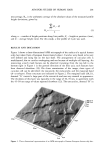
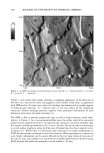
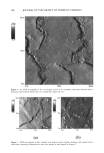
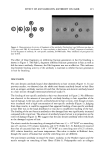
AFM FOR STUDIES OF HUMAN HAIR 207 -90.0' { { 20 prn 10prn ' 0 pm 10 prn 20 urn 0 prn 10 prn 20 prn (a) (b) Figure 8. (a) Topographic image, and (b) lateral force image of a human scalp hair sample obtained at the same time under ambient conditions using AFM. REFERENCES (1) (2) (3) (4) (5) (6) (7) (8) (9) (10) (11) (12) (13) (14) (15) (16) L. P6tsch, A discourse on human hair fibres and reflections on the conservation of drug molecules, Int. J. Legal Med.. 108(6), 285-293 (1996). L. Wolfram and M. Lindmann, Some observations on the hair cuticle, J. Soc. Cosmet. Chem., 22, 839-850 (1971). J.A. Swift and B. Bews, The chemistry of the human cuticle. I. A new method for the physical isolation of cuticle, J. Soc. Cosmet. Chem., 25, 13-22 (1974). J. A. Swift and B. Bews, The chemistry of the human hair cuticle. The isolation and amino acid analysis of various subfractions of the cuticle obtained by pronase and trypsin digestion,J. Soc. Cosmet. Chem., 27, 289-300 (1976). J.A. Swift and A.W. Holmes, Degradation of human hair by papain. Some electron microscope observations, Text. Res. J, 35, 1014 (1965). M. S.C. Birbeck and E. Mercer, The electron microscopy of the human hair follicle. The hair cuticle, J. Biophys. Biochem. Cytol., 3, 215-222 (1957). M. S.C. Birbeck and E. Mercer, The electron microscopy of the human hair follicle. The inner root sheath and trichohyalin, J. Biophys. Blochem. CytoL, 3, 223-233 (1957). V. A. Puccinelli, R. Caputo, and B. Cecarelli, The structure of the human hair follicle and hair shaft: An electron microscope study, G. Ital. Dermatol., 108, 453-498 (1967). P. F. Parakkal and A. G. Matoltsy, A study of the differentiation products of the hair follicle cells with the electron microscope, J. Invest. Dermatol., 43, 23-34 (1964). G. Binnig, C. F. Quate, and C. Gerber, Atomic force microscope, Phys. Rev. Lett., 56(9), 930-933 (1986). G. Binnig, H. Rohrer, C. Gerber, and E. Heibel, Tunnelling through a controllable vacuum gap, Appl. Phys. Lett., 40(2), 178-180 (1982). R. Wisendanger, Scanning Probe Microscopy and Spectroscopy. Methods and Applications (Cambridge Uni- versity Press, Cambridge, 1994). P. Corcuff, P. Gremillet, M. Jourlin, Y. Duvault, F. Leroy, and J.-L. Leveque, 3D Reconstruction of human hair by confocal microscopy, J. Soc. Cosmet. Chem., 44, 1-12 (1993). E.D. Goddard and R.L. Schmitt, Atomic force microscopy investigation into the absorption of cationic polymers, Cosmet. Toiletr., 109(3), 55--61 (1994). R. L. Schmitt and E. D. Goddard, Atomic force microscopy. II. Investigation into the absorption of cationic polymers, Cosmet. Toiletr., 109(12), 83-93 (1994). S. D. O'Connor, K. L. Komisarek, and J. D. Baldeschwieler, Atomic force microscopy of human hair

208 JOURNAL OF THE SOCIETY OF COSMETIC CHEMISTS (23) (24) cuticles: A microscopic study of environmental effects on hair morphology,J. Invest. DermatoL, 105(1), 96-99 (1995). (17) P. U/Sssel, D. I. R. Sander, and W. Schrepp, Scanning force microscopy, Cosmet Toilerr., 111, 57-65 (1996). (18) TopoMetrix SPM Lab., Version 3.06.06, TopoMetrix Corporation, Santa Clara, CA, USA (1996). (19) J. Jachowicz, Hair damage and attempts to its repair, J. Soc. Cosmet. Chem., 38(4), 263-286 (1987). (20) R. D. B. Fraser, T. P. MacRae, and G. E. Rogers, Keratins: Their Composition, Structure and Biosynthesis (C. C. Thomas, Springfield, IL, 1972), pp. 56-82. (21) K. Hashimoto, The marginal band, a demonstration of the thickened cellular envelope of the human nail cell with the aid of lanthanum staining, Arch. Derre., 103,387-393 (1971). (22) K. Hashimoto and S. Shibazaki, "Ultrastructural Study on Differentiation and Function of Hair, in Biology and Disease of the Hair, T. Kobori and W. Montagna, Eds. (University Park Press, Baltimore, 1976), pp. 23-57. G. Sauermann, U. Hoppe, R. Lunderstiidt, and B. Schubert, Measurement of the surface profile of human hair by surface profilometry, J. Soc. Cosmet. Chem., 39, 27-42 (1988). G. Imokawa, H. Shimizu, and K. Okamoto, Antimicrobial effect of zinc pyrithione, J. Soc Cosmet. Chem., 33, 27-37 (1982).
Purchased for the exclusive use of nofirst nolast (unknown)
From: SCC Media Library & Resource Center (library.scconline.org)