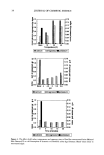
36 JOURNAL OF COSMETIC SCIENCE This phenomenon was reported as the "Dead Sea Anti-Wrinkle Effect" (1). The present study differed from the previous one by the use of a cream application, and by the addition of 5 % Triple D Complex TM. This Triple D Complex TM contains Mineral Skin Osmoter TM. The similar improvement achieved in skin smoothing in both studies suggests that the Dead Sea minerals play a significant role in the mechanism of the proven effect of antiwrinkling. Thus the minerals may be assumed to be a potent antiwrinkle agent. The mechanism of the beneficial activity of the minerals on the skin, and the role of other components of the Triple D Complex, namely the algae and plant extracts, will be further investigated. ACKNOWLEDGMENTS The authors would like to thank Dr. W. Voss of Dermatest for skillful profilometric and corneometric clinical measurements Dead Sea Works Ltd. for financial support the Pharmacist, Dr. I. Iaccony from AMI, for her essential support in formulation of the Complex Dr. E. Kvallen of IMI for his statistical analyses Dr. E. Cohen of Ben-Gurion University, Beer-Sheba, for supplying the algae and Ms. A. Alzaradel, Ms. M. Weis- buch, and Ms. M. Friedman of IMI for their technical assistance. REFERENCES (1) Z. Ma'or, S. Yehuda, and W. Voss, Skin smoothing effects of Dead Sea minerals, Int. J. Cosmet. Sci., 19, 105-110 (1997). (2) P. Morganti, "Skin Hydration," in Novel Cosmetic Delivery Systems, S. Magdasi and E. Touitou, Eds. (Marcel Dekker, New York, 1999), pp. 71-97. (3) L. R. Smith, The sea: The oldest and newest source for cosmetic ingredients, SOFWJ. 122, 11-28 (1996). (4) P.M. Elias, L. C. Wood, R. K. Feingold, Relationship of the epidermal permeability barrier to irritant contact dermatitis, Immunology and Allergy Clinics of North America, 17, 417-430 (1997). (5) G. K. M. Menon and K. R. Feingold, Integrity of the permeability barrier is crucial for maintenance of the epidermal calcium gradient, Br. J. Dermatol., 130, 139-147 (1994). (6) Z. Ma'or, S. Magdassi, D. Efron, and S. Yehuda, Dead Sea mineral-based cosmetics--Facts and illusions, Isr. J. Med. Sci., 32, 28-35 (1996). (7) B. Volesky, Biosorption of Heavy Metals (CRC Press, Boca Raton, FL, 1990). (8) M. Borowitzka and L.J. Borowitzka, "Dunaliella," in Micro-Algal Biotechnology, M. Borowitzka, and L.J. Borowitzka, Eds. (Cambridge University Press, 1988), pp. 27-58. (9) Yeda R&D Ltd, Production of glycerol, carotenes & algae meal, PCT No. 54881 (1978). (10) A. Ben-Amotz and M. Avron, Glycerol and [3-carotene metabolism in the halotolerant alga Dunaliella: A model system for biosolar energy conversion, TIBS 6, 297-299 (1981). (11) F.J. Wright, Beneficial effects of topical application of free radical scavengers,./. Appl. Cosmetol., 13, 41-50 (1995). (12) J. Wepierre, "Biological Activity of Active Ingredients and Cosmetics," in Cosmetic Dermatology, R. Baran and H. I. Maibach, Eds. (Martin Dunitz, 1994), pp. 9-20. (13) M.E. Jackson, "Assessing the Bio-Activity of Cosmetic Products and Ingredients," in Novd Cosmetic Delivery Systems, S. Magdassi and E. Touitou, Eds. (Marcel Dekker, New York, 1999), pp. 99-113. (14) Z. Ma'or and S. Yehuda, A skin care and protection composition and a method for preparation therof, WO 99/02128-PCT No. IL98/00311 (1998). (15) W. Voss, "Die Laserprofilometrie nach DIN 4768ff im Rahmen klinisch-dermatologischer Untersu- chungen," in 6th Forum Cosmeticurn Potsdam 14-15.4.94 (1994). (16) J. L. Leveque, Physical methods for skin investigation, Int. J. Dermatol., 22, 368-375 (1983). (17) C. W. Blichmann andJ. Serup, Assessment of skin moisture, Acta Derm. Venerol. (Stockh.), 68, 284-290 (1988). (18) ATCC Catalogue of Algae and Protozoa, 17th ed. (1991).

j. Cosmet. Sci., 51, 37-38 (January/February 2000) Letter to the Editor TO THE EDITOR: The cuticle controls bending stiffness of hair Perceptions of the coarseness or fineness of human hair, aside from the uncertainty of being able to observe actual direct differences in diameter, are markedly influenced by the bending behavior of the individual fibers. Accordingly, the hair is more commonly judged by tactile sensation, observation of the amount of "stand-off" from the scalp, and observation of dynamic motion in the hair array, in all of which fiber bending plays a dominant role. A theoretical study has been made of the mechanics of bending of human hair (1) in which this author suggested the cuticle might make a substantial contribution to bending resistance, even despite the relative thinness of this layer at the hair's surface. In the absence of a value for the elastic modulus for the cuticle, assumptions were made that this modulus was the same as for the hair's cortex. On this basis, a freshly emergent hair of circular section, of 70-1•m overall diameter and with a cuticle of 5-1•m thickness, was estimated to have a cuticle contributing perhaps as much as 46% to the fiber's total bending resistance. In a recent most elegant paper Parbhu et al. (2) describe nano-mechanical studies of sections of wool fibers with the aid of an atomic force microscope (AFM). By this means they obtained not only realistic measures for the elastic modulus of the fiber cortex but also elastic moduli for the subcomponent layers of each cuticle cell (exocuticle and endocuticle). These moduli confirm earlier speculations on the physical properties of the major subcomponents of the human hair cuticle based upon their chemical analysis (3). It seems opportune now to extend my earlier studies (1) in the light of these definitive measurements. We will use two principal equations: Bending resistance of a solid rod -- Eq'rr4/4 (1) where r is the rod radius and E is the Young's modulus, and Bending resistance of a cylindrical shell = Eq'r(ro 4 - ri4)/4 (2) where r o and r i are, respectively, the outer and inner radii of the shell. We will consider the bending resistance of a freshly emergent human hair of circular section and 70-pm overall diameter. According to common microscopic wisdom we will consider this hair to possess a cuticle of 5-pm overall thickness, consisting of ten cell 37
Purchased for the exclusive use of nofirst nolast (unknown)
From: SCC Media Library & Resource Center (library.scconline.org)