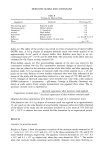
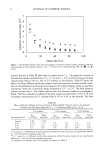
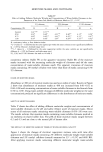
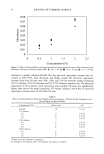
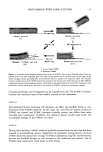
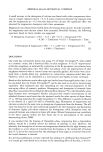
38 JOURNAL OF COSMETIC SCIENCE layers (each shell of 0.5-pm thickness), and that each layer contains an exocuticle sub-lamina of 0.3-prn thickness. For the purposes of this calculation we will ignore the cuticle cell membrane complex and the A-layer subcomponent of the exocuticle and assume that the 0.2-pm remaining thickness of each cuticle cell sheet behaves as endo- cuticle. We also make the reasonable assumption that the cortex and the subcomponents of the cuticle of human hair possess the same mechanical properties as wool. Parbhu et al.'s values for the Young's modulii of cortex, exocuticle, and endocuticle, were 4.0, 19.8, and 3.0 GPa, respectively. By summing bending resistances according to equations 1 and 2 for all the components of our target hair (i.e., cortex and ten alternating layers of exocuticle and endocuticle), we can derive an estimate of its overall bending resistance. What we find is that the cuticle as a whole contributes 74% to the total bending resistance (66% from the exocuticle and 8% from the endocuticle). The result of the present theoretical calculations must await confirmation by direct physical measurement of the bending in hairs. Nevertheless, in conjunction with the earlier study (1), there can be no denying the enormous influence the cuticle has upon the hair's bending resistance and a significant influence upon subjective perceptions of the coarseness and fineness of hair. The present results can be extended to provide yet further predictive opportunities for the cosmetic processing of hair. Thus if one's wish were to make fine hair perceptually thicker, this might be accomplished by stiffening the hair's endocuticle and, conversely, making coarse hair appear finer by degrading the stiffness of the exocuticle. Of course, it may be that existing toiletry products unknow- ingly operate by these routes. REFERENCES (1) J. A. Swift, Some simple theoretical considerations on the bending stiffness of human hair. Int. J. Cosmet Sci., 17, 245-253 (1995). (2) A. N. Parbhu, W. G. Bryson, and R. Lal, Disulphide bonds in the outer layer of keratin fibres confer higher mechanical rigidity: Correlative nano-indentation and elasticity measurements with an AFM, Biochemistry, 38, 11755-11761 (1999). (3) J. A. Swift and B. Bews, The chemistry of human hair cuticle. Part 3. The isolation and amino acid analysis of various subfractions of the cuticle obtained by pronase and trypsin digestion,J. Soc. Cosmet. Chem., 27, 289-300 (1976). j. A. Swift Department of Fetal and Infant Toxico-Pathology University of Liverpool Liverpool L69 7ZA, U.K. e-maih jaswift@ gayton. u-net. corn

j. Cosmet. sci., 51, 39-71 (January/February 2000) Papers Presented at the 1999 Annual Scientific Meeting December 9-10, 1999 New York Hilton New York, NY 39
Purchased for the exclusive use of nofirst nolast (unknown)
From: SCC Media Library & Resource Center (library.scconline.org)