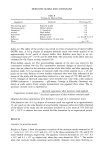
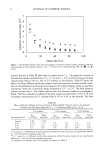
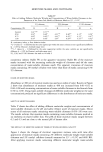
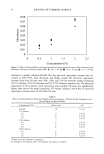
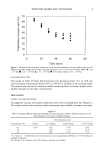
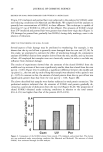
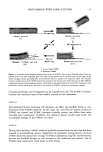
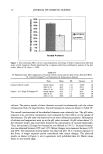
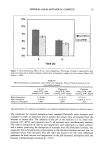
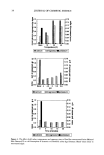
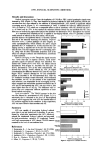
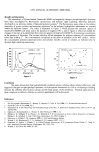
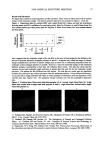
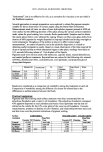
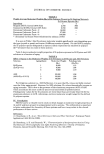
62 JOURNAL OF COSMETIC SCIENCE Discussion: As predicted by the contact angle measurements between the pigments and octyl palmitate, the C8 silane and the Dimethicone treated pigments gave the lowest viscosity dispersions in octyl palmitate, indicating better wetting. In the emulsion color grind, the descending order of viscosities was the same as the order for the contact angles with the C8 silane being the lowest. The rank of viscosity for the silane and the dimethicone were reversed in the anhydrous system, indicating an effect from the waxes or the elevated temperature. Absolute values for contact angles will not be obtained from the above method, but useful reproducible data can be collected by controlling experimental parameters. A day spent screening treatments in various vehicles will narrow the number of time consuming experiments that need to be made in the lab to optimize formulations. References: •Hollenberg, J., Price, M.S., Sujet, D., Performance of a Range of Surface Treatments, SCC Annual Scientific Meeting, 12/96. 2young, T., Phil. Trans: Royal Soc. (London), 95, 65 (1805). 3Rulison, C., Technical Notes, Kriiss USA, 1997. *Wenzl, R.N., Ind. Eng. Chem. (Anal.), 28, (1936) 988. Cardre 01/JANE/scc 1299

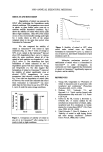
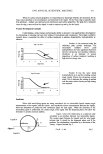
1999 ANNUAL SCIENTIFIC MEETING 63 SURFACE SCIENCE METHODS FOR COSMETIC CHEMISTS Christopher Rulison, Ph.D. ThetaDyne Corporation, Charlotte, NC 28270 Introduction Shampoo, hairspray, hair color, moisturizer, lipstick, shaving creams and gels, toothpaste, sunscreen. Each of these products contain surface active molecules (small molecule surfactants and/or polymers) that are responsible for the product's ability to wet substrates, clean, form a coating, foam, or simply remain stable on the shelf as an emulsion or colloidal dispersion. As a result, a good understanding of surface science, and analytical methods in surface science, is key to every cosmetic chemist's success. We will review the traditional methods for studying both equilibrium and non-equilibrium surfaces and interfaces (the Wilhelmy and DuNouy methods, bubble pressure, drop volume and the like). We will also discuss the future for analytical methods in surface science - surface and interfacial theology. Traditional Surface Science Methods Definitions Surface science is the study of the boundaries between immiscible phases, be they gas/liquid, liquid/liquid, liquid/solid, or even gas/solid combinations. To a laymen, such interfaces would seem to be 2-dimnesional in nature. However, surface science is really the study of the transition region between two bulk phases. The breadth of this region varies from less than 10A, in the case of a monolayer of gas adsorbed on a solid, to more than 1000Jr for an oil-in-water emulsion system stabilized by an emulsifier. One of first things to learn about surface science is the conventional use of the terms "surface" and "interface". The term "surface" is traditionally is used to describe a gas/liquid boundary. The term "interface" is used to describe a liquid/liquid boundary. The term "surface tension" is therefore used to describe the tension that develops in the plane between a gas and a liquid. The term "interfacial tension" is used to describe the tension that develops in a liquid/liquid interface. Several methods exist to measure each of these properties. However, this distinction between surface and interfacial tension is somewhat critical. Ring and Plate Methods for Surface Equilibrium and Interfacial Tension Most people have their first experience measuring surface or interfacial tension with either a DuNouy ring or a Wilhelmy Plate. With the ring method, a ring of platinum wire is used to stretch a portion of the surface or interface. The force needed to accomplish this is measured. For the plate method, a small rectangle of platinum is placed exactly at the surface or interface to be measured, so that the edge of the plate is tangent to the surface or interface. The fbrce associated with the displacement of one of two phases from the plate, in favor of the other phase, is measured. Commercial instruments abound which will perform either of these measurements. However, the utility of these measurements is primarily to determine tension of a surface or interface that is in an equilibrium condition (i.e. with surface active additives (surfactants) already adsorbed to the surface or interface). Bubble Pressure and Drop Volume Methods for Non-Equilibrium Surface and Interfacial Tension Equilibrium surfaces and interfaces are not all that is of interest to a cosmetic chemist, whose products (be they sprays, creams, shampoos, or any of others listed above) are used and formulated under non-equilibrium conditions. Take hairspray as an example. It's effectiveness depends on its ability to wet and coat the surface of hair. The surface tension of a liquid determines its ability to wet substrates. Lower surface tension means better wetting. However, the surface tension of a hairspray is time dependent (i.e. not at equilibrium when it is applied to hair). As you spray the hairspray, you are creating a large amount of air/hairspray surface (in the form of small droplets flying through the air toward your hair). The surface actives in the hairspray start adsorbing to the newly created surfaces during the time of flight of the droplets. However, they do not have time to impart the equilibrium surface tension (that one might measure
Purchased for the exclusive use of nofirst nolast (unknown)
From: SCC Media Library & Resource Center (library.scconline.org)