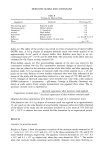
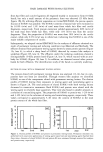
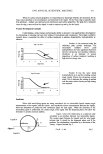
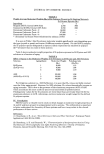
60 JOURNAL OF COSMETIC SCIENCE CONTACT ANGLE MEASUREMENTS TO PREDICT PERFORMANCE OF SURFACE TREATED PIGMENTS Jane Hollenberg •, Dylan Sujet 2, and M. Scott Price 2 •JCH Consulting, Red Hook, NY 12571 and 2Carde, South Plainfield, NJ 07080 Introduction: Although there are a wide variety of surface treatments which impart hydrophobicity to pigments, the property of hydrophobicity alone does not predict performance in actual cosmetic formulations. Most cosmetic chemists use the "shake test"{ to measure the resistance of hydrophobic pigments to wetting by water. Although the shake test can be a quick semi-quantitative indicator of hydrophobicity, any comparison of samples is subjective, and the method is not useful for studying wettability by non-aqueous systems. Previously •, a variety of applications based tests were used to distinguish between surface treatments, including viscosity measurement of suspensions. Contact angle measurements offer the potential of a quick, reproducible, quantitative screen to differentiate between degrees of hydrophobicity imparted to pigments surfaces, resistance to wetting by cosmetic oils, and wetting ability of various oils. The objective of this study was to take the contact angle measurements against different vehicles using pigments having different surface treatments to relate to wettability and functionality in actual formulations. Materials and Methods: For a drop of liquid resting on a solid, contact angle, 0, is the angle formed between the surface of the solid and a line tangent to the curve of the droplet at the point of contact between the solid and the liquid. The interaction between solids and liquids was first described by the Young 2 almost 200 years ago: ¾sv - ¾SL = ¾•,V COS 0 •liquid •sL •sv solid A liquid will wet the surface of a solid when 0 90 ø (cos 0 0). The lower the contact angle, the better the wetting of the solid by the liquid. For 0 90øC, the liquid will not wet the surface, and the higher the contact angle, the less the affinity of the liquid for the solid. Contact angle measurements can be utilized to calculate the surface fre6 energy of solids, a more comprehensive description of the properties of the solids, but are beyond the scope of this study. Measurement of contact angles between solids and liquids is subject to any variables which affect the purity of the surface, roughness of the surface, and purity of the liquid. The particulate nature of pigments further complicates development of a reproducible procedure. Relation of speed of vehicle uptake to capillarity has proven an excellent method for measuring contact angles of particulates with water using the Kffiss K-12

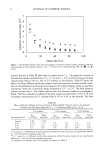
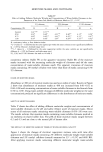
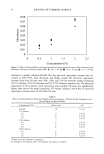
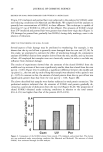
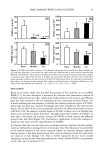
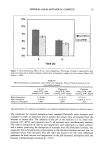
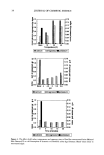
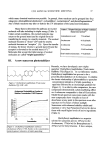
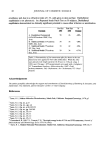
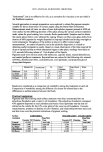
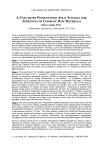
1999 ANNUAL SCIENTIFIC MEETING 61 Tensiometer 3, but is not effective for oils, as a correction for viscosity is not provided in the Washburn equation.. Several approaches to sample preparation were explored to obtain flat pigment samples suitable for direct observation of contact angles using the Ram6-Hart Goniometer. Measurements made of water on cakes of pure hydrophobic pigment pressed at 4000 psi were useful, but the differing densities of the cakes among the various surface treatments made values for good wetting, low viscosity fluids questionable. Samples used to obtain the results shown below were obtained by casting 100gm wet films onto glass slides from slurties of 60% pigment by weight dispersed in isopropyl alcohol and drying overnight at room temperature. Roughness of the surface is known to affect contact angle measurements 4, so control of particle size in the alcoholic dispersions is critical to obtaining useful comparative results. Based on visual observation of the time required for drops to spread and that at which absorption began to take place, readings were taken at 0.33 seconds following release of 15gl droplets of the liquids. Pigments used were red iron oxide with methicone, caprylyl silane, reacted dimethicone, and reacted perfluoro treatments. Reported here are values for the following oils: mineral oil/300cs, dimethicone/100cs, cyclomethicone, octyl palmitate, and propylene glycol dicaprylate/dicaprate. Mineral Oil Dimethicone Ds Octyl Prop. Glycol water Palmirate C840 Methicone 21.0 21.5 6.7 16.0 15.0 •07 C, Silane 22.7 22.7 7.8 8.3 20.0 117 Dimethicone 29.7 23.5 4.7 10.0 22.0 119 , , Perfluoro 95.8 34.1 10.5 40.7 64.1 130 Results are considered as a comparison ofwettability among the treatments in each oil. Comparison ofwettability among the different oils cannot be inferred due to the differences in surface tensions between the fluids. Practical Application: Pigments and fillers having each surface treatment were then incorporated into an anhydrous foundation and a water in oil foundation. The anhydrous foundation contained 43% pigment dispersed in octyl palmitate and waxes. Octyl palmitate was the sole oil utilized as the vehicle for the 39% color grind of the water-in-oil foundation. Viscosity measurements, presence or absence of color flotation, and relationship between mass tone and skin tone were the practical indications of pigment wetting. Surface ANHYDROUS W/O EMULSION - COLOR GRIND treatment Mass/Skin Mass/Skin Viscosity 70C Flotation Tone Viscosity RT Flotation Tone Control 30,000 mass light 30,00i) mass dark Methicone 2,900 mass red 4,300 Cs Silane 1,900 good 1,000 good Dimethicone 1,000 none good . . 1,300 .gøød . . Perfluoro 30,000 26,000
Purchased for the exclusive use of nofirst nolast (unknown)
From: SCC Media Library & Resource Center (library.scconline.org)