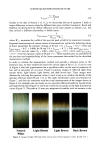
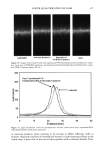
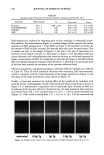
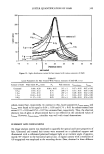
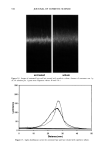
LUSTER QUANTIFICATION OF HAIR 351 exposure modes, were converted into light distribution curves similar to those obtained in goniophotometer experiments (1,3,4). Several equations, empirically verified by vari- ous authors, were utilized to calculate the luster parameters. The results were generally consistent with the literature data and visual observations. It was shown that: © Natural white, light blonde, light brown, medium brown, and dark brown hair showed a gradual increase in luster proportional to the amount of melanin pigmen- tation. Light-colored hair clearly displayed two specular reflection bands correspond- ing to the front- and back-face reflections from hair fibers. © Silicone and hydrocarbon oils, specifically phenyl trimethicone, amodimethicone, and castor oil, increase the luster of hair by enhancing the contrast between specular and diffuse areas. Phenyl trimethicone was found to be the most effective treatment. © Luster can be increased by the deposition of polymers, such as hairspray or styling resins, forming thin films on the hair surface. © A controlled reduction in hair luster can be achieved by deposition of various amounts of micronized ZnO, which increases the width and intensity of both specular and diffuse reflection from hair. Additionally, a decrease in luster was demonstrated with the use of a synthetic sebum. ACKNOWLEDGMENTS The authors acknowledge help in performing experiments from S. Chen and many useful discussions with C. Rocafort and L. Foltis. This paper is dedicated to the memory of Dr. Robert Stamm who performed pioneering studies in this area. REFERENCES (1) R.F. Stamm, M. L. Garcia, and J.J. Fuchs, The optical properties of human hair. I. Fundamental considerations and goniophotometric curves, J. Soc. Cosmet. Chem., 28, 571-599 (1977). (2) R. F. Stamm, M. L. Garcia, and J. J. Fuchs, The optical properties of human hair. I. The luster of hair fibers, J. Soc. Cosmet. Chem., 28, 601-609 (1977). (3) W. Czepluch, G. Hohm, and K. Tolkiehn, Gloss of hair surfaces: Problems of visual evaluation and possibilities for goniophotometric measurements of treated strands,J. Soc. Cosmet. Chem., 44, 299-318 (1993). (4) C. Reich and C. R. Robbins, Light scattering and shine measurements of human hair: A sensitive probe of the hair surface, J. Soc. Cosmet. Chem., 44, 221 (1993). (5) H. K. Bustard and R. W. Smith, Studies of factors affecting light scattering by individual human hair fibers, Int. J. Cosmet. Sci., 12, 121-133 (1990). (6) T. Maeda, T. Hara, M. Okada, and H. Watanabe, Measurements of hair luster by color image analysis, 16 t•5 UFSCC Congress, New York, 1990, Vol. I, p. 127. (7) C. Scanavez, M. Zoega, A. Barbosa, and I. Joekes, Measurement of hair luster by diffuse reflectance spectrophotometry, J. Cosmet. Sci., 51, 289-302 (2000).

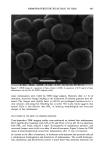
j. Cosmet. sci., 54, 353-366 (July/August 2003) Influence of internal structures of hair fiber on hair appearance. III. Generation of light-scattering factors in hair cuticles and the influence on hair shine MASAYUKI OKAMOTO, RYOKO YAKAWA, AKIRA MAMADA, SHIGETO INOUE, SHINOBU NAGASE, SATOSHI SHIBUICHI, EMIKO KARIYA, and NAOKI SATOH, Kao Corporation, Analytical Research Center, 1334 Minato, Wakayama-shi, Wakayama 640-8580 (M.O., R.Y., S.I.), and Kao Corporation, Hair-Care Research Laboratories, 1-3, Bunka 2-chome, Sumida-ku, Tokyo 131-8501 (A.M., S.N., S.S., E.K., N.S.),Japan. Accepted for publication December 20, 2002. Based on a presentation at the 2001 IFSCC International Congress, Taipei, Taiwan, September 17-19, 2001. Synopsis The effects of thermal treatments on hair fiber induced by blow-drying have been investigated. It was found that the hair shows whitish and powdery appearance after heat drying, especially when dark hair is rapidly dried from a wet condition. For all kinds of hair, the appearance of numerous glittering speckles was confirmed on the cuticle surface by optical microscopic observations. SEM images of hair transverse and longitudinal sections with glittering speckles revealed that the splitting of cuticle layers generated by blow-drying occurred not only at the outermost parts of cuticle cells but also at the inner parts of the cellular interfaces. The release and uptake of moisture through fiber surfaces induces deformation of cuticle cells, probably because of anisotropic swelling or drying of the cells. The cuticles with glittering speckles are found to be fragile and are easily damaged in combination with other mechanical stresses such as combing force. Furthermore, the authors have found an efficient system for both improving hair shine and preventing cuticle damage caused by the blow-drying/combing process. INTRODUCTION The structure of human hair is a highly organized stratum that is very resistant to external stimuli. However, morphological changes can occur through daily hair care routines, chemical treatments, exposure to UV-light, and other stresses. Hair damage leads to a change in not only the physical properties of hair, by becoming harsh, stiff, weak, and brittle, but also in optical properties such as shine. Hair shine is one of the largest concerns of consumers, and as a result, numerous studies regarding hair shine have been conducted. Although most of the studies discuss the optical properties at the hair surface, we have found that structural changes occur in the internal hair fiber 353
Purchased for the exclusive use of nofirst nolast (unknown)
From: SCC Media Library & Resource Center (library.scconline.org)