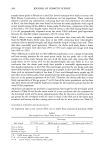
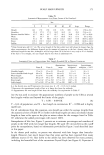
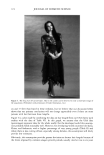
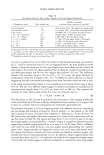
368 JOURNAL OF COSMETIC SCIENCE attends theme parks in Florida or in the USA. Several attempts were made to contact the Wait Disney Corporation to obtain information on that population. Those contacted refused to provide any information, indicating that such was proprietary. As indicated in Part I, the hair-length data were found to be from the same population (with regard to hair length) among all the different theme parks. Furthermore, comparison of the data to that from a 1972 hair-length market research survey in the USA among females ages 14 to 60 (geographically dispersed across the entire USA) indicated good agreement between the shoulder-length assessments (26.3% versus 24%). Table I shows a more complete comparison, with newer data, from only 601 females from the MGM Studio theme park, done in late 2000, evaluating short (chin-length), medium (chin-to-shoulder-length) and long (shoulder-length or longer) hair only. These data show reasonably good agreement. However, the theme park study shows a lower percentage of women with short hair (29% to 33%) and a larger percentage with long hair (30% to 24%). These differences could be due to either different populations, or to a change in hairstyles and hair-cutting practices for the more recent study, but are partly due to the small sample size of this study, because the sum of all the theme park data versus this USA study shows 26.3% versus 24% for the shoulder-length data (see Table I). It is our conclusion that the theme park study does provide a reasonable approximation for hair-length populations in the USA. The percentages provided by our theme park data most likely represent the mid-teenage group up to people in their mid-60s. We excluded those with an estimated height of less than 4.5 feet, and although many people age 60 and older attend theme parks, fewer people from this older age group attend theme parks than are in the general population of the USA. Therefore, the theme park data is more likely representative of the age group 15 to 60 than of the entire population, and so these data most likely provide slightly higher percentages for the long-hair groups than for the overall USA population. Additional calculations are provided to approximate hair length for the developed world (defined in Table II) and for the entire world. It is our conclusion that the estimates for the developed world will be better approximations than for the entire world because the age groups for the developed world are closer to those of the USA and of the theme park attendees and because the hair cutting practices will also be more similar (see Table II). ANATOMICAL POSITIONS AND HAIR LENGTH An important step in our current effort was to relate these anatomical positions (Table Table I Hair Length From Theme Parks Versus a I972 USA Study Percentage Hair length 1972 USA study* MGM study on women** All theme park studies*** Chin or shorter 33 29 -- Chin-to-shoulder 43 41 -- Shoulder or longer 24 30 26.3 * N = 15,000 women ages 14 to 60. ** N = 601 women, MGM Studios theme park. *** N = 12,150 women, several Florida theme parks.

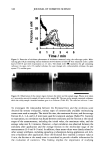
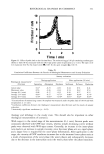
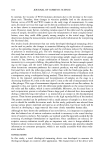
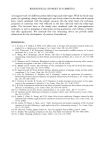
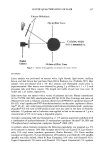
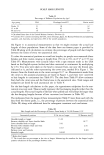
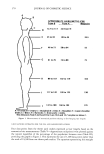
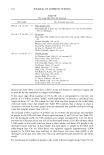
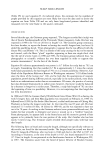
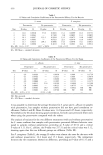
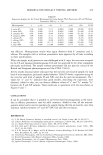
SCALP HAIR LENGTH 369 Table II Percentage of Different Populations by Age* Age group USA Developed world** Entire world Under 15 21 18 32 15 to 60 63 63 58 60 and over 16 19 10 * Calculated from data of the United Nations Statistics Division (2). ** Consists of 43 countries including the USA, most of Europe, Japan, the Russian Federation and adjoining countries, and Australia, and represents 20% of the world's population. III, Figure 1) to anatomical measurements so that we might estimate the actual hair lengths of these populations. Some of the data from our former paper is provided in Table III along with calculations to estimate the percentages of people with hair lengths between the limits of every two anatomical sites. To relate the anatomical positions to actual hair lengths, six people were measured (three females and three males), ranging in height from 158 cm to 191 cm (5'2" to 6'3") (see Table IV). Measurements were actually taken with a tape measure made in the USA based on the English system (inches) and then converted to centimeters by multiplying by 2.54. Two sites were taken on the head to measure from, one near the frontal area, indicated as A, and the other representing the crown area, marked B in Figure 1. The distance from the frontal area to the crown averaged 12.7 cm. Measurements made from the crown to the anatomical positions are listed in Figure 1, and these were converted to hair lengths in centimeters (see Table IV). The data from Table IV allow estimates from both the crown area and the frontal area to the anatomical sites. Total ranges and midpoints are listed for each anatomical site in Table V. For the hair-length calculations in this paper, the approximate midpoints for the ana- tomical sites were used. These actually represent the free-hanging lengths rather than the actual lengths. The actual lengths of the hair when pulled taut will always be longer than the free-hanging lengths because of hair curvature (see footnote in Table IV). The midpoints from the ranges of these measurements (Table V) were then used with the data from the theme parks, i.e., the percentage of persons between the anatomical sites (Table III) along with additional data for subsequent treatment and conclusions. Table III Hair Length and the Percentage of Persons From Study of 24,300 Persons (11)* Anatomical position % At site or longer % Between sites** Shoulder-length or longer Between shoulder and lower shoulder blade Lower shoulder blade or longer Between lower shoulder blade and waist Waist-length or longer Between waist and buttocks Buttocks-length 13.20 10.77 2.43 2.11 0.317 0.301 0.0165 * Males plus females ** The actual data are percentages at the site or longer. Subtracting the numbers for the longer lengths permits calculation of the percentages between sites.
Purchased for the exclusive use of nofirst nolast (unknown)
From: SCC Media Library & Resource Center (library.scconline.org)