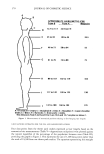
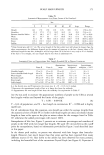
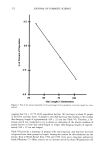
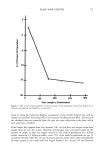
378 JOURNAL OF COSMETIC SCIENCE Kentucky, measured at 35.6 cm (14 inches) in 1884 as the longest recorded beard for a woman (6). The longest mustache on record was that of Kalyan Ramji Sain of Sundargarth, India, with a span of 339 cm (133.5 inches) and a length of 172 cm (673/4 inches) on the right side and 167 cm (653/4 inches) on the left side, measured in July of 1993 (6). SUMMARY AND CONCLUSIONS Hair length estimates by anatomical site, previously made in Florida theme parks on "adults," are related to anatomical measurements to obtain estimates of actual free- hanging hair lengths in centimeters. A plot of the natural logarithm of the percent population versus these hair lengths provides a straight line. The equation of this line permits the estimation of the numbers of persons in the USA and the developed world with hair lengths up to about 183 cm (just beyond ankle-length). Data were also collected via a literature search for even longer hair lengths (ankle-length or longer) to provide an equation to estimate the numbers of persons with exceptionally long hair. A plot of these two equations together suggests that "normal" anagen periods may be considerably longer than current estimates in the literature. REFERENCES (1) C. Robbins and M. G. Robbins, Scalp hair length. I. Hair length in Florida theme parks: An approxi- mation of hair length in the United States of America, J. Cosmet. Sci., 54, 53-62 (2003). (2) www. UNSTA TS. UN. O R G /UNS D/demographic/ww2OOOtahle l a. htm. (3) Guinness Book of World Records 1968, Norris and Ross McWhirter, Eds. (Bantam Books, published by arrangement with Sterling Publishing Co., 1968), p. 25. (4) Guinness Book of World Records 1981, Norris and Ross McWhirter, Eds. (Sterling Publishing Co., New York, 1981), p. 37. (5) Guinness Book of World Records 1996 (Facts on File, Inc., New York, 1995), p. 13. (6) Guinness Book of World Records 1999 (Facts on File, Inc., New York, 2000), p. 241. (7) F. Pflonissen, www. tlhs. org/extlng. html. (8) S. Wannabovorn, www. rense. com/ufo2ghostly. html. (9) Godrej Hair Care Institute, www. haircareindia. com/funzone. html. (10) Resident population of the US by 5-year age groups and sex: April 1, 1990 census and July 1, 1990 to July 1, 1995 estimates, www. state. la.m/state/census/95ageest. html. (11) M. Saitoh, M. Uzuka, and M. Sakamoto, Human hair cycle, J. Invest. Dermatol., 54, 65-81 (1970). (12) A.M. Kligman, The human hair cycle,•/. Invest. Dermatol., 33, 307-316 (1959). (13) R.J. Myers andJ. B. Hamilton, Regeneration and rate of growth of hairs in man, Ann. N.Y. Acad. Sci., 53, 562-568 (1951). (14) J. M. Barman, I. Astore, and V.J. Pecoraro, The normal trichogram of the adult. J. Invest. Dermatol., 44, 233-236 (1965). (15) Trends in births, life expectancy, fertility and age structure, 1975 to 2000, www. overpopulation. org/ culture. html. (16) C. Haub, How Many People Have Ever Lived on Earth ? (Population Reference Bureau, Washington, D.C., 1995).

j. Cosmet. sci., 54, 379-394 (July/August 2003) Chemical and photo-oxidative hair damage studied by dye diffusion and electrophoresis S. B. RUETSCH, B. YANG, and Y. K. KAMATH, TRI/Princeton, 60I Prospect Ave., Princeton, NJ 08542. Accepted for publication September 6, 2002. Synopsis Microspectrophotometric and electrophoretic methods were used to characterize and quantify the effects of primary damage to hair from chemical and photochemical oxidative processes. The diffusion of molecules proceeding from the fiber surface to the center of untreated and modified (by chemical and photochemical oxidative processes) hair fibers was mapped by fluorescence microscopy and quantified by calculating diffusion coefficients of a fluorescent molecule. In addition, an electrophoretic separation technique, namely, SDS-PAGE (sodium dodecyl sulfate-polyacrylamide gel electrophoresis), was used not only to substantiate the results obtained in the microfluorometric study, but also to show how the main classes of proteins of unaltered hair are modified by cosmetic chemical treatments, light exposure, and combinations of these two processes. UV microspectrophotometry is an alternate analytical method to evaluate photo-oxidative damage in hair, and supports the results obtained by microfluorometry. INTRODUCTION Natural weathering and grooming practices to improve appearance inflict irreversible damage to human hair. Grooming practices such as combing, blow drying, and brushing lead to mechanical damage, mainly to the surface of the hair fiber. On the other hand, chemical methods such as bleaching, perming, and photochemical oxidation result in chemical damage to the cuticle and cortex. The nature of this damage is in the form of cleaved chemical bonds, which are further oxidized to hydrophilic (acidic) functional- ities. This alters the properties of the material, such as the extent of swelling and receptivity to other molecules that interact strongly with the acidic functionalities. In undamaged hair, diffusion of dyes with a molecular weight of-300-400 is relatively difficult and requires more than one hour to penetrate through the cuticular layers to reach the cortex. The molecular architecture within the cell structure restricts access to foreign molecules such as dye molecules. In chemically damaged fibers, on the other hand, cleavage of the disulfide bonds and further oxidation decrease the disulfide crosslink density in the matrix, and result in the formation of hydrophilic sulfonic acid groups. In some cases, damage can also result in cleavage of the peptide bonds and formation of carboxyl and amine groups, both of which are hydrophilic. The overall effect of such damage is an increase in swelling of the hair fiber (in the wet condition), 379
Purchased for the exclusive use of nofirst nolast (unknown)
From: SCC Media Library & Resource Center (library.scconline.org)