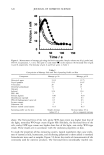
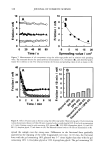
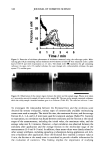
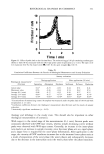
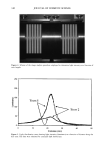
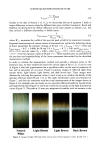
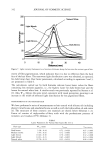
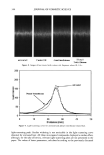
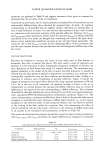
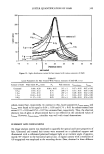
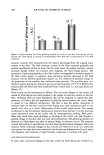
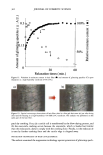
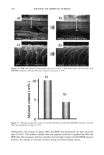
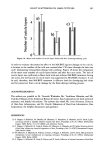
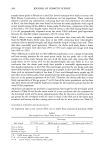
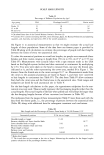
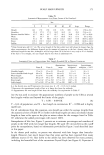
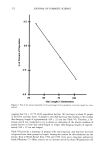
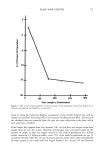
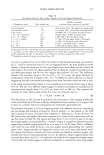
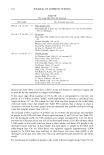
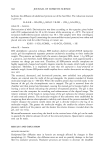
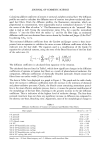
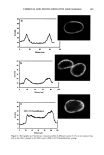
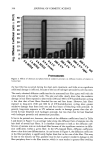
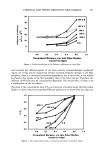
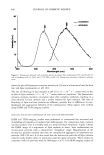
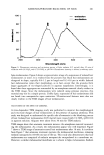
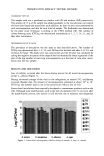
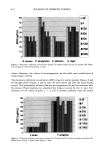
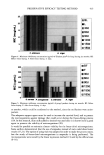
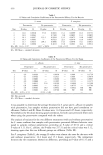
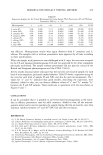
384 JOURNAL OF COSMETIC SCIENCE Calculating diffusion coefficients of uranine in untreated andphoto-oxidized hair. The diffusion profiles are used to calculate the diffusion rates of uranine into photo-oxidatively dam- aged hair fibers. From the diffusion profiles, the fluorescence intensities, which are proportional to concentration, were sequentially read at normalized distances "r" from the center of the fiber of radius "a." The fluorescence intensity at the "saturated" fiber edge is read as well. Using the concentration ratios C/C o for a specific, normalized distance "r" into the fiber with the radius "a," and for the fiber edge, an estimated diffusion coefficient was obtained from curves drawn by Carslaw and Jaeger (4) for Dt/a 2 by plotting C/C o vs r/a. This estimated diffusion coefficient from the Carslaw and Jaeger curves is then incor- porated into an equation to calculate the more accurate diffusion coefficients of the dye molecule into the hair shaft. The equation used is a modification of the Crank (5) equation for cylindrical systems, using the roots of the Bessel functions of the first kind of the order zero (1). C ø=(-Dt)Jo(r•,/a) -1-2Zex p •5-'[3, 2 ß (1) The diffusion coefficient is calculated from equation (1) by iteration. The calculated data are listed in Table I, which show significant changes in the diffusion coefficients of uranine in human hair fibers as a result of photochemical oxidation. For comparison, diffusion coefficients of chemically bleached (peroxide bleach cream) hair fibers from our earlier work (2) are included. The data in Table I are displayed in a graph in Figure 3. The graph and the table clearly show the increase in diffusion coefficients with the increase in the intensity of chemical and photo-oxidative processes. Clearly, the bleach cream containing ammonium persul- fate is the most effective oxidative process, that is, it causes the greatest modification of the morphology of the hair fiber, resulting in the greatest increase in the dye diffusion coefficient. This is indicative of the highest level of oxidative damage. The four-hour peroxide treatment does not show any significant increase in diffusion rate compared to the shorter, one-hour, bleaching time. Apparently, most of the morphological change to Table I Diffusion Coefficients of Uranine in Untreated and Modified Hair Fibers Hair sample D (m2/s x 10 •5) 0 h peroxide 3.59 + 0.67 1 h peroxide 9.78 + 3.67 4 h peroxide 10.30 _+ 0.87 0.5 h bleach cream 45.21 _+ 28.66 0 h UV 4.34 + 2.66 200 h UV/humidification cycling 6.47 _+ 5.44 300 h UV/humidification cycling 8.62 + 7.95 500 h UV/humidification cycling 18.18 _+ 6.72 600 h UV/humidification cycling (right side) 23.16 _+ 12.78 600 h UV cycling (left side) 20.39 _+ 7.76 Sample size: -10 hair fibers/category and -5 diffusion coefficients/hair fiber.

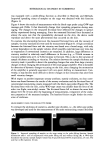
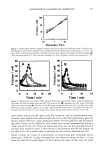
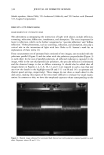
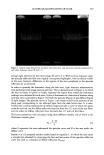
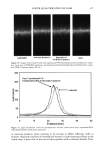
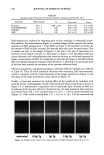
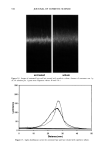
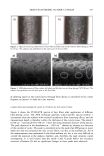
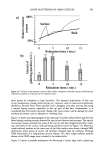
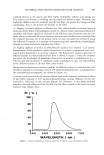
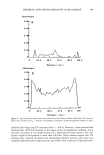
CHEMICAL AND PHOTO-OXIDATIVE HAIR DAMAGE 385 lO 20 40 6• 80 Distance (•m) 6O so 40 20 1o b 0 20 40 60 80 Distance (Inn) so • 30 20 10 0 ., 0 20 40 60 80 100 120 Distance (Inn) Figure 2. Micrographs and fluorescence emission profiles of diffused uranine (5.5 h) in (a) untreated hair and in hair fibers exposed to (b) 200 h and' (c) 600 h of UV/humidification cycling.
Purchased for the exclusive use of nofirst nolast (unknown)
From: SCC Media Library & Resource Center (library.scconline.org)