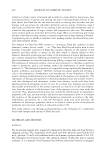
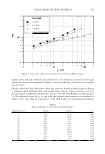
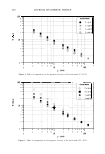
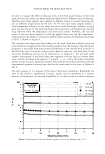
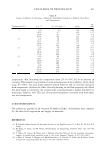
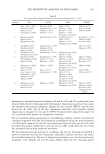
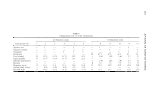
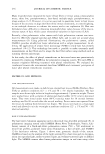
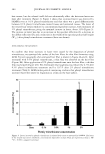
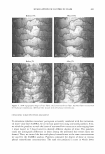
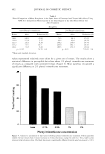
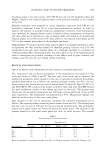
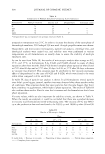
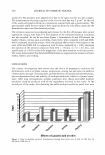
482 JOURNAL OF COSMETIC SCIENCE Table I Paired Comparison of Mean Roughness in the Same Areas of Untreated and Treated Hair Fibers Using AFM: Five Independent Measurements of the Same Region of the Hair Fibers Before and After Treatment Roughness 0.5% Phenyl trimethicone 2% Phenyl trimethicone Before After Reduction (%) 146.1 149.1 -2.06 122.0 115.4 5.37 121.5 116.3 4.28 117.2 97.7 16.7 103.1 93.5 9.26 p = 0.107 *6.70 6.9 * Mean and standard deviation. Before 73.5 96.2 194.2 203.8 189.5 p 0.01 After 64.3 65.6 154.0 182.7 152.3 Reduction (%) 12.63 34.94 20.74 10.35 19.64 *19.65 9.6 values represented relatively more shine for a given set of tresses. The results show a statistical difference in perceptible hair shine above 1 % phenyl trimethicone treatment of tresses as compared with untreated tresses (Figure 5). Most panelists recognized a significant difference at 2% phenyl trimethicone treatment. 60 ..... $--4 40 - 20 base 0.1% 0.5% 1% 2% Phenyl trimethicone concentration Figure 5. Subjective assessment of hair luster following phenyl trimethicone treatment. Fifteen panelists ranked the hair tresses from 1 (most lustrous) to 5 (least lustrous), using the rank test. Thus, lower values represent relatively more shine. The black bar group is significantly different from the gray bar group (p 0.01).

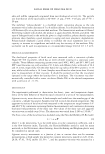
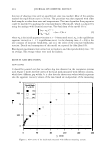
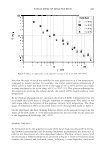
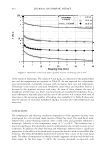
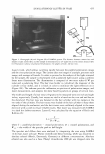
EVALUATION OF LUSTER IN HAIR 483 CORRELATION BETWEEN INSTRUMENTAL AND SUBJECTIVE MEASUREMENT We analyzed the data to determine if results from the instrumental analysis and the panelists' subjective assessment were in agreement. A comparison of the instrumental results with the results from the panel test indicates that luster value from SAMBA was inversely proportional to visual luster ranking assessed by the panelists (Figure 6). Collectively, the scores from the panel test were in good agreement with the luster measurements obtained from SAMBA. The panelists' assessments demonstrate that consumers' perception of hair shine depends not only on the increase in specular reflec tion but also on the reduction of width of the reflected light. This reduction of width was caused by a narrowing of the shine band, so that panelists easily felt much more spotlight above 1 % phenyl trimethicone treatment than below 0.5%, and it was clearly visible for panelists at 2% phenyl trimethicone treatment. DISCUSSION We used a polarimetric camera with a high polarization contrast parameter value at a fast video rate (30 frames/sec) to quantitate shine using polarized illumination. SAMBA provided reliable results for luster measurement and a rapid, easy, and quantitative means of determining the shine effect of silicone on hair tresses. 40 r2 0.84 30 • ,-. � 20 fl.I ·-� a.. 10 � fl.I 0 -10 -------------------.---------------, 10 20 30 40 50 60 70 80 Total luster ranking Figure 6. The correlation between luster increase(%) as measured by SAMBA and subjective luster ranking by panelists.
Purchased for the exclusive use of nofirst nolast (unknown)
From: SCC Media Library & Resource Center (library.scconline.org)