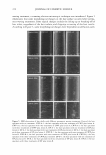
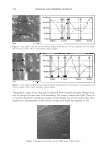
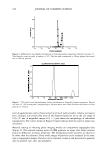
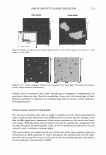
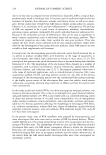
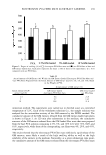
208 JOURNAL OF COSMETIC SCIENCE 300 - - CWP-A DP-A -CWP-B DP-B 250 - c::J Centro! - -- 200 - -- -- §3 ,... � 6 ..c:: blJ 150 == � -s � 0 �� -- -- -- - -- - -- -- 100 - 50 - 0 I I I I Control 1 2 3 Penning times Figure 2. Change in protein content of human head hairs by different waving treatments. CWP-A: the hair sample with CWP plus lotion A. DP-A: the hair sample with DP plus lotion A. CWP-B: the hair sample with CWP plus lotion B. DP-B: the hair sample with DP plus lotion B. Control: the hair sample with no permanent waving treatment. protein content (by 58%) was observed in the hair shafts processed after three treatments with permanent waving method DP, using lotion B (Figure 2), indicating that this type of permanent waving treatment may result in hair damage. Some workers (2,6,7) have also provided evidence that permanent waving treatment leads to a decrease or structural changes in human hair protein. Their data may support our results that the permanent waving treatment is directly associated with a decrease in the protein content of human head hairs. For analysis of the protein profile in human head hairs by the permanent treatment, SDS-PAGE was carried out. As shown in Figure 3, several polypeptides with various sizes ranging from 10 to 200 kDa were seen in an acrylamide gel. The two most abundant polypeptides were approximately 48 kDa and 60 kDa (Figure 3). Among the polypeptides, the largest polypeptide was approximately 200 kDa, and two smaller polypeptides with sizes of approximately 18 kDa and 10 kDa were also observed. The band signals of other minor polypeptides were present or absent in the gel (the boxed area and arrows on the gel), depending on the permanent waving treatments. According to the figure, three polypeptides were affected by the permanent waving treatment. The band signals of two large polypeptides with sizes of approximately 200 kDa and 210 kDa were slightly weaker (two arrows in lanes 1 and 2) or much weaker (two arrows in lanes 3 and 4) than those of the control (with no permanent waving treatment lane C),

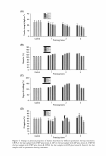
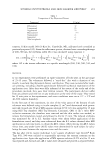
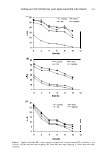
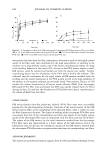
(kDa) 201 119 98 56 37 29 20 7 CHANGES IN HAIR DURING PERMANENT WAVING 209 M C 1 2 3 4 Figure 3. SDS-PAGE analysis of protein variation by various permanent waving treatments. M: molecular size marker. C: control (the hair sample with no permanent waving treatment). 1: the hair sample with three treatments of CWP plus lotion A. 2: the hair sample with three treatments of DP plus lotion A. 3: the hair sample with three treatments of CWP plus lotion B. 4: the hair sample with three treatments of DP plus lotion B. suggesting that some amounts of polypeptides might be lost by various treatments performed during the process of permanent waving. More importantly, some faint band signals were observed in the treatment by waving lotion B (the arrows in Figure 3), assuming that the hair protein might respond more to lotion B. Another feature of the protein variation was that one smaller polypeptide with approximately 31 kDa was very weakly identified in three treatments of both CWP and DP using waving lotion A (lane C of the boxed region), which was not recognized in other treatments. Although some previous studies showed that there may be eight different hair polypeptides based on the electrophoretic patterns extracted from human head hair materials (16,17), the results of our experiments demonstrate that slightly different electrophoretic profiles (lane C of Figure 3) were recognized and that some loss of certain polypeptides by the permanent waving treatments was exemplified using SDS-P AGE analysis (lanes 1-4 of Figure 3). EFFECTS OF PERMANENT WAVING TREATMENT ON CHANGES IN PHYSICAL PROPERTIES OF HUMAN HEAD HAIRS Several physical parameters have been used to estimate the effects of permanent waving treatment on the changes in human head hairs. Such major parameters include changes in tensile strength and hair diameter, the degree of swelling of the hair shafts, and hair elongation (2). Figure 4 displays that their overall responses to the permanent waving treatments were dependent on the method of permanent waving. Figure 4A demon strates the change in tensile strength of the hair shafts after the permanent waving treatment. On the whole, there was a decrease in tensile strength of the hairs in all treatments as the perming time increased (Figure 4A). The lowest tensile strength was
Purchased for the exclusive use of nofirst nolast (unknown)
From: SCC Media Library & Resource Center (library.scconline.org)