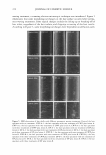
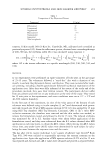
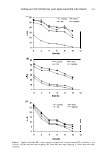
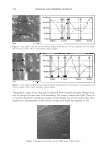
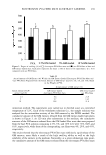
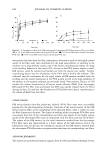
ELECTROSPUN PVA FIBER MATS AS EXTRACT CARRIERS 239 700 600 * * * * 500 400 300 200 100 0 PVA 2.5% GM-loaded 5% GM-loaded 10 % GM-loaded Figure 2. Degree of swelling (%) of (D) electrospun PVA fiber mats and (■) cast PVA films of bare and GM extract-loaded mats. Each point represents the mean ± S.D. of three to five experiments. *p 0.05 compared with cast PVA films. Table II Actual Amount of GM Extract(%) Within the GM Extract-Loaded Electrospun PVA Fiber Mats and Cast PVA Films Prepared From the Initial Amount of GM Extract Load of 2.5%, 5%, and 10%, Based on the Weight of PV A Initial amount of GM extract load (%) 2.5 5 10 Actual amount of GM extract(%) GM extract-loaded electrospun PVA fiber mats 9.6 9.7 10.8 GM extract-loaded cast PV A films 23.9 14.5 21.0 immersion method. The experiments were carried out in distilled water at a controlled temperature of 32°C. Each of the withdrawn solutions (i.e., the sample solution) was analyzed for the antioxidant activity of the GM extracts by the DPPH method. The cumulative amount of the GM extracts released from the GM extract-loaded specimens is shown in Figure 3. At 120 min after submersion in the medium, the cumulative amounts of the GM extracts released from the GM-loaded fiber mats that were prepared from the base PVA solution containing 2.5%, 5%, and 10% w/w were 73%, 84%, and 81 %, respectively, while those of the corresponding cast films were 4%, 29%, and 41 %, respectively. The results showed that the electrospun PVA fiber mats exhibited a rapid release of the GM extracts, most likely a result of the high swelling ability as well as the high solubility of the extracts in the medium. Noticeably, at a given submersion time point, the cumulative amount of the GM extracts released from the electrospun PVA fiber mats

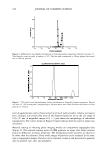
240 a) 100 80 60 .::: 40 20 u '$- 0 0 20 40 JOURNAL OF COSMETIC SCIENCE 60 80 100 120 140 Time(min) 100 80 60 40 20 0 b) 0 20 40 60 80 100 120 140 Time(min) Figure 3. % Cumulative release of (a) GM extract-loaded electrospun PVA fiber mats and (b) as-cast films. ( ♦) 2.5% initial GM extract-loaded electrospun PVA mat. (■) 5% initial GM extract-loaded electrospun PVA mat. (,._) 10% initial GM extract-loaded electrospun PVA mat. was greater than that from the film counterparts, obviously a result of the highly porous nature of the fiber mats that contributed to the high susceptibility to swelling in the medium. For a drug delivery system, one of the factors controlling the release of a drug is the swelling behavior of the carrier (29). As soon as the PV A matrix begins to swell, GM extracts could be solvated and leached out from the matrix very readily. Another contributing factor was the dissolution of the PV A matrix within the medium. This indicated that the mechanism for the rapid release of GM extracts included both the swelling and the partial dissolution of the PV A matrix as well as the high solubility of the extracts in the aqueous medium, as previously noted. Very recently, Zeng et al. (30) studied the release characteristics of bovine serum albumin (BSA) from electrospun BSA-loaded PVA fiber mats and found that BSA was rapidly released from the fibers during the first 2 h and that the dissolution of PV A fibers was a factor contributing to the release of BSA from the fibers. CONCLUSIONS GM extract-loaded ultra-fine poly(vinyl alcohol) (PV A) fiber mats were successfully prepared by the electrospinning technique. Variation of the initial content of the GM extracts had no effect on the morphology of the obtained fibers, while it tended to cause the fiber diameters to decrease. The degree of swelling of the electrospun PVA fiber mats was greater than that of the corresponding cast films, due largely to the highly porous nature of the electrospun fiber mats in comparison with the dense structure of the films. The release of the GM extracts by the total immersion method from the electrospun PVA fiber mats was characterized as a burst release of the GM extracts, and at the submersion time of 120 min, the cumulative amount of the GM extracts released from the electrospun PVA fiber mats was greater than that from the corresponding cast films. ACKNOWLEDGMENTS The authors are grateful for financial support from the National Nanotechnology Center
Purchased for the exclusive use of nofirst nolast (unknown)
From: SCC Media Library & Resource Center (library.scconline.org)