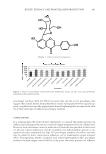
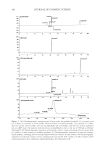
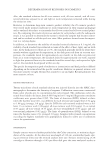
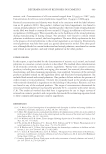
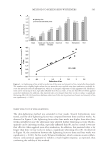
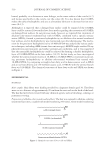
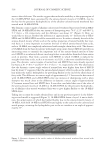
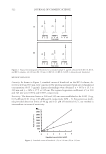
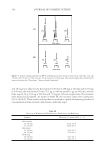
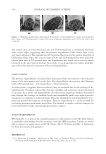
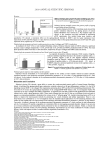
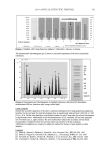
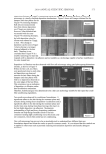
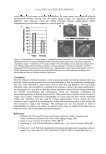
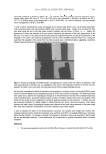
JOURNAL OF COSMETIC SCIENCE 514 DEPOSITION OF FATTY ACID The amount of fatty acid sorption of alkaline-color-treated weathered hair treated with n-HEA/SPDA, 19-MEA/SPDA, and 18-MEA/SPDA conditioners and after one instance of shampooing measured by LC-MS were 25.4 ± 6.4 μg/g-hair, 24.2 ± 3.8 μg/g-hair, and 18.7 ± 6.0 μg/g-hair (for n = 3), respectively. There were no signifi cant differences be- tween these three kinds of fatty acid in the amount of fatty acid sorption by ANOVA. The results indicated that the amount of fatty acid sorption on alkaline-color-treated weath- ered hair was not just directly related to the branch structure of fatty acid. In our previous paper a surface model of hair treated with 18-MEA/SPDA was proposed, in which 18- MEA/SPDA formed a layer 1 nm in thickness, having a hydrophilic area of molecules binding tightly to the surface and orienting the hydrophobic part to the air interface at an angle of approximately 25° (14). In this model the anteiso-branch moiety of 18-MEA does not interact with the surface directly, and therefore it seems reasonable that there were no signifi cant differences in the deposition of fatty acid among the alkaline-color- treated weathered hair samples treated with n-HEA/SPDA, 19-MEA/SPDA, and 18- MEA/SPDA conditioners. AFM INVESTIGATION USING MICA SURFACE It is very diffi cult to examine the exact situation of an 18-MEA/SPDA layer adsorbed onto an alkaline-color-treated weathered surface, since the surface of hair is too rough for AFM investigation. In order to investigate the thickness and physical proper- ties of the layer formed by n-HEA/SPDA, 19-MEA/SPDA, or 18-MEA/SPDA, an atom- ically fl at surface is needed for the AFM observation. In this study, mica was also used for AFM investigation as a hydrophilic model surface instead of hair, as in our previous study (14), although it might be open to question whether these surfaces would behave differently due to the different compositions of the surfaces. We believe, however, that the attachment and orientation of these complexes could be similar in human hair. The AFM height images of the absorbed layers on mica surfaces treated with n-HEA/ SPDA (a), 19-MEA/DAPS (b), and 18-MEA/SPDA (c) conditioner solutions (Figure 3) showed that the all conditioner formulations were homogeneously adsorbed on the mica surfaces. The mechanical properties of the adsorbed membranes were analyzed using the AFM scratching method, as shown in Figure 3. A layer that is diffi cult to remove indicates that the adsorbed layer is strongly bound to the surface. The images were corrected after 1-μm × 1-μm scratching tests by rastering a tip with constant force. The images of the absorbed fi lms treated with n-HEA/SPDA (a), 19-MEA/SPDA (b), and 18-MEA/SPDA (c) showed small grooves. The results indicated that the n-HEA/ SPDA, 19-MEA/SPDA, and 18-MEA/SPDA conditioner solutions adsorbed homoge- neously on the mica surfaces and had a high wear resistance. The observation that the adsorbed layer on the mica surfaces treated with the n-HEA/SPDA, 19-MEA/SPDA or 18-MEA/SPDA conditioners had a high wear resistance corresponded to the observation that there were no differences in the amount of fatty acid adsorbed on alkaline-color- treated weathered hair. The fact that the adsorbed layers on the mica surfaces treated with the n-HEA/SPDA, 19-MEA/SPDA, or 18-MEA/SPDA conditioners had a high wear resistance, however, did not correspond with the observation that the anteiso-branch

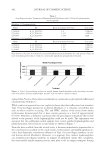
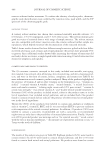
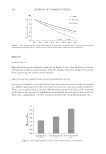
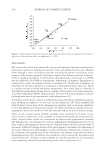
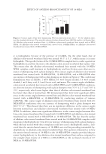
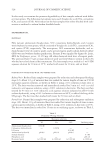
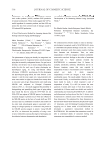
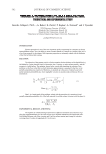
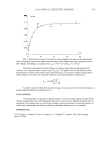
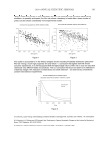
EFFECT OF ANTEISO-BRANCH MOIETY OF 18-MEA 515 moiety of 18-MEA was responsible for maintaining persistent hydrophobicity to alka- line-color-treated weathered hair. The question still remains as to why the anteiso-branch structure of 18-MEA is essential for providing a persistent hydrophobicity to alkaline-color-treated weathered hair sur- faces. In untreated healthy hair, the precise role of 18-MEA remains unclear, but the large segmental volume of the anteiso-moiety is expected to provide molecular mobility and exhibit liquid-like behavior compared with a straight-chain fatty acid (22,23). It is gen- erally accepted that a liquid crystalline membrane is very soft and fl uid. This means that the AFM tip cannot trace the surface of the membrane exactly. It is very diffi cult, there- fore, to analyze the thickness of a liquid crystalline membrane. Investigating the thick- ness of an adsorbed layer as a function of temperature is a useful technique for judging the situation of the layer, whether the layer is solid-like or liquid-like. Here, analysis of the effect of the anteiso branch in the adsorbed membrane by using temperature-controlled AFM was attempted. Figure 4 plots the thickness of the adsorbed layers on the mica sur- faces treated with n-HEA/SPDA and 18-MEA/SPDA conditioners as a function of tem- perature. The thickness of the layer on the mica surface treated with 18-MEA/SPDA conditioner was 1.08 nm at 25°C and increased to 1.39 nm as the temperature reached −10°C, while the thickness of the layer on the mica surface treated with n-HEA/SPDA conditioner was 1.19 nm at 25°C and 1.29 nm at −10°C, showing more stability in the temperature range of 25°C to −10°C. This change is considered to be chiefl y due to the anteiso-branched alkyl chains coagulating upon the transition from the liquid crystalline Figure 3. AFM height images of adsorbed layer on mica surface. Dark areas are mica without sorbed com- pound bright areas are sorbed chemicals from conditioner. The white squares indicate where 1-μm × 1-μm scratching tests were performed by rastering the tip at constant force. (a) n-HEA/SPDA. (b) 19-MEA/SPDA. (c) 18-MEA/SPDA. Figure 4. AFM height images of adsorbed layer on mica surface for 18-MEA/SPDA ( ) and n-HEA/SPDA ( ). The data represent means for n = 5 the whiskers represent the standard deviations.
Purchased for the exclusive use of nofirst nolast (unknown)
From: SCC Media Library & Resource Center (library.scconline.org)