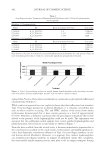
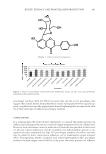
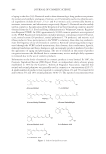
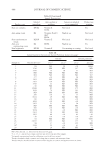
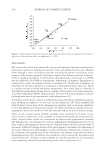
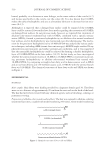
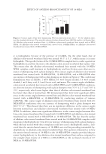
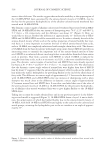
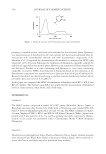
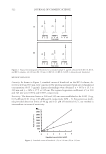
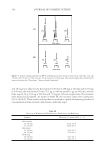
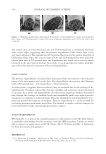
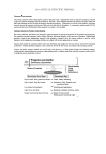
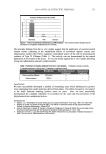
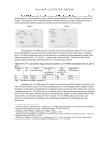
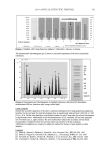
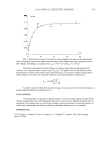
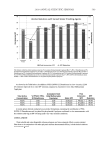
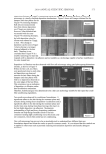
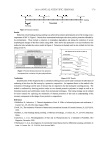
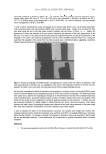
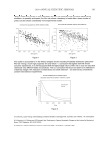
JOURNAL OF COSMETIC SCIENCE 516 state to the solid state. The results suggest that molecular mobility at the upper region of the 18-MEA/SPDA layer, generated by the anteiso-branch moiety of 18-MEA, may be the key for the persistent hydrophobicity of the alkaline-colored-treated weathered hair treated with 18-MEA/SPDA. The dynamic contact angles of alkaline-color-treated weathered hair treated with n-HEA/ SPDA and 18-MEA/SPDA after one instance of shampooing were 76.9° ± 2.5° and 88.0° ± 5.1° (for n = 10), respectively, and the difference was about 11° (Figure 2). Here, we would like to discuss whether the difference of approximately 11° between the n-HEA/ SPDA and 18-MEA/SPDA would be reasonable or not. In order to identify the role of the anteiso-branch moiety of fatty acid on the surface properties of natural healthy hair (nor- mal hair), it is very important to examine the hair in which anteiso-branch fatty acids, such as 18-MEA, are completely substituted with straight-chain fatty acids. The absence of 18-MEA from the hair of patients with maple syrup urine disease (MSUD) provides an interesting route to examine the important role of the anteiso-branch moiety of fatty acid. MSUD is an inherited disease involving failure to metabolize branched-chain amino acids in proteins. Hair from a patient with MSUD in which 18-MEA is replaced by straight-chain fatty acids, such as n-eicosanoic acid (23), is the most suitable for this pur- pose. The dynamic contact angles of normal hair and MSUD hair were already reported by Naito as 91.5° ± 0.7° and 82.5° ± 1.5° (for n = 5), respectively (24). The observation that the dynamic contact angle values of normal hair were higher than that of MSUD hair by about 9° suggested that the anteiso-branch moiety of fatty acids on the surface of hair makes the surface hydrophobic by providing fl uidity at the end of the alkyl chain of fatty acids. The difference in contact angle of approximately 11° between the hair treated with 18-MEA/SPDA and n-HEA/SPDA after one instance of shampooing with a plain shampoo was much closer to the difference in dynamic contact angle of approximately 9° between normal hair and MSUD hair. It was thus concluded that one of the roles of the anteiso-branch moiety of 18-MEA in 18-MEA/SPDA for the persistent hydrophobic- ity of alkaline-color-treated weathered hair was to give higher fl uidity to the 18-MEA/ SPDA layer. Taking into account the results obtained here and in our previous report (14), the follow- ing revised model is suggested (Figure 5). 18-MEA/SPDA forms a layer 1.4 nm in thick- ness, the upper region of which has higher fl uidity due to the anteiso-branch moiety of 18-MEA, with both 18-MEA and SPDA bound tightly to the surface by the carbonyl and amide groups, orienting the hydrophobic part to the air interface at an angle of approxi- mately 35°. Figure 5. Schematic diagram of the cuticle surface of alkaline-color-treated weathered hair treated with 18-MEA/SPDA.

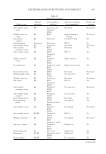
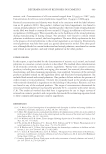
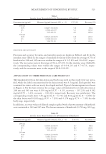
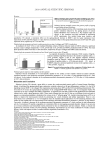
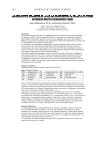
EFFECT OF ANTEISO-BRANCH MOIETY OF 18-MEA 517 CONCLUSIONS The following conclusions are based on the fi ndings reported in this paper: 1. The surface of alkaline-color-treated weathered hair treated with 18-MEA/SPDA complex can maintain its hydrophobicity even after one instance of shampooing with a plain shampoo, while the hair treated with n-HEA/SPDA or 19-MEA/SPDA complex cannot create a hydrophobic surface. The results indicate that the anteiso-branch moiety of 18-MEA is vital for providing persistent hydrophobicity to alkaline-color-treated weathered hair. 2. Characterization of adsorbed layers of 18-MEA/SPDA on a mica surface, as a possible hydrophilic surface model, was performed using AFM, although it might be open to question whether these surfaces behave differently due to the different compositions of these surfaces. The results reveal that the mechanism of the sustainable hydrophobicity of the hair surfaces generated by the anteiso-branch moiety of 18-MEA is that the anteiso- branch moiety of 18-MEA in 18-MEA/SPDA can produce higher fl uidity to the upper region of the 18-MEA/SPDA layer compared to the straight chain of n-HEA in n-HEA/ SPDA or the iso-branch moiety of 19-MEA in 19-MEA/SPDA. Table II Formulation of Conditioners 1 2 3 4 5 6 (control) Stearoxypropyldimethylamine 2 — — — — 2 Dimethylaminopropylstearamide — 2 — — — — Stearyltrimethylammonium chloride — — 2 — — — Docosyldimethylamine — — — 2 — — Stearoxyhydroxypropyldimethelamine — — — — 2 — Benzyl alcohol 0.5 0.5 0.5 0.5 0.5 0.5 Stearyl alcohol 3 3 3 3 3 3 18-MEA 1 1 1 1 1 — Lactic acid 0.3 0.3 — 0.3 0.3 0.6 Water Balance APPENDIX ERRATUM A previous paper (14) by the present authors [H. Tanamachi et al., Deposition of 18-MEA onto alkaline-color-treated weathered hair to form a persistent hydrophobicity, J. Cosmet. Sci., 60, 31–44 (2009)] contained an incorrect representation of Table II. The corrected table is reprinted below: REFERENCES (1) D. J. Evans, J. D. Leeder, J. A. Rippon, and D. E. Rivett, Separation and analysis of the surface lipids of the wool fi ber, Proc. 7th Int. Wool Text. Res. Conf., Tokyo, Japan, I, 135–142 (1985). (2) P. W. Wertz and D. T. Dowing, Integral lipids of human hair, Lipids, 23, 878–881 (1988). (3) P. W. Wertz and D. T. Dowing, Integral lipids of mammalian hair, Comp. Biochem. Physiol., 92B, 759– 761 (1989).
Purchased for the exclusive use of nofirst nolast (unknown)
From: SCC Media Library & Resource Center (library.scconline.org)