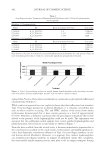
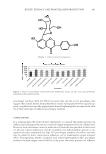
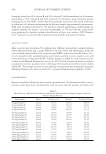
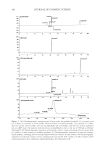
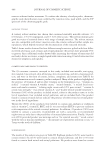
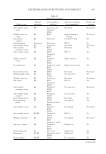
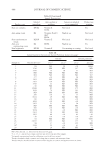
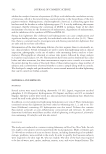
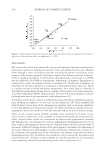
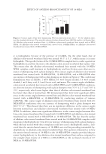
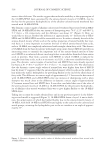
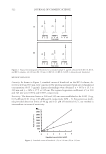
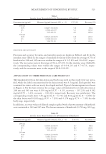
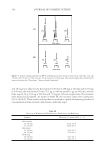
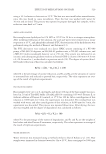
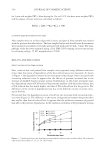
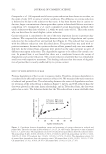
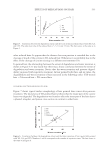
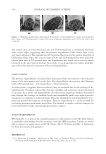
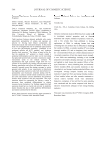
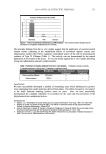
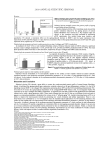
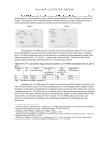
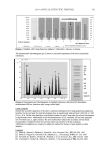
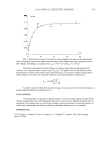
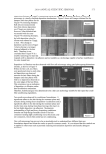
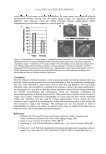
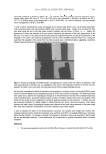
JOURNAL OF COSMETIC SCIENCE 524 Figure 4. Typical chromatograms (on RP-4) of hinokitiol in hair restorer, skin lotion, and body soap. (A) 240 nm (B) 345 nm. (1) Hair restorer (2) skin lotion (3) body soap. The tested samples were diluted with water as described in “Procedures.” Arrowed peak: hinokitiol. and 16.0 μg) was added to the hair restorer (0.50 ml 0.268 mg at 240 nm and 0.251 mg at 345 nm), the skin lotion (10 ml 78.1 μg at 240 nm and 80.2 μg at 345 nm), and the body soap (0.10 g 18.2 μg at 240 nm and 17.8 μg at 345 nm), respectively. The mixtures were diluted and analyzed. As shown in Table III, the recovery values were satisfactory (92.4–104.8%). These results indicate that our method is capable of measuring hinokitiol concentration in hair restorers, skin lotions, and body soaps. Table III Recovery of Hinokitiol in Hair Restorer, Skin Lotion, and Body Soap Samples Recovery (%, mean ± S.D., n = 5) Hair restorer At 240 nm 102.2 ± 6.8 At 345 nm 104.8 ± 6.6 Skin lotion At 240 nm 96.4 ± 6.3 At 345 nm 95.0 ± 6.2 Body Soap At 240 nm 92.4 ± 5.3 At 345 nm 94.6 ± 5.5

MEASUREMENT OF HINOKITIOL BY HPLC 525 CONCLUSION We present a simple HPLC method with dual-wavelength UV detection for determina- tion of hinokitiol, using an RP-4 column. The sensitivity of our method was moderate, but was suffi cient for the measurement of hinokitiol levels in the tested personal care products. REFERENCES (1) J. Nault, A capillary gas chromatographic method for thujaplicins in western red cedar extractives, Wood Sci. Technol., 21, 311–316 (1987). (2) Y. Inamori, S. Shinohara, H. Tsujibo, T. Okabe, Y. Morita, Y. Sakagami, Y. Kumeda, and N. Ishida, Antimicrobial activity and metalloprotease inhibition of hinokitiol-related compounds, the constitu- ents of Thujopsis dolabrata S. and Z. hondai MAK, Biol. Pharm. Bull., 22, 990–993 (1999). (3) Y. Inamori, Y. Sakagami, Y. Morita, M. Shibata, M. Sugiura, Y. Kumeda, T. Okabe, H. Tsujibo, and N. Ishida, Antifungal activity of hinokitiol-related compounds on wood-rotting fungi and their insecti- cidal activities, Biol. Pharm. Bull., 23, 995–997 (2000). (4) E. L. Johnson and A. J. Cserjesi, Gas-liquid chromatography of some tropolone-TMS ethers, J. Chro- matogr., 107, 388 (1975). (5) F. Hanafusa, K. Nakamura, S. Togano, and T. Ohta, Determination of hinokitiol in cosmetic products by HPLC, Bunseki Kagaku, 38, 124–128 (1989). (6) M. Endo, T. Mizutani, M. Matsumura, M. Moriyasu, M. Ichimaru, A. Kato, and Y. Hashimoto, High- performance liquid chromatographic determination of hinokitiol in cosmetics by the formation of di- fl uoroborane compounds, J. Chromatogr., 455, 430–433 (1988). (7) L. Dyrskov, B. W. Strobel, B. Svensmark, and H. C. B. Hansen, Beta-thujaplicin: New quantitative CZE method and adsorption to goethite, J. Agric. Food. Chem., 52, 1452–1457 (2004).
Purchased for the exclusive use of nofirst nolast (unknown)
From: SCC Media Library & Resource Center (library.scconline.org)