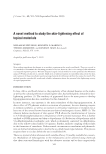
J. Cosmet. Sci., 60, 527–535 (September/October 2009) 527 Enzymatic approach to analyze the effects of mercaptans on hair CHIKARA YAMAUCHI, AKIMASA MOCHIZUKI, KEISUKE TAKAYAMA, SATOSHI SUZUKI, and ATSUSHI SAKAINO, Higashi-Matsuyama Laboratories, Arimino Co. Ltd., 25-5 Miyako, Namekawa-machi, Hiki-gun, Saitama 355-0812, Japan, and WATARU OKAZAKI, Department of Life Sciences, Faculty of Life Sciences, Toyo University, 1-1-1 Izumino, Itakura-machi, Ora-gun, Gunma 374-0193, Japan. Accepted for publication February 11, 2009. Synopsis Different mercaptans were used to prepare reduced hair and permed hair samples. The reduced hair showed much higher protease degradation than the permed hair also, the protease degradability of permed hair in- creased with repetitive treatments. The degradability of reduced hair was closely related to its cystine con- tent, and that of permed hair was nearly unaffected by its cystine content. The degradability of both the reduced and permed hair was related to the reduction power of each mercaptan used on the hair and increased in the following order: CYS-treated hair CA-treated hair TG-treated hair. INTRODUCTION In a permanent wave treatment, the hair-waving technique is a two-step operation involving the breaking of disulfi de bonds in hair using a mercaptan, and then regenerat- ing these bonds using an oxidizing agent (1). To evaluate the effect of mercaptans, many studies have been conducted (2–5). Morphologically, hair consists of a cuticle layer that envelops the fi brous hair cortex, constituting the bulk of the fi ber (6). The cortex mainly consists of two types of proteins: about 60% of intermediate fi lament proteins and about 40% of interfi brillar-associated proteins, traditionally called microfi bril (Mf) and matrix (Ma), respectively. The Mf is crystalline protein that is mainly composed of an α-helical protein with low cystine, and the Ma is an amorphous globular protein with high cystine (7,8). Recently, some investigators examined the effect of permanent waving on hair using a biochemical method, and reported interesting fi ndings about structural change in hair protein (7,9). We have also reported the correlation between the extent of protease degra- dation and the frequency of TG permanent wave treatments (10). Additionally, we showed that the degradation is closely related to the denaturation of Mf protein (10,11).
Purchased for the exclusive use of nofirst nolast (unknown)
From: SCC Media Library & Resource Center (library.scconline.org)