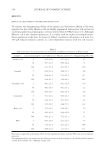
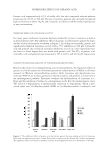
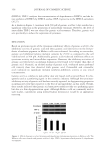
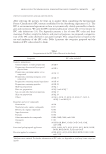
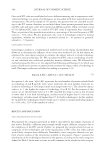
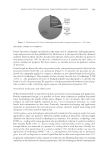
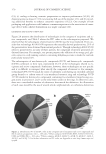
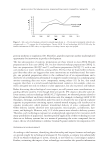
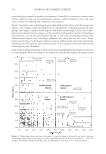
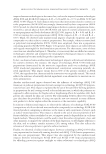
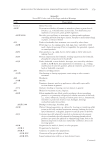
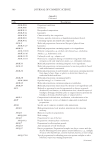
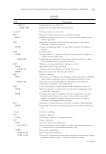
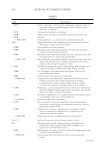
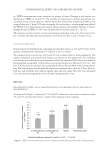
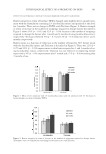
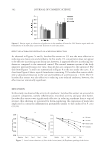
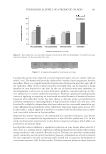
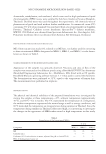
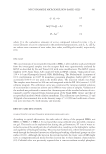
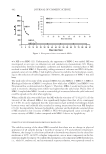
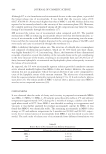
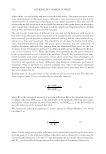
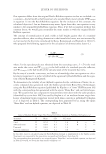
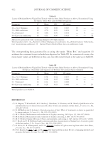
JOURNAL OF COSMETIC SCIENCE 368 Once each IPC code was established to have a different meaning and to represent an indi- vidual technology or a group of technologies, we proceeded with their quantifi cation and interpretation. Out of the sample of 335 patents, two patents were not classifi ed accord- ing to the IPC system, therefore, we excluded them. Some patents presented more than one IPC code and some codes were repeated in different patents. Then, we found a total of 341 different IPC codes or a total of 876 IPC codes if repetitions were considered. Thus, we presented the quantifi cation results as a percentage of the total frequency of IPC codes (n = 876 codes). We also presented a life cycle of technologies related to natural ingredients, whether the technology is primarily related (n = 45 patents) or generally related (n = 72 patents). CROSS-IMPACT ANALYSIS Cross-impact analysis is a mathematical model based on the theory of probability that allows us to determine the infl uence of one event over another (9,14). In this survey, we employed the cross-impact analysis to calculate the impact index of a certain technology “A” over a certain technology “B.” We considered each IPC code as a technology of inter- est and calculated the conditional probability between different codes. We followed the method proposed by Choi et al. (9), adapted from Blanning and Reinig’s (14), which uses patent classifi cation systems to quantitatively estimate the impact index of technology A on B. The impact index was calculated according to equation 1 (9). Impact A,B B| A n A B /n A p (1) In equation 1, the term “ n A B ” represents the total number of patents included both in technology A and B and the term “ n A ” represents the total number of patents in- cluded in technology A. The impact index score ranges from 0 to 1. The closer the impact index is to 1, the higher the impact of technology A on B (9). For the purpose of this survey, we set the threshold value at 0.5. We classifi ed the impact scores as low (if equal or lower than 0.5 for both technologies), unidirectional (if higher than 0.5 for only one technology), or bidirectional (if higher than 0.5 for both technologies). In this analysis, we excluded the technologies observed only once to avoid occasional misleading impacts (n = 109 codes, 32% of the number of codes). RESULTS AND DISCUSSION THE CATEGORIZATION OF IPC CODES We proposed the categories presented in Table I especially for the sample of patents of this survey. Possibly, a different patent sample would require different categories due to the complexity of the IPC system. Further, we proposed the categories based on our as- sumptions of the technologies and of the organization of IPC codes, but other authors would likely compose them differently. Nonetheless, these categories allowed us to per- form a better analysis of the information available in the patents. Figure 1 presents the distribution of the technologies observed in the patents, according to the main categories defi ned in Table I. In the next sections, we will comment on the results for each category.

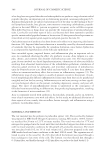
HOW COULD TECHNOLOGICAL FORECASTING HELP COSMETIC CHEMISTS 369 PROCESSES APPLIED TO COSMETICS Patent literature is highly specialized in the many uses of compounds, although prepara- tions and processes are also published (10). However, it is also reported that the chemical industry will less likely disclose detailed descriptions of processes, whether in patent or non-patent literature (10). In this case, industrial secrecy is usually the fi rst choice to protect intellectual property. For these reasons, we decided to focus on products instead of processes. Even though we fi ltered for skin care products only, some patents presented claims for the processes involved with the core innovation (Figure 1). In general, the processes we ob- served are commonly applied to cosmetics, whether or not adapted from food and phar- maceutical technologies. One example in this category was the use of technology C12P 21/04, i.e., the preparation of cyclic or bridged peptides or polypeptides, to describe the bond of a self cell-penetrating Tat peptide to a human parathyroid hormone-derived pep- tide in order to offer a slimming agent superior cell-penetration properties (15). FUNCTIONAL PACKAGING AND APPLICATORS Other elements liable to innovation in skin care products are packaging and applicators. Besides ornamental design, it is possible to devise these elements to perform functional roles. Considering the results of this survey (Figure 1), we can observe that such tech- nologies are still only slightly explored. In fact, even in non-patent literature, we could barely fi nd information on this issue. Certainly, functional packaging and applicators represent an opportunity for innovation and cosmetic chemists should work along with designers to elucidate possible approaches. At fi rst glance, some technologies observed and included in this category might not seem applicable to skin care products. However, further analysis of the patent contents might illustrate the function of such technologies in cosmetics. For instance, technology class F25D, i.e., cooling or freezing apparatus, has no immediate relation to cosmetic products. But subclass F25D 3/00, i.e., devices using other cold materials or devices using cold- storage bodies, was observed in a patent of a cooling device with the aim of locally im- proving the skin penetration of a cosmetic product (16). Another similar case was the application of technology B43K 7/10, i.e., arrangements for feeding ink to ball-point pens, in a roll-on dispenser to control liquid fl ow and to offer more equivalent doses (17). In general, technologies in this category are related to the following functions: (a) avoiding oxidation or deterioration of cosmetic preparations (18), (b) avoiding microbial contamination Figure 1. Distribution (%) of the technologies in the main categories proposed. n = 876 codes.
Purchased for the exclusive use of nofirst nolast (unknown)
From: SCC Media Library & Resource Center (library.scconline.org)