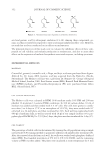
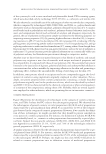
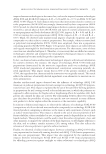
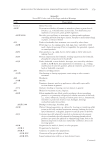
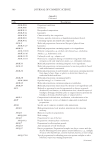
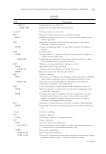
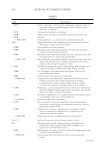
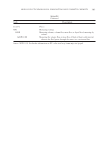
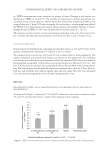
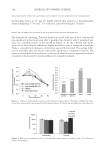
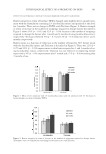
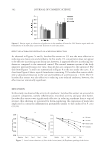
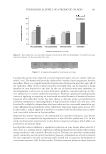
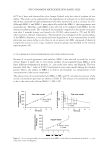
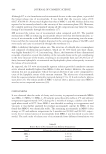
JOURNAL OF COSMETIC SCIENCE 370 (19), (c) cooling or heating cosmetic preparations to improve performance (16,20), (d) dispensing precise doses (17,18), (e) ensuring full use of the product (21), and (f) provid- ing additional benefi ts to enhance consumer experience (16,22). One example of how packaging and applicators could enhance consumer experience is the association of a mas- sage device with a shower formulation in a single container (22). EXCIPIENTS AND ACTIVE COMPOUNDS Figure 2A presents the distribution of technologies in the category of excipients and ac- tive compounds, and Table I relates the IPC codes to the subcategories proposed. We observed that the subcategory of preservatives (A01N) was the most explored. If we con- sider that technology A01N 65/00 represents the naturally derived preservatives, 25% of the preservatives were obtained from natural products. Though technology A01N 65/00 refers to preservatives, in some of these patents, the compound of interest presented ad- ditional functions. For example, one patent proposes the addition of an orange peel gly- colic extract to a self-tanning cosmetic containing dihydroxyacetone to make the tan look particularly natural (23). The subcategories of non-heterocyclic compounds (C07C) and heterocyclic compounds (C07D) combined, in their turn, represented 26.1% of the technologies related to ex- cipients and active compounds. Sometimes, however, these technologies are not specifi c and it is diffi cult to interpret what exactly the compound of interest is. For example, technology C07C 69/76 stands for esters of carboxylic acids having an esterifi ed carboxyl group bound to a carbon atom of a six-membered aromatic ring and technology C07D 317/08 stands for heterocyclic compounds containing fi ve-membered rings having oxy- gen atoms in positions 1 and 3 as the only hetero atoms in the rings. In these two cases, there are a considerable number of substances that match the defi nition. An illustration of such cases would be the use of several amide, sulphonamide, or carbamate derivatives Figure 2. Distribution (%) of the IPC codes in the categories (A) of excipients and active compounds and (B) of cosmetic preparations. (A) n = 188 codes. *Others comprise A61P, B32B, B60C, C01B, C07F, C07G, C08J, and C08K. (B) n = 644 codes. *Others comprise A61K 6, A61K 35, A61K 39, A61K 47, A61L 9, A61Q 3, and A61Q 15. For further information on IPC codes, see Appendix or visit http://www. wipo.int/ ipcpub.

HOW COULD TECHNOLOGICAL FORECASTING HELP COSMETIC CHEMISTS 371 of the cyanoacrylic acid as new uncolored and photostable broad-UVA screening agents, which were described only by technology C07C 255/00, i.e., carboxylic acid nitriles (24). We also observed a considerable use of the subcategory of other macromolecular compounds, which is comprised by technologies C08B, C08F, C08G, and C08L, i.e., polysaccharides and derivatives (such as chitosan-thio-amidine), polymers obtained by reaction of C–C unsatu- rated bonds (such as polyethylene and acrylates), polymers obtained otherwise (such as silox- anes), and compositions thereof (such as blends of acrylates and siloxanes), respectively. In general, the use of polymers in this patent sample was related to the following purposes: (a) improving sensory properties (25), (b) granting higher adhesion to the skin (26), (c) improv- ing resistance to pH (27) and to electrolytes (28), (d) increasing (29) or reducing (30) the gelling power, (e) promoting powder surface treatments (31), (f) encapsulating (32), and (g) replacing surfactants in surfactant-free formulations (27), among others. Even though these functions may be well-characterized in non-patent literature, such as the use of polymers as surfactants (33), patent literature provides updated information on economically viable uses of polymers and may lead formulation practitioners through a competitive market. Another issue we know from non-patent literature is that blends of synthetic and natural polymers may originate a new class of materials with unique mechanical properties and biocompatibility, if compared with those of neat polymers (34). One example from patent literature is the association of alginate, poly(vinyl alcohol), and carboxymethylcellulose in concentrations that reduce wrinkles by improving adhesion to the skin and promoting a tightening effect, without the uncomfortable feeling of stretching out the skin (35). In addition, some patents related to excipients and active compounds suggest the devel- opment of cosmetics using ingredients originally employed in other industries. For ex- ample, one patent proposed some cosmetic preparations containing a volatile branched polysiloxane originally used in the production of tires, which was described by technol- ogy B60C 1/00 (tires characterized by the chemical composition or physical arrangement, or a mixture of the composition), among others (36). Probably, there are several ingredi- ents employed in other industries, which are promising for use in innovative cosmetics. COSMETIC PREPARATIONS Figure 2B presents the distribution of technologies in the category of cosmetic prepara- tions, and Table I relates the IPC codes to the subcategories proposed. We observed that the subcategories of general cosmetic or toilet preparations (A61K 8) and of preparations characterized by a special physical form (A61K 9) accounted for 41.9% of the technolo- gies observed in the category of cosmetic preparations. However, if we consider the defi ni- tion of these technologies, we might conclude that they should be present somehow in every patent of a cosmetic preparation. For instance, the defi nition of subclass A61K 8/02 is considerably broad, i.e., cosmetic or toilet preparations characterized by a special phys- ical form. Indeed, the non-specifi c subclasses A61K 8/00, A61K 8/02, and A61K 8/18 (see Appendix) accounted for 23.1%, 32.9%, and 7.8% of the technologies related to general preparations (A61K 8), respectively. A similar situation is observed for the subcategory of preparations characterized by a spe- cial physical form (A61K 9). For instance, subclass A61K 9/00 (medicinal preparations characterized by a special physical form) accounted for 25.9% of the technologies related to this subcategory (A61K 9). Perhaps, one might say that class A61K 9 should not be related to cosmetic preparations once its defi nition consists of medicinal preparations
Purchased for the exclusive use of nofirst nolast (unknown)
From: SCC Media Library & Resource Center (library.scconline.org)