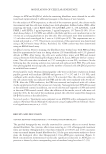
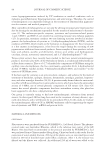
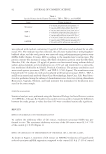
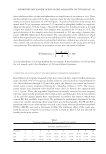
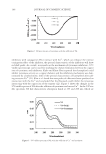
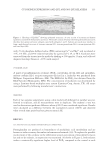
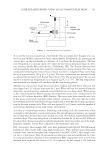
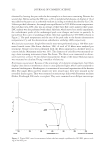
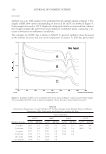
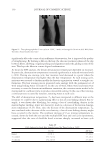
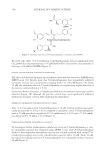
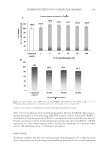
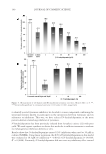
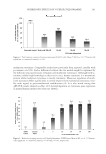
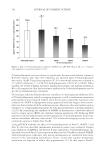
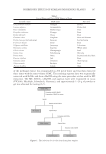
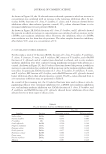
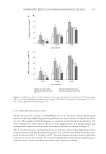
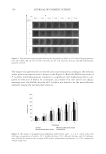
JOURNAL OF COSMETIC SCIENCE 122 obtained by leaving the pan with the hair sample in a dessicator containing Drierite for several days. Before sealing the DSC pan, a 200 cp polydimethylsiloxane oil droplet of 10 μl was added to the pan to act as a thermal medium according to method described by Cao (7,8). Unless specifi ed otherwise, the sample was equilibrated at 58% RH at room temperature. For each hair tress, DSC data was an average of three heat fl ow curve analyses (three pans). DSC analysis was also performed with ethnic Afro hair, which served as a model experiment the endothermic peaks of the undamaged peak were sharper and easier to quantify. A typical heat fl ow curve of undamaged ethnic Afro hair equilibrated at 58% RH is shown in Figure 2. The peak temperature and the area of the peak refer to the keratin denaturation temperature (Td) and the denaturation endothermic enthalpy (ΔH), respectively. Wet elasticity measurement. Single-fi ber tensile tests were performed using a 100-fi ber auto- mated tensile tester (Dia-Stron, Andover, UK). A total of 50 fi bers were analyzed per treatment. Tensile tests were performed with the fi bers immersed in distilled water in cassette holder. Maximum strain was 10%. The diameter of each fi ber was measured us- ing a laser-scanning instrument from Dia-Stron. The fi bers were immersed in deion- ized water for at least 30 min before measurement. Slope of the linear Hookean region was measured to calculate Young’s modulus of elasticity. Birefringence measurement. Because of the anisotropy of its keratin arrangement, hair fi bers display clear distinct interference colors in cross-polarized light, which can be analyzed to measure birefringence. Birefringence is a measure of structural organization of the keratin fi ber. The single fi bers used for tensile test were reused since they were strained in the reversible linear region. They were mounted on microscope slides with Permount medium (Fisher, Pittsburgh, PA) and a cover glass. They were examined on an Eclipse microscope Figure 2. Typical DSC curve for an untreated ethnic afro hair sample equilibrated at 58% RH, prior to seal- ing of the DSC pan.

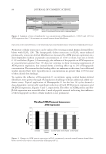
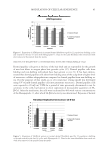
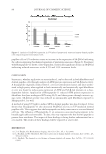
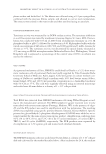
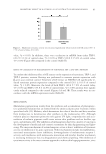
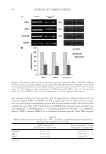
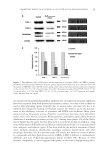
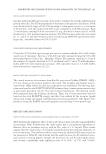
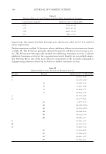
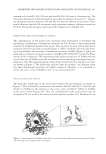
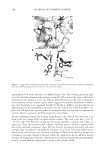
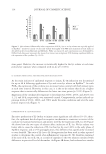
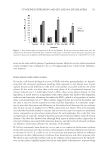
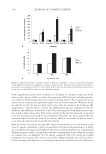
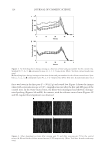
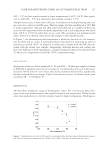
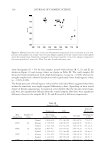
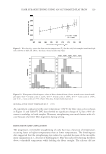
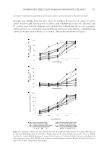
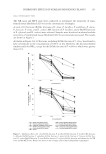
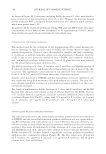
HAIR STRAIGHTENING USING AN AUTOMATED FLAT IRON 123 (Nikon, Melville, NY) using cross-polarized illumination and the method described by McCrone et al. (12). The fi ber was oriented 45° to the vibration direction of the crossed polars to obtain the brightest interference color. The main interference colors were observed close to the center axis, which were then compared to a Michel–Levy chart to obtain the value of retardation (optical path difference). The retardation and fi ber thickness were related to the birefringence according to the following equation: λ = 1000 × t × (Δn) where λ is the retardation in nm, t is the fi ber diameter in micron, and Δn is the birefrin- gence. About 40 to 50 fi bers were examined for each treatment. Statistical analysis was performed using Minitab software. RESULTS EFFECT OF MOISTURE ON THERMAL α-KERATIN DENATURATION The denaturation temperature and the enthalpy as a function of initial humidity during sample equilibration are shown in Table I for undamaged ethnic Afro hair. The denatur- ation temperature decreased as moisture increased, which is consistent with the data of Cao and Leroy for Caucasian hair (8). In contrast, the value of denaturation enthalpy did not vary signifi cantly. When the matrix keratin was plasticized by water, the denatur- ation transition of the crystalline α-keratin microfi laments occurred at lower tempera- tures. In the next sections, the initial moisture of the hair tresses was controlled by placing them in a 90% RH chamber before ironing. STRETCHING FORCE Curly hair was treated as described in the section Multiple Iron Cycles Protocol. Stretching force was recorded as a function of time at each pass. Figures 3A and B represent the stretching force through one ironing cycle for samples treated with water and silicone, respectively. In the water-treated sample, the force was higher in the fi rst pass (F = 130 ± 6 g) and decreased as the hair fl attened. In the sample treated with silicone, the stretching Table I Denaturation Temperature, Td and Enthalpy, ΔH as Function of Initial RH of the Hair Sample (Equilibration) for Ethnic Afro Hair Sample Equilibrated at Different RHs Initial RH (%) Td (°C) ΔH (J/g) 0 213.2 ± 2.2 5.0 ± 1.6 21 186.0 ± 0.1 5.3 ± 0.3 33 181.7 ± 0.3 6.7 ± 0.6 43 180.0 ± 0.3 5.3 ± 0.4 58 177.1 ± 0.4 5.0 ± 0.5 75 167.6 ± 0.4 5.1 ± 0.3 86 166.6 ± 1.8 5.5 ± 0.4 97 163.5 ± 0.4 4.6 ± 0.8
Purchased for the exclusive use of nofirst nolast (unknown)
From: SCC Media Library & Resource Center (library.scconline.org)