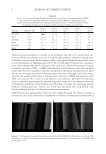
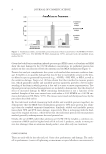
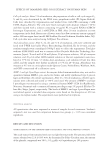
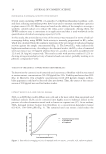
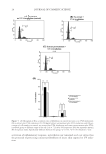
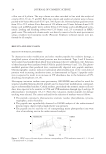
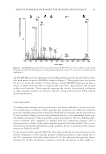
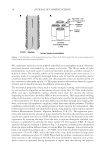
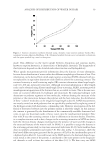
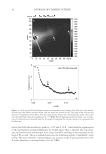
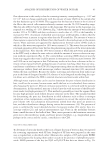
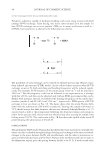
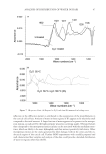
JOURNAL OF COSMETIC SCIENCE 38 (IFs, sometimes referred to as microfi bril) embedded in an amorphous matrix of keratin- associated proteins cross-linked by the amino acid cystine. The IFs are made of eight protofi laments, each with a pair of coiled-coil α-keratin molecules, and thus contains 32 α-helical chains. The medulla, which can be sometimes found in the cross section, is a structure made of incompletely developed hollow cells. IF and the surrounding matrix constitute about 85% of the hair shaft, but the properties of hair are determined by all the constituents that make up hair (3). This paper presents observations about the ingress of water and its distribution into the different structures of hair. The mechanical properties of hair, such as tensile strength, bending, and torsional rigid- ity, are sensitively dependent on the amount of water in the fi ber (4). Hair, with a hydro- philic core and a hydrophobic surface, absorbs water from the vicinity, the amount depending on the relative humidity (RH) of the environment. The longitudinal swelling of hair with moisture content is the basis of hygrometer used for the measurement of RH in the environment (2). Water molecules diffuse into the fi ber through intercellular path- ways, such as the cell membrane complexes, rather than transcellular pathways. The fi ber equilibrates rather slowly to the partial pressure of water vapor in the environment. This behavior has been studied and quantifi ed in detail, using dynamic vapor sorption analyzer (Surface Measurements Systems, Alperton, Middlesex, U.K.) (5). This apparatus gravi- metrically determines the amount of water absorbed by hair from the moisture surround- ing the hair sample as a function of RH. Desorption data can also be obtained in the same experiment by reversing the steps. From the data, a sorption–desorption isotherm com- bination is generated by plotting the water uptake (% w/w) against %RH. A typical sorption–desorption isotherm is shown in Fig. 2. A sorption isotherm gives information about the water held in different forms at varying RHs. For example, water is held in the form of an adsorbed monolayer up to ~20 %RH, in the form of adsorbed multimolecular layers from ~20 to 65 %RH, and in the form of free water held in relatively large pores (capillary condensation) above 65 %RH. Water held by capillary condensation leads to a sharp increase in the swelling of the fi ber. For most hydrophilic materials such as hair, water content as measured during desorption is higher than that during the sorption Figure 1. (A) Schematic of the longitudinal section of hair shaft, (B) A model for the internal organization of the keratin molecules in the microfi bril.

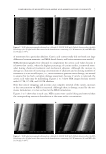
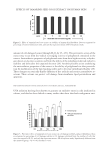
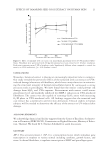
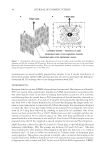
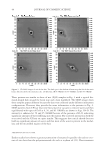
ANALYSIS OF DISTRIBUTION OF WATER IN HAIR 39 mode. This difference in the water uptake between desorption and sorption modes, known as sorption hysteresis, is characteristic of hydrophilic materials. The magnitude of this hysteresis depends on the detailed molecular structure and hydrophilicity. Water uptake measurements provide information about the kinetics of water absorption, but not about distribution of water within the different morphological features of hair. This information can be derived from small-angle neutron scattering (SANS) obtained with wa- ter replaced by its equivalent deuterium oxide (D2O) to achieve the scattering contrast. The scattered intensity at small scattering angles (2θ) contains information about large length- scale (10–100 nm, mesoscale) structures. Although structural information at these length scales can be obtained using X-rays (small-angle X-ray scattering, SAXS), neutrons provide unambiguous interpretation of the features that are accessible to water. This is because neu- trons are scattered differently by hydrogen and deuterium. By replacing hydrogen with deuterium on polymer segments or host molecules, without altering the structure of the polymer or the interactions between the polymer and the host molecules, the distribution of these “colored” molecules can be imaged at large length scales (6). SANS measurements are mostly carried out with polymers that are specifi cally synthesized by replacing some of the hydrogen atoms with deuterium, a demanding task. However investigation of the dif- fusion of deuterated solvents into the polymer matrix is relatively simple. In this instance the contrast is generated by the distribution of the commercially available deuterated sol- vents, in our case deuterium oxide or heavy water, into the nondeuterated polymer. Note that with X-rays the scattering contrast is due to differences in electron density. Therefore, in a complex structure such as hair, changes in the scattering intensities in SAXS are due to both the electron density changes resulting from the presence of water and the changes in the structural features of the matrix itself. In SANS, it is possible to assign the features in the scattering pattern solely to structures associated with water (D2O). Such work has been done on synthetic polyamides and starch (7,8). The data in Fig. 3, for instance, show the four broad diffraction spots generated by the presence of D2O in the interlamellar spaces of a hydrated nylon fi ber (9). A second feature in the SANS pattern, the diamond-shaped equa- torial streak at the center of the pattern, is attributed to the water present in the longitudi- nal channels as well as from the surfaces of the fi ber (10,11). We here carry out SANS Figure 2. Sorption–desorption isotherm obtained using a dynamic vapor sorption analyzer (Surface Mea- surements Systems, Alperton, Middlesex, U.K.). Diamond symbols (bottom curve) corresponds to absorption and the square symbols (top curve) to desorption.
Purchased for the exclusive use of nofirst nolast (unknown)
From: SCC Media Library & Resource Center (library.scconline.org)