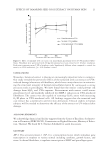
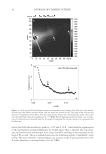
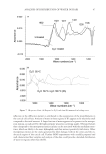
JOURNAL OF COSMETIC SCIENCE 4 (16.75 g of a 32 wt% solution in water) was added dropwise with stirring, and the resulting mixture was stirred for 10 min at which time 25% aqueous NH3 or MEA (amount indicated in Table I) was added. Water was added so that total weight equaled 500 g. The resulting mixture was stirred for 10 min. Procedure for bleaching tress and rinse/wash cycle. To a plastic weigh boat was added 3 g of dyeless chassis and 3 g of 20 volume Welloxon® developer (6% H2O2). The two gels were mixed thoroughly and the pH was measured [Mettler Toledo SevenEasy™ pH meter S20 (Columbus OH)] before applying to the desired 1.5 g hair tress. After uni- formly applying the mixture to the tress, the hair was placed in a covered weigh boat and incubated in a 30°C oven for 30 min. After completion of the incubation period, the hair was removed from the oven and rinsed for 2 min (37 ± 2°C water at a fl ow rate of 1.0 ± 0.2 gal/min), shampoo (0.15 ml per tress) was added and massaged into the hair for 30 s followed by a 30-s rinse (massaging hair once in every 2 s). On completion, the hair was dried using a blow dryer on high heat/high air fl ow for 3 min (1 min per side + 1 min combing). Shampoo/conditioner cycles. The tresses were subjected to additional treatments with Pantene® Fine Hair Solutions Flat to Volume shampoo and Pantene® Classic Conditioner. One complete cycle was performed as follows: • The hair was wetted (37 ± 2°C water at a fl ow rate of 1.0 ± 0.2 gal/min) for 30 s. • Shampoo (0.1 ml/g hair) was applied and the hair was massaged thoroughly for 30 s. • The hair was rinsed (massaging every other second) for 30 s, blotted with a towel, and blown dry (high heat/high air fl ow) for 3 min (1 min each side with fi nger pressing fi nal minute brushing with hair brush). • The hair was again wetted (37 ± 2°C water at a fl ow rate of 1.0 ± 0.2 gal/min) for 30 s. • Shampoo (0.1 ml/g hair) was applied and the hair was massaged thoroughly for 30 s. • The hair was rinsed (massaging every other second) for 30 s. • Immediately after the second shampoo rinsing, conditioner (0.1 ml/tress 1.5 g tresses) was applied for 30 s and rinsed for 30 s (massaging every 2 s). • The hair was patted dry with a towel before being blown dry (high heat/high air fl ow) for 3 min (1 min each side with fi nger pressing fi nal minute brushing with hair brush). The above steps were repeated an additional 17 times for a total of 18 cycles after each bleaching treatment. Cysteic acid determination. Cysteic acid readings were obtained on a Perkin Elmer Spectrum 100 FT-IR (Waltham MA) with universal attenuated total refl ectance (UATR) sampling accessory immediately following bleaching as well as after the wash cycles. The hair tress was fastened onto the baseplate of the UATR and was twisted three rotations, then 70 N was applied by means of a piston. The collected absorbance spectrum is normalized by setting the highest peak between 1000 and 2000 cm−1 to 1.5 AU. The invariant 1450 cm−1 peak is set to zero AU and the second derivative of the normalized spectrum is taken. The second derivative of the 1040 cm−1 peak (cysteic acid, S=O stretch) is multi- plied by −104 to give the cysteic acid value. Four measurements were taken and the arithmetic mean of those measurements was calculated to give the output reading. The process was performed on four locations along the length of the hair tress. Values reported

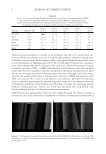
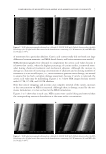
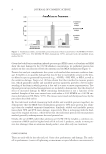
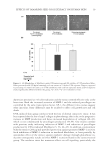
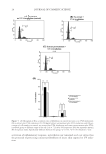
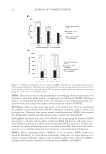
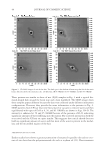
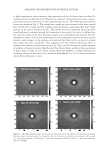
COMPARISON OF MONOETHANOLAMINE AND AMMONIA HAIR COLORANTS 5 are the arithmetic mean of all measurements of the four output readings for each bleach- ing cycle. Scanning electron microscope (SEM) analysis. SEM images were obtained using a Hitachi S- 3000N Scanning Electron Microscope with Oxford detector (Schaumburg, IL), at 500× magnifi cation. The hair tress was separated with a wooden applicator stick so that ca. 70 fi bers were lifted from the bulk of the tress. The fi bers were cut and laid onto a 15 mm × 15 mm SPI aluminum mount that was coated with an adhesive polymer. Loose hair fi bers were removed with tweezers and the ends of the fi bers were cut and affi xed to the disc with a carbon coating. The disc was allowed to dry for 5 min before placing it in the SEM sample chamber for analysis. SEM analysis was performed under low pressure (50 Pa) at 500× magnifi cation examining ca. 50 hair fi bers for cuticle damage. Preparation of samples for protein loss analysis. To a plastic weigh boat was added 3 g dyeless tint (0.82 M MEA or NH3 chassis) and 3 g of 20 volume Welloxon® developer. The two gels were mixed thoroughly before applying to a 1.5 g light brown hair tress. After uni- formly applying the mixture to the tress, the hair was placed in a covered weigh boat and incubated in a 30°C oven for 30 min. After completion of the incubation period, the hair was removed from the oven and rinsed for 2 min (37 ± 2°C water at a fl ow rate of 1.0 ± 0.2 gal/min), shampoo (0.15 ml per tress) was added and massaged into the hair for 30 s followed by a 30 s rinse (massaging the hair once in every 2 s). On completion, the hair was dried using a blow dryer on high heat/high air fl ow for 3 min (1 min per side + 1 min combing). Protein loss measurements. Protein loss analysis was performed on hair tresses after a single bleaching cycle using a modifi ed Lowry Assay against a porcine gelatin standard (8), for both the soluble and the insoluble fractions. Hair samples (0.2–0.3 g) were added to scintillation vials. Water was added at a ratio of 10 ml water per gram of hair. Samples were shaken for 1 h at 2500 rpm on a DVX-2500 Multi-2 Vortexer platform (Radnor, PA). For direct measurement of protein, samples were subjected to centrifugation at 14,000 rpm to separate the soluble/insoluble fractions. Pelleted material (insoluble) was solubilized in 3 M urea, 1 M NaOH, 0.06% 3-[(3-cholamidopropyl)dimethylammonio]- 1-propanesulfonate followed by sonication for 30 min in a Branson B300 sonicating water bath (34 kHz) (Danbury, CT). Four replicates were done per sample, and the reported values are the arithmetic mean of the four individual values. RESULTS AND DISCUSSION Given that MEA–peroxide is less effective for lightening hair than ammonia–peroxide at equimolar concentrations, we were interested in beginning to quantitate other trade-offs associated with its use. When hair is subjected to oxidative conditions and damage is expected, it is common to measure cysteic acid levels to quantitate that damage. How- ever, this can be somewhat misleading in cases in which other damage pathways exist, and in which cuticle is removed. Because our desire was to have a more complete idea of damage for Level 3 oxidation dye formulations containing MEA versus ammonia, we also used SEM as a damage measure, and for the potentially most extreme examples of high alkalizer concentration, we incorporated protein loss methods that have been successfully used for hair color product damage measurements (9).
Purchased for the exclusive use of nofirst nolast (unknown)
From: SCC Media Library & Resource Center (library.scconline.org)