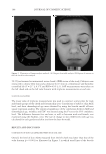
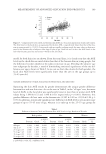
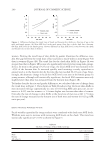
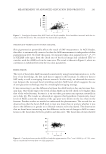
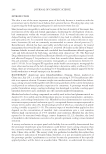
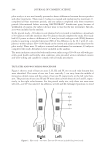
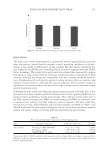
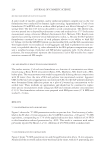
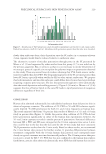
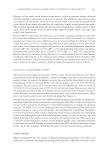
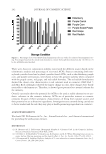
JOURNAL OF COSMETIC SCIENCE 208 pilot study so it was not formally powered to detect differences between the test product and other treatments. There were 12 subjects screened and randomized to treatment 11 completed all four treatment periods, and one subject completed only three treatment periods (discontinued before receiving BACTROBAN® disinfectant spray because of withdrawal of consent, the subject did not want to wait for the last treatment). All sub- jects were included in the analysis. In the pivotal study, ~60 subjects were planned to be screened to randomize a maximum of 50 subjects with the intention that 45 subjects should complete the study. The study had 85% power to detect a difference of 12 mm [in visual analogue scale (VAS)] between products assuming a standard deviation (SD) of the difference to be 26.1 with 45 com- pleters ( within-subject SD = 18.46 based on the review and analysis of the data from the pilot study). There were 50 subjects screened and randomized to treatment 49 subjects completed the study. All subjects were included in the analysis. The main inclusion criteria for both studies were subjects aged 18–60 year old with gen- erally good health and healthy skin condition, who provided written informed consent and were willing and capable to comply with all study procedures. TEST SITES AND WOUNDING PROCEDURE Figure 1 shows a total of four test areas: I, II, III, and IV, two on each volar forearm that were identifi ed. The center of test site I was vertically 5 cm away from the middle of transverse cubital crease and the center of test site II, respectively, in the left volar fore- arm. The positions of test sites III and IV were identical with those of site I and II, respec- tively, in the right volar forearm. For the pivotal study site, only three test areas were selected—site IV was omitted. In addition, sites II and III exchanged positions to avoid Figur e 1. Pilot study - test areas. Test area IV was not included for pivotal study.

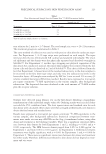
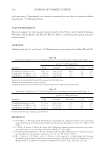
EVALUATE SKIN DISINFECTANT SPRAY 209 the application of two products, and the subsequent sensory assessment occurring con- secutively on the same forearm, therefore, reduces interference between products. Each superfi cial wound was created by a sequential removal of the stratum corneum layers using the Corneofi x® tape (2 × 1.95 cm) until a clear glistening layer was visualized (at least 40 times). The TEWL measurements were taken after wound creation and before test product application. The procedure was conducted in all four test areas for the pilot study and three test areas for the pivotal study except the TEWL measurements. The sequence of wounding was I, II, III (and IV, pilot study only), and the sequence of allocation of product to each test site was randomized. FORMULATIONS AND BLINDING For both studies, the test product was a prototype disinfectant spray containing 0.13% benz- alkonium chloride and 1% menthol derivatives (menthone glycerin acetal). The reference product was the BACTROBAN® disinfectant spray (0.13% benzalkonium chloride) sourced from a market place in China. The negative control was 0.9% w/v sodium chloride solution (saline) (China Otsuka Pharmaceuticals Co., Ltd., Foshan, China). The pilot study also in- cluded a positive control (70% v/v isopropyl alcohol) this was not included in the pivotal study. The active ingredient, batch number, and expiration date of the test products are pro- vided in Table I. The sequence of product applications on wound sites (I, II, II, and IV for the pilot study and I, II, and III for the pivotal study) was randomly assigned to each subject. There were eight different sequences in the pilot study and six different sequences in the pivotal study. The randomization schedule was generated using a computerized randomization generator and provided to the site by the GSK Biostatistics Department. In the pilot study, a square fi lter paper (1.8 × 1.8 cm) (Courage + Khazaka electronic GmbH, Köln, Germany) saturated with each product was applied and left on each test Table I The Active Ingredient, Batch Number, and Expiration Date of Test Products Product Ingredients Batch No. Use By Prototype disinfectant spray 0.13% Benzalkonium chloride (active) RDMF0024B01 May 6, 2014 Menthone glycerin acetal (active) Polysorbate 20 Edetate disodium dihydrate Propylene glycol Sodium bicarbonate Purifi ed water BACTROBAN® disinfectant spray 0.13% benzalkonium chloride (active) BDB130104 January 24, 2015 Polysorbate 20 Edetate disodium dihydrate Propylene glycol Sodium bicarbonate Purifi ed water 0.9% w/v sodium chloride solution 0.9% w/v sodium chloride 1H73G1 July 1, 2016 Aqua 70% v/v isopropyl alcohol 70% v/v isopropyl alcohol 1BI0808 August 31, 2014 Aqua
Purchased for the exclusive use of nofirst nolast (unknown)
From: SCC Media Library & Resource Center (library.scconline.org)