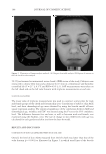
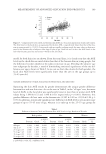
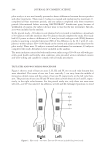
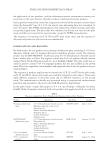
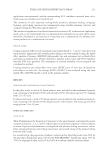
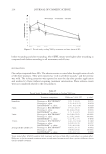
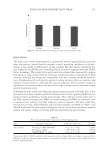
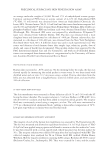
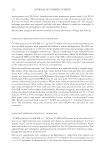
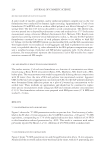
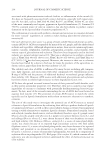
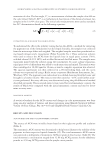
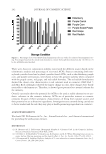
JOURNAL OF COSMETIC SCIENCE 198 50.25 [see footnote for institutional review board’s (IRB) review of the study]. Subjects were instructed to cleanse their skin and acclimatize for 15 min in a temperature and humidity controlled lab (T = 21° ± 0.5°C and RH = 45% ± 1). SAF measurements were taken on the left cheek and on the left volar forearm with triplicate measurements on each site. STATISTICAL ANALYSIS The mean value of triplicate measurements was used to construct scatter plots for male and female groups of the cheek and forearm skin sites. Correlations of subjects’ skin AGE level, and their chronological age were obtained by using the best-fi t model of least- square regression analysis. The statistical signifi cance of the correlations between AGE and chronological age, wrinkles, and ITA° was assessed using the F-test at the 95% confi dence level. The difference between face and arm, as well as between male and female, was examined using the Student t-test. The rate of change in skin AGE levels with age was calculated for each gender and skin site from the best-fi t model. RESULTS AND DISCUSSION COMPARISON OF SKIN AGE LEVELS BETWEEN FACE AND ARM Overall, the level of skin AGEs measured from the left cheek was lower than that of the volar forearm (p 0.001) as illustrated in Figure 3 in which trend lines of the best-fi t Figu re 2. Illustration of Image analysis methods. (A) Output of wrinkle analysis. (B) Region of interest on the left cheek for color analysis.

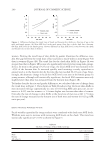
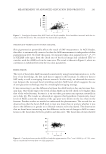
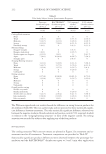
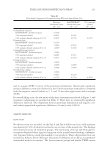
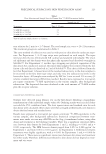
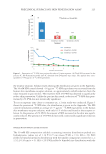
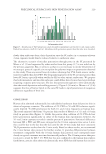
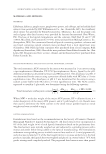
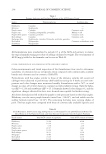
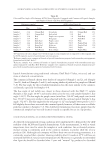
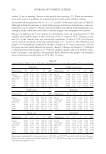
MEASUREMENT OF ADVANCED GLYCATION END-PRODUCTS 199 model for both skin sites are shown. From the trend lines, it is clearly seen that the AGE levels in the cheek skin are much lower than that of the forearm skin in young people, but the difference becomes smaller as the subjects increase in age. Dividing the subjects’ age into subgroups by decades, a trend of diminishing statistical signifi cance of the site dif- ference over age is shown in Table I. As we can see from the column for both genders, the facial skin AGE levels were signifi cantly lower than the arm in the age groups up to 35–45 year old. GENDER DIFFERENCE OF SKIN AGE LEVELS BETWEEN FACE AND ARM SITES Separating the skin AGE results by gender demonstrates the unique gender difference between face and arm skin sites. As can be seen in Table I, in the “all ages” row, the mean level of AGEs in the facial skin was signifi cantly lower in men than in women with AFR values being 1.648 ± 0.52 and 1.946 ± 0.59, respectively ( p 0.001). However, this gender difference did not exist at the forearm site (1.925 ± 0.40 vs. 2.034 ± 0.48, p 0.05). In addition, statistically signifi cant site difference of AGE level is seen in men’s age groups of up to 35–45 year of age, whereas it is only up to the 25–35 age group for Figur e 3. Comparison between cheek and forearm skin AGEs in a Caucasian population of men and women. The AGE level in the facial skin, as represented by the skin AFR, is signifi cantly lower than that of the fore- arm in young people ( p 0.001). It increased with age rapidly, reaching nearly the same values as that mea- sured in the forearm skin of subjects older than 60 year of age. Dark line and circles = the AGE levels in the left volar forearm gray line and crosses = AGEs in the left cheek. Table I D ifferences between Cheek and Forearm Skin AGE Levels in Age Brackets of Decades Both genders Men Women Forearm Cheek p @95% CL Forearm Cheek p @95% CL Forearm Cheek p @95% CL All ages 1.994 1.849 0.000 1.925 1.684 0.001 2.034 1.946 0.159 Age 25 1.546 1.187 0.002 1.525 1.134 0.012 1.559 1.219 0.020 25 age 35 1.688 1.455 0.000 1.668 1.274 0.000 1.700 1.560 0.036 35 age 45 2.001 1.815 0.014 1.954 1.742 0.028 2.050 1.891 0.272 45 age 55 2.113 2.092 0.707 2.045 1.894 0.206 2.151 2.200 0.586 55 age 65 2.474 2.344 0.163 2.484 2.374 0.600 2.471 2.336 0.402 p: probability value CL: confi dence level.
Purchased for the exclusive use of nofirst nolast (unknown)
From: SCC Media Library & Resource Center (library.scconline.org)