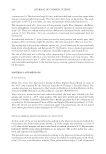
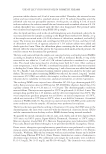
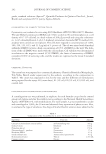
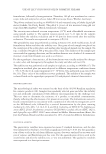
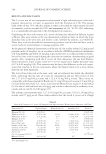
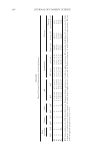
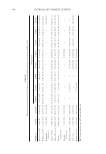
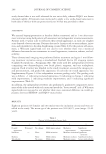
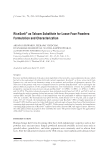
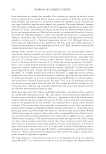
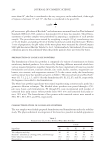
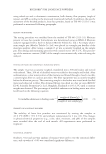
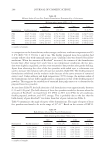
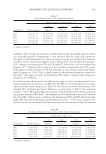
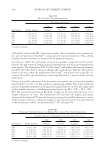
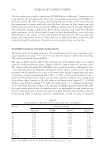
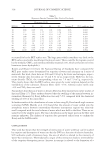
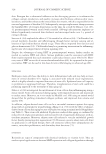
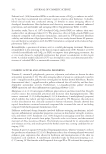
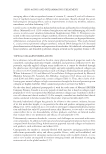
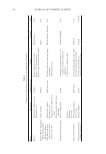
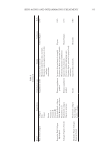
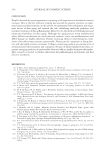
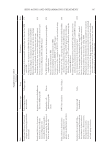
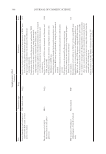
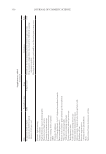
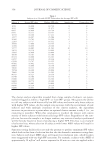
T able IV Relative Concentrations of Fatty Acids in the Cream Formulations before and after the Stability Test Formulation FAME (%) OilBST OilAST F0BST F0AST F1BST F1AST F2BST F2AST F3BST F3AST Myristic (C14:0) 0.09 ± 0.1 0.08 ± 0.04 3.36 ± 0.58 3.55 ± 0.37 1.80 ± 0.32 2.61 ± 0.09 0.39 ± 0.04 0.91 ± 0.01 0.35 ± 0.01 0.70 ± 0.03 Palmitic (C16:0) 12.20 ± 0.01 11.96 ± 0.06 65.89 ± 0.46 46.05 ± 1.01 35.09 ± 0.14 49.34 ± 0.23 16.95 ± 0.11 28.69 ± 0.20 19.28 ± 0.2723.25 ± 0.31 Palmitoleic (C16:1 n-7) 0.41 ± 0.02 0.31 ± 0.04 — — — — — — — 0.25 ± 0.07 Stearic (C18:0) 6.99 ± 0.03 7.15 ± 0.01 24.47 ± 0.54 18.21 ± 0.67 13.49 ± 0.40 22.93 ± 0.89 8.66 ± 0.03 15.48 ± 0.14 9.95 ± 0.2612.45 ± 0.11 Oleic (C18:1 n-9) 49.95 ± 0.02 38.24 ± 0.03 2.29 ± 0.17 15.00 ± 0.51 42.27 ± 0.07 9.40 ± 0.90 47.38 ± 0.11 38.84 ± 0.27 48.46 ± 0.67 41.92 ± 0.22 Linoleic (C18:2 n-6) 29.84 ± 0.01 41.67 ± 0.02 2.90 ± 0.27 7.21 ± 0.80 7.36 ± 0.18 4.55 ± 0.44 24.65 ± 0.01 11.78 ± 0.07 31.62 ± 0.43 18.10 ± 0.04 Linolenic (C18:3 n-3) 0.2 ± 0.03 0.20 ± 0.02 — — — — 0.50 ± 0.06 — — — Arachidic (C20:0) 0.18 ± 0.01 0.18 ± 0.03 — 1.75 ± 0.13 — 1.44 ± 0.40 0.16 ± 0.04 0.35 ± 0.01 0.14 ± 0.06 — C20:1 n-9 0.07 ± 0.01 0.09 ± 0.01 — — — 0.90 ± 0.02 0.69 ± 0.06 3.44 ± 0.11 0.91 ± 0.05 2.94 ± 0.26 Behenic (C22:0) 0.05 ± 0.01 0.12 ± 0.01 — 6.73 ± 0.46 — 4.74 ± 1.10 0.62 ± 0.03 — — — BST: before stability test AST: after stability test. JOURNAL OF COSMETIC SCIENCE 248

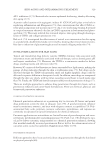
USE OF LECYTHIS PISONIS OIL IN COSMETIC CREAMS 249 The oil from L. pisonis is a potential material in cosmetic formulations, with good quality, possessing a desirable fatty acid composition for such applications. Now with the most stable concentration being established, it is possible to proceed with the tests in humans to fulfi ll the parameters to release the L. pisonis cream for human use. A CKNOWLEDGMENTS This work was supported by the Foundation for Support to Research and Innovation of Espírito Santo-FAPES (TO # 241/2016) and the Secretaria de Estado da Agricultura, Abastecimento, Aquicultura e Pesca (SEAG) (grant number TO # 432665/2016). The authors thank the National Council for Scientifi c Technological Research (PQ-process # 310680/2016-6) for their fi nancial support. This study was fi nanced in part by the Coor- denação de Aperfeiçoamento de Pessoal de Nível Superior—Brasil (CAPES)—Finance Code 001. The authors also thank FGR for helping in fruit collection. REFER ENCES (1) L . F. Braga, M. P. Sousa, S. Gilberti, and M. A. C. de Carvalho, Caracterização morfométrica de sementes de castanha de Sapucaia (Lecythis pisonis CAMBESS - Lecythidaceae), Rev Ciências Agro-Ambientais, 5, 111–116 (2007). (2) H. L o renzi, Árvores Brasileiras: Manual de Identifi cação e Cultivo de Plantas Arbóreas Nativas do Brasil, 5th Ed. (Instituto Plantarum de Estudos da Flora Ltda, Nova Odessa, Brazil, 2008), Vol. 1. (3) M. I. Vallilo, M. Tavares, S. Aued-Pimentel, N. C. Campos, and J. M. Moita Neto, Lecythis pisoni s Camb. nuts: oil characterization, fatty acids and minerals, Food Chem., 66, 197–200 (1999). (4) F. Demoliner, P. de Britto Policarpi, L. F. L. Vasconcelos, L. Vitali, G. A. Micke, and J. M. Bl o ck, Sapu- caia nut (Lecythis pisonis Cambess) and its by-products: a promising and underutilized source of bioactive compounds. Part II: phenolic compounds profi le, Food Res. Int., 112, 434–442 (2018). (5) I. M. M. de Carvalho, L. D. Queirós, L. F. Brito, F. A. Santos, A. V. M. Bandeira, A. L. de Souz a , and J. H. de Queiroz, Chemical characterization of Sapucaia nuts (Lecythis pisonis Cambess.) from zona da mata mineira region, Biosci. J., 28, 971–977 (2012). (6) M. S. Brandão, S. S. Pereira, D. F. Lima, J. P. C. Oliveira, E. L. F. Ferreira, M. H. Chaves, and F.R.C. Almeidaand, Antinociceptive effect of Lecythis pisonis Camb. (Lecythidaceae) in models of acute pain in mice, J. Ethnopharmacol., 146, 180–186 (2013). (7) ÉL. de F. Ferreira, T. S. Mascarenhas, J. P. de C. Oliveira, M. H. Chaves, B. Q. Araújo, and A. J. Caval- heiro, Phytochemical investigation and antioxidant activity of extracts of Lecythis pisonis Camb, J. Med. Plants Res., 8, 353–360 (2014). (8) C. Paquot, Standard methods for the analysis of oils, fats and derivatives, Pure Appl. Chem., 51, 25 0 3– 2525 (1979). (9) I. A. Lutz, Cap XVI Óleos E Gorduras. Métodos Físicos-Quimicos para Análise Aliment (Instituto Adolf Lutz, São Paulo, Brazil, 2008), pp . 593–629. (10) E. G. Bligh and W. J. Dyer, A rapid method of total lipid extraction and purifi cation, Can. J. Biochem. Physiol., 37, 911–917 (195 9). (11) J. D. Joseph and R. G. Ackman, Capillary column gas chromatographic method for analysis of encap- sulated fi sh oils and fi sh oil eth y l esters: collaborative study, J. AOAC Int., 75, 488–506 (1992). (12) J. V. Visentainer, Aspectos analíticos da resposta do detector de ionização em chama para ésteres de ácidos graxos em biodiesel e a limentos, Quim. Nova, 35, 274–279 (2012). (13) T. Mosmann, Rapid colorimetric assay for cellular growth and survival: application to proliferation and cytotoxicity assays, J. Immunol . Methods, 65, 55–63 (1983). (14) ANVISA, Guia de Controle de Qualidade de Produtos Cosméticos (2008), vol. 121. (15) M. T. Knorst, Desenvolvimento Tecnológ i co de Forma Farmacêutica Plástica Contendo Extrato Concentrado de Achyrocline Satureioides (LAM.) DC . Compositae (Marcela) (Universidade Federal do Rio Grande do Sul, Porto Alegre, 1991).
Purchased for the exclusive use of nofirst nolast (unknown)
From: SCC Media Library & Resource Center (library.scconline.org)