JOURNAL OF COSMETIC SCIENCE 262 ( 12) E. Marchei, D. De Orsi, C. Guarino, S. Dorato, R. Pacifi cia, and S. Pichini, Measurement of iodide and caffeine content in cellulite reduction cosmetic products sold in the European market, Anal. Methods, 5, 376–383 (2013). ( 13) K. Wojciechowska, M. Zun, D. Dwornicka, K. Swiader, R. Kasperek, and E. Poleszak, Physical proper- ties and caffeine release from creams prepared with different oils, Curr. Issues Pharm. Med. Sci., 27, 224–228 (2014). ( 14) N. Cabaleiro, I. De la Calle, C. Bendicho, and I. Lavilla, Current trends in liquid–liquid and solid– liquid extraction for cosmetic analysis: a review, Anal. Methods, 5, 323–340 (2013). ( 15) Z. Zhong and G. Li, Current trends in sample preparation for cosmetic analysis, J. Sep. Sci., 40, 152–169 (2017). ( 16) M. C. R. De Camargo and M. C. F. Toledo, HPLC determination of caffeine in tea, chocolate products and carbonated beverages, J. Sci. Food Agric., 79, 1861–1864 (1999). ( 17) P. N. Patil, Caffeine in various samples and their analysis with HPLC - a review, Int. J. Pharmaceut. Sci. Rev. Res., 16, 76–83 (2012). ( 18) E. Rudolph, A. Färbinger, and J. König, Determination of the caffeine contents of various food items within the Austrian market and validation of a caffeine assessment tool (CAT), Food Addit. Contam., 29, 1849–1860 (2012). (1 9 ) B. Asci, S. D. Zor, and Ö. A. Dönmez, Development and validation of HPLC method for the simultane- ous determination of fi ve food additives and caffeine in soft drinks, Int. J. Anal. Chem., 2016, 2879406 (2016). (20) M. Russo, P. Dugo, C. Fanali, L. Dugo, M. Zoccali, L. Mondello, and L. De Gara, Use of an online ex- traction technique coupled to liquid chromatography for determination of caffeine in coffee, tea, and cocoa, Food Anal. Methods, 11, 2637–2644 (2018). (21) Council of Europe, European Pharmacopoeia 9.0 (Council of Europe, Strasbourg, France, 2018). (22) Lubrizol Advanced Materials, Inc. (2012)., Separation of Carbopol® Polymers from Complex Formula- tions for Quantitive Analysis, accessed July 21, 2016, https://www.yumpu.com/en/document/ view/12345746/tds-231-separation-of-carbopolr-polymers-from-lubrizol. (23) EFSA Panel on Dietetic Products, Nutrition and Allergies (NDA), Scientifi c opinion on the safety of caffeine, EFSA J., 13, 4102 (2015).

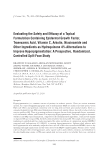
J. Cosmet. Sci., 71, 263–290 (September/October 2020) 263 Evaluating the Safety and Effi cacy of a Topical Formulation Containing Epidermal Growth Factor, Tranexamic Acid, Vitamin C, Arbutin, Niacinamide and Other Ingredients as Hydroquinone 4% Alternatives to Improve Hyperpigmentation: A Prospective, Randomized, Controlled Split Face Study BRANDON D. KALASHO, ARDALAN MINOKADEH, SANDY ZHANG-NUNES, RICHARD A. ZOUMALAN, NIMA L. SHEMIRANI, ANDREA R. WALDMAN, VADIM PLETZER, and CHRISTOPHER I. ZOUMALAN , Zoumalan Plastic Surgery, Beverly Hills, CA (B.D.K., R.A.Z., C.I.Z.) , Skin Care and Laser Physicians of Beverly Hills, Los Angeles, CA (A.M.), Department of Ophthalmology, Keck School of Medicine of USC, Los Angeles, CA (S.Z.-N.), Eos Rejuvenation, Beverly Hills, CA(N.L.S.), Albert Einstein College of Medicine, Montefi ore Medical Center, New York , NY (A.R.W.), KlinConsult, Wellington, New Zealand (V.P.) Accepted for publication April 13, 2020 . Synopsis Hyperpigmentation is a common concern of patients in aesthetic practice. There are various treatment options, but topical depigmenting agents such as hydroquinone (HQ) are usually a fi rst-line option. Given HQ’s side effects and potential controversy over its long-term use from prior animal studies, there is a consumer demand for non-HQ topical formulations that provide similar effi cacy, but with a reduced adverse reaction profi le to HQ. There is increasing evidence to support the use of selective growth factors, tranexamic acid, niacinamide, arbutin, and Vitamin C in improving hyperpigmentation. This study sought to determine whether a non-HQ topical formulation, composed of the aforementioned ingredients, could provide similar or improved effi cacy to topical HQ, but with a reduced adverse reaction profi le. This single-center, prospective, randomized, controlled split face study investigated the safety and effi cacy of a proprietary product SKNB19 compared with hydroquinone 4% (HQ4%) in treating hyperpigmentation. Eighteen adult subjects with facial pigmentation were randomly assigned to have one side of their face treated with SKNB19 twice a day (morning and night application) and the other treated with HQ4% applied nightly. Patients used a 5-point scale to self-assess their overall appearance, and a 4-point scale to assess redness, irritation, and tolerability to the skin-brightening creams. A Wilcoxon signed-rank test was used to test whether there was a statistical Address all correspondence to Christopher I. Zoumalan at research@zoumalanmd.com.
Purchased for the exclusive use of nofirst nolast (unknown)
From: SCC Media Library & Resource Center (library.scconline.org)