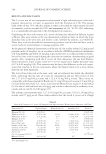
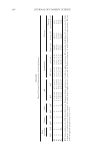
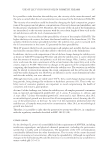
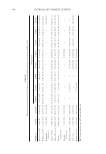
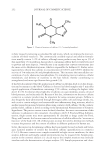
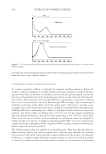
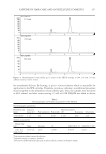
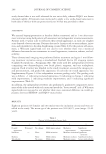
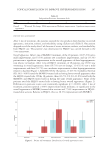
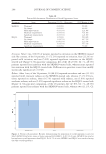
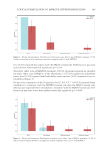
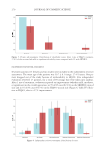
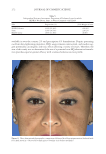
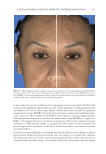
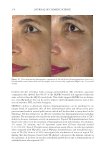
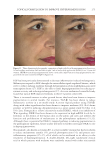
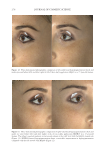
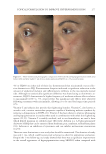
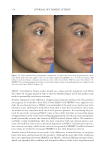
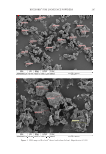
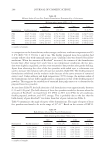
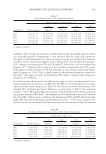
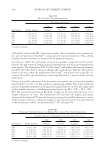
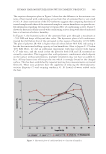
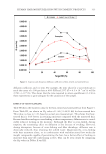
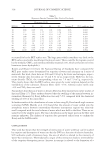
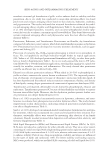
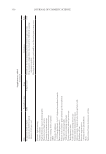
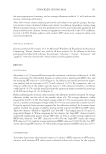
JOURNAL OF COSMETIC SCIENCE 296 RESULTS AND DISCUSSION PHYSICOCHEMICAL PROPERTY O F RICESORB® AND TALCUM Morphology. Using the SEM technique, it was found that RiceSo rb® had almost a spherical shape with rather smooth surface morphology. Uniformity of particles was observed. Its particle size was around 6 μm (Figure 1). Talcum possessed irregular surfaces and bigger particle sizes about 25 μm. It was observed that the particle sizes of talcum were not uni- form. Talcum used in the current study was pharmaceutical grade its greater particle sizes thus provided lower surface areas for sebum or oil absorption in comparison to RiceSorb®. Also, more spherical shapes of RiceSorb® could improve the skin feel (1). Bulk density, fl ow property, and pH. As seen from Table II, bulk densities of RiceSorb® and talcum were 0.40 ± 0.01 and 0.55 ± 0.11 g/ml, respectively. The bulk density of the two materials differed signifi cantly (p 0.05). It was noted that RiceSorb®, which had almost spherical shapes and smaller particle sizes, exhibited lower bulk density than talcum. The fl ow of powder is essential for the manufacturing process, especially during mixing and packaging. The fl ow characteristics of the substances were determined by angle of repose measurement. Several methods have been proposed for angle of repose determination such as the tilting box method, fi xed funnel method, and hollow cylinder method (13). In the current study, the fi xed funnel method was selected. It was found that the angle of repose of RiceSorb® was lower than that of talcum (Table II). Based on the USP 41 and NF 36 (10), RiceSorb® with an angle of repose of 35° could be classifi ed as having good fl owability, whereas talcum, which had an angle of 38°, could be classify as fair (aid not needed) fl owability. This is probably due to rather rounded shape and smooth surface of RiceSorb®. Such properties are capable of reducing resistance to movement between par- ticles, resulting in a lower angle of repose. The pH values of two materials were markedly different. Talcum had a higher basic pH of 8.8. RiceSorb® showed a weak acidic pH of 6.2, which is more compatible with the skin surface pH. Based on these results, the basic properties of RiceSorb® were more promising than those of talcum. LOOSE FACE POWDERS: PHYSICOCHEMICAL PROPERTY AND STABILITY The ing redients of loose face powders composed of RiceSorb® or tal cum, other white mate- rials such as zinc oxide and zinc stearate, tamarind fruit pulp extract, and preservatives. Five formulations of loose face powders were prepared, namely, FT0, FT1, FT2, FT3, and FT4 based on the ratios of talcum and RiceSorb® (4:0, 3:1, 2:2, 1:3, and 0:4). The physicochemical properties of the freshly prepared formulations (24 h) were investigated Table II Bulk Density, Angle of Repose, and pH of RiceSorb® and Talcum Substance Bulk density (g/ml) Angle of repose (°) pH [mean ± standard deviation (SD), n = 3] RiceSorb® 0.40 ± 0.01 35.10 ± 1.27 6.16 ± 0.01 Talcum 0.55 ± 0.11 38.07 ± 0.44 8.75 ± 0.01 n: number of samples.

RICESORB® FOR LOOSE FACE POWDERS 297 Figure 1. SEM images of RiceSorb® (above) and talcum (below). Magnifi cation ×1,000.
Purchased for the exclusive use of nofirst nolast (unknown)
From: SCC Media Library & Resource Center (library.scconline.org)