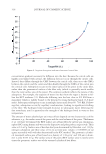
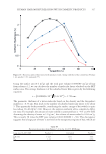
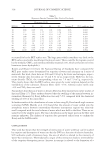
JOURNAL OF COSMETIC SCIENCE 304 The importance of water to hair can be experienced by running one’s fi ngers through the hair in an environment of low humidity ( 20% RH). The hair feels coarse and rough to touch and has a “fl yaway” effect due to the development of static charges on the surface of hair. On the other hand, hair in an environment of high humidity ( 70% RH) has a limp and heavy feel because of interfi ber adhesion from the condensed moisture fi lm on the surface. In this communication, we consider the interaction of water with hair in its natural state, or in combination with cosmetic formulations and actives, and grooming processes. EXPERIMENTAL MATERIALS The hair sample used in these experiments was European dark brown hair obtained from DeMeo Brothers of New York. Sodium lauryl sulfate was obtained from Sigma Aldrich. Cosmetic products used in this study were either raw materials or confi dential experi- mental formulations from commercial sources. METHOD Because the behavior of a hair assembly depends on its moisture content, which in turn depends on the transport of water vapor in and out of hair, a device suitable for studying the sorption and desorption of water from hair is used in this work. The device is a dynamic vapor sorption (DVS) instrument supplied by Surface Measurement Systems (Allentown, PA). It is a gravimetric device using a microbalance enclosed in a temperature-controlled incubator. The sample pan of the microbalance is enclosed in an environment in which the humidity is controlled with an accuracy of ±0.4%, using dry and moisture saturated nitrogen (bubbled through distilled water) in an appropri- ate proportion with a humidity controller. In this work, all experiments were carried out at 25°C. I n a typical experiment, about 20 mg of hair is placed in the sample pan and the humidity set for 0% RH. The sample is completely dried to a constant weight and the weight is recorded. Then the humidity is increased by steps of 10% up to 95% RH, the last step being 5%. The weight of the sample is recorded at the end of each step when the equilibrium is reached. The attainment of equilibrium is automatically sensed by the instrument based on the dM/dt value set in the software (for hair this value is generally 0.001%/min). If the behavior of the sample is known from previous experiments, then the equilibrium criterion can also be set to a maximum time limit (2–3 h for hair) for each step. Equilibrium is attained in this relatively short time because of the small sample size (20 mg). A part from obtaining sorption-desorption (S-D) isotherms, the instrument can also be used to determine moisture contents of materials at a given humidity. It should be noted, however, that with materials which show sorption hysteresis, such as hair, the moisture content at a given humidity depends on whether we approach that humidity from the dry side or the wet side.

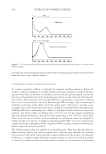
HUMAN HAIR MOISTURIZATION WITH COSMETIC PRODUCTS 305 T HERMODYNAMIC ORIGIN OF SORPTION HYSTERESIS T he following discussion is based on the work of W. P. Bryan (4) on sorption hysteresis. The nature of the DVS experiment lends itself conveniently to thermodynamic analysis. If the sorbent (hair) and the sorbate gas (water vapor) are confi ned to a cylinder with a piston, then sorption and desorption, respectively, can be carried out by reversibly com- pressing and expanding the sorbate. If the amount of moisture (sorbate) in the hair is determined and plotted as n (moles) vs lnP (P = partial pressure of water vapor), then we get the sorption and desorption isotherms. If the sorption and desorption process is re- versible, then the sorption–desorption isotherms will be coincident, and the overall work carried out is zero (W = 0). On the other hand, if the process is irreversible, then applying the second law of thermodynamics, the compression–expansion path gives a loop. The work that needs to be carried out on the system is given by the area of the loop and will be negative as seen in equation 1: ¨ ¨ 0 ln ln ln , D n low P S P W pdV RT n d P (1) w here R is the gas constant, T absolute temperature, nD and nS are moles of sorbate in the sorbent during desorption and sorption, respectively, P0 is the saturation vapor pressure of the pure sorbate, and Plow is the pressure between 0 and P0. W = -RT (area of the constant temperature hysteresis loop). For this purpose, the isotherm needs to be plotted as (moles of water sorbed) vs lnP. How ever, in this work, S-D data are plotted in terms of regain% vs RH. The region sur- rounded by the isotherms is the hysteresis loop. We have arbitrarily quantifi ed hysteresis H at a given humidity as fol lows: . D S H M M (2) T o correct for this change, we can express equation (2) as H = K (MD–MS). Using H, we can express equation (1) as a fi nite summation as 1"n i W RT K H i (3) Eq ua tion (3) can be used to interpret moisturizing ability of actives from cosmetic formu- lations on hair. Irrev ersibility of the S-D process also leads to an increase in the entropy of the system given by equation (4). ¨ 0 ln ln ln . low P D S P dS R n n d P (4) 'S = R (area of the constant temperature hysteresis loop). Increase in entropy refl ects the change in the fi ber structure as a result of sorption of water and consequent swelling. Rosenba um (5) has examined the applicability of Flory–Huggins polymer solution the- ory to sorption of water into keratin and has found that the theory agrees with the iso- therm only at high vapor pressures. Agreement at lower vapor pressures improves with
Purchased for the exclusive use of nofirst nolast (unknown)
From: SCC Media Library & Resource Center (library.scconline.org)