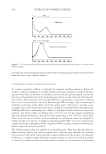
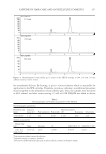
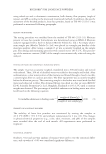
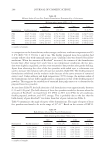
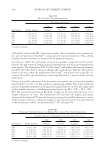
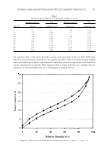
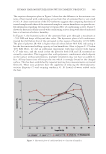
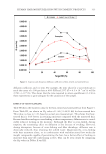
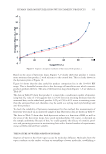
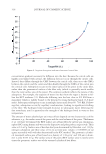
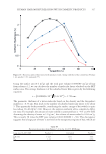
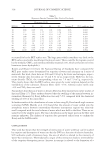
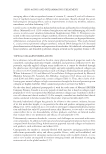
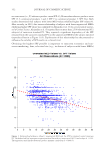
JOURNAL OF COSMETIC SCIENCE 306 the consideration of volume change with sorption of water, something similar to the transition occurring in polymers at the glass transition temperature. QUANTIF ICATION OF MOISTURIZATION Moistur ization as understood in the cosmetic industry can be loosely defi ned as the ability of a cosmetic product to enhance the retention of water in hair or skin. Because both hair and skin naturally have the ability to retain water to a certain extent with- out the application of any product, we need to defi ne moisturization with reference to the untreated hair or skin. Change in sorption hysteresis as a result of product ap- plication enables us to defi ne a hysteresis ratio of the hair treated with the product to that of the untreated hair. A hysteresis ratio higher than 1 (can be expressed as a percentage) indicates the ability of the product to absorb and retain water (Wtr Wuntr). A ratio lower than 1 indicates that the treatment with the product facilitates evaporation of water from treated hair (Wtr Wuntr). We defi ne this ratio as HR (hys- teresis ratio): (Area o f the hysteresis loop of treated hair in a given RH range/Area of the corresponding loop for untreated hair in the same RH range). . R tr untr H W W (5) Fr om eq uation (2), H = K (nD - nS) where K is a constant, then assuming the constants to be the same for treated and untreated hair, and replacing the integrals in equation (1) with fi nite summation, we can express equation (5) as follows (because all other factors cancel): , R tr untr i,tr i,untr H W W H H (6) (i = 1… n), n being the number of RH steps selected over the 'P interval. ¦Hi is the area of the hysteresis loop in the selected range of RH. From a practical point of view, it is suggested that the higher (70–95% RH) and the lower (0–10% RH) segments of the isotherm should not be included in this calculation. Including these regions in the calcu- lation can skew the result, limiting its usefulness. It is this strong interaction between water and the protein component in the mid-humidity range which gives rise to an increase in entropy and the moisturizing effect. RESULTS AND D ISCUSSION SORPTION HYST ERESIS Typical outco me of a DVS experiment conducted at a constant temperature (in this work, all experiments were carried out at 25°C) are a pair of isotherms forming a loop (S-D loop). To check the reproducibility of the measurement, we ran three experiments from a single sample of hair. The average moisture contents in each of the experiments in the S-D mode are given in Table I, and the S-D loops are plotted in Figure 1. The S-D iso- therm loops clearly show the accuracy of the instrument and excellent reproducibility of

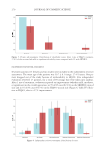
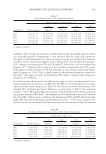
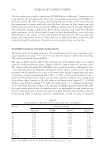
HUMAN HAIR MOISTURIZATION WITH COSMETIC PRODUCTS 307 the sorption data in the entire humidity range, and especially in the 10–60% RH range which is most relevant to the effi cacy of cosmetic products. This is a result of small sample mass and small space where experimental conditions such as temperature and humidity can be maintained accurately. This suggests that a single S-D run on a sample may be adequate to obtain reliable data on a well-prepared sample of hair. Table I Moisture Sorption Da t a for S–D Isotherms in Figure 1 (n = 3) RH (%) Average regain % 95% Average regain % 95% sorption confi dence level desorption confi dence level 0 0 0 0.8 0.72 10 2.8 0.46 5.1 0.29 20 5.4 0.41 7.7 0.17 30 7.5 0.11 9.8 0.21 40 9.3 0.09 11.7 0.21 50 11.0 0.14 13.5 0.25 60 12.7 0.25 15.5 0.29 70 14.6 0.24 17.7 0.29 80 17.6 0.19 20.6 0.19 90 23.4 0.38 25.1 0.25 Figure 1 . Hair–water S–D isotherms for untreated hair. Expt.1: ¡ Expt. 2: o Expt. 3: x.
Purchased for the exclusive use of nofirst nolast (unknown)
From: SCC Media Library & Resource Center (library.scconline.org)