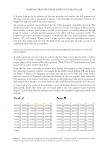
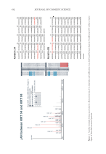
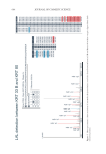
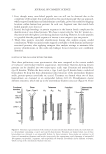
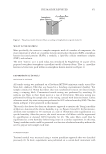
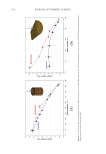
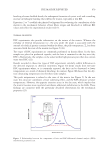
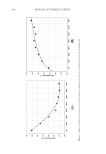
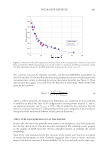
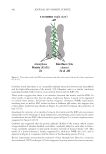
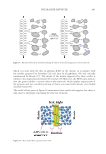
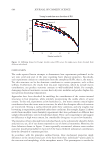
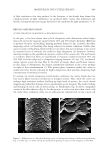
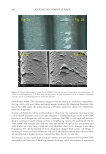
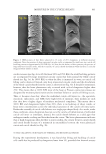
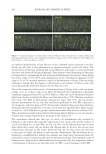
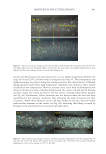
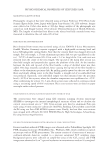
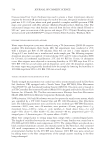
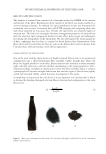
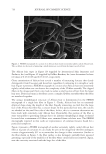
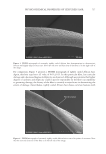
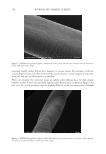
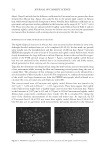
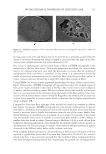
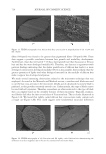
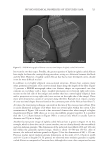
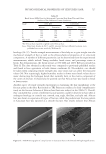
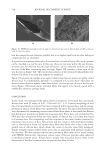
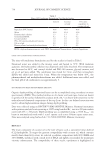
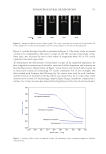
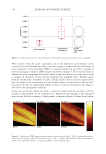
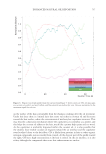
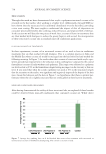
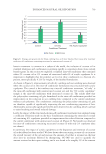
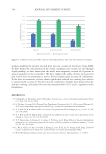
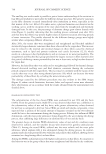
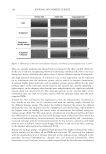
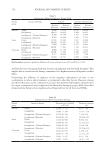
728 JOURNAL OF COSMETIC SCIENCE hair has unique fracture behavior, possibly due to its higher lipid levels or other biological components not yet identified. A typical fracture pattern observed in Caucasian hair is found in Figure 16A. Such a pattern can be classified as a step fracture. In this case, there are two steps within the step fracture. In some cases, we observed that this type of fracture can be a relatively uniform cut along the axis of the fiber (containing only one step). Figure 16B contains a closer view of the step fracture in Figure 16A. The overall characteristics of the extended, broken fibrils were observed in all the Caucasian hair samples we examined. Figure 17A presents an example of an angle or slanted step fracture pattern in tightly curled African hair. It is immediately apparent—as compared to Caucasian hair—that there are shorter broken fibrils in tightly curled African hair. A close-up view of one of the fracture zones (Figure 17B) reveals shorter extended fibrils that appear to be heavily coated with a nonfibrillar substance, perhaps lipids. CONCLUSION In this work, we investigated the physicochemical properties of textured hair, specifically African hair with CI values of 0.45 ± 0.08 and 0.63 ± 0.13. General morphological and fine structural details of textured hair were compared with Caucasian hair, and the unique geometrical aspects of the fibers were qualitatively described. The lipid distribution levels were determined by examining cross-sections of hair fibers where it was found that African hair had greater quantities of lipids than Caucasian hair. These data were corroborated by DVS data that demonstrated that the water uptake of African hair is less than that found in Caucasian hair. The morphology and fine structure of hair were further examined by preparing cross-sections of hair. African hair did not contain a well-developed medulla, such as that found in Asian or Caucasian hair. More than likely, this is due to the slower growth rate of African hair, which allows the cortex to become more fully developed. Tensile strength studies yielded break stress data in agreement with previous studies in the literature. We also examined the fracture patterns of fibers subjected to tensile testing with FESEM. African hair experiences various types of fracture patterns when subjected to mechanical tensile strain. African hair is unique from Caucasian hair in terms of the dimensions of the fibril remnants that are present after fiber fracture. Figure 17. FESEM micrographs of (A) an angle or slanted step fracture in African hair and (B) a close-up view of a fracture region.

729 PHYSICOCHEMICAL PROPERTIES OF TEXTURED HAIR ACKNOWLEDGMENTS The authors would like to express their gratitude to the R&D management team at Ashland LLC for their support of this project. REFERENCES (1) R. de la Mettrie, D. Saint-Léger, G. Loussouarn, A.-L. Garcel, C. Porter, and A. Langaney, Shape variability and classification of human hair: a worldwide approach, Hum. Biol., 79(3), 265–281 (2007). (2) N. P. Khumalo, P. T. Doe, R. P. Dawber, and D. J. Ferguson, What is normal black African hair? A light and scanning electron-microscopic study, J. Am. Acad. Dermatol., 43(5 Pt. 1), 814–820 (2000). (3) A. McMichael, Ethnic hair update: past and present, J. Am. Acad. Dermatol., 48(Suppl. 6), S127–S133 (2003). (4) C. E. Porter, F. Dixon, C. C. Khine, B. Pistorio, H. Bryant, and R. de la Mettrie, The behavior of hair from different countries, J. Cosmet. Sci., 60(2), 97–109 (2009). (5) T. Takahashi, Unique hair properties that emerge from combinations of multiple races, Cosmetics, 6(2), 36 (2019). (6) L. J. Wolfram, Human hair: a unique physicochemical composite, J. Am. Acad. Dermatol., 48(6 Suppl.), S106–S114 (2003). (7) Y. Kamath, S. Hornby, and H.-D. Weigmann, Mechanical and fractographic behavior of Negroid hair, J. Soc. Cosmet. Chem., 35(1), 21–43 (1984). (8) L. Coderch, M. A. Oliver, V. Carrer, A. M. Manich, and M. Martí, External lipid function in ethnic hairs, J. Cosmet. Dermatol., 18(6), 1912–1920 (2019). (9) C. F. Cruz, M. M. Fernandes, A. C. Gomes, L. Coderch, M. Martí, S. Méndez, L. Gales, N. G. Azoia, U. Shimanovich, and A. Cavaco-Paulo, Keratins and lipids in ethnic hair, Int. J. Cosmet. Sci., 35(3), 244–249 (2013). (10) M. Martí, C. Barba, A. M. Manich, L. Rubio, C. Alonso, and L. Coderch, The influence of hair lipids in ethnic hair properties, Int. J. Cosmet. Sci., 38(1), 77–84 (2016). (11) B. A. Benard, Hair shape of curly hair, J. Am. Acad. Dermatol., 48(Suppl. 6), S120–S126 (2003). (12) W. G. Bryson, D. P. Harland, J. P. Caldwell, J. A. Vernon, R. J. Walls, J. L. Woods, S. Nagase, T. Itou, and K. Koike, Cortical cell types and intermediate filament arrangements correlate with fiber curvature in Japanese human hair, J. Struct. Biol., 166(1), 46–58 (2009). (13) D. P. Harland, J. A. Vernon, J. L. Woods, S. Nagase, T. Itou, K. Koike, D. A. Scobie, A. J. Grosvenor, J. M. Dyer, and S. Clerens, Intrinsic curvature in wool fibres is determined by the relative length of orthocortical and paracortical cells, J. Exp. Biol., 221(6), jeb172312 (2018). (14) Y. Kajiura, S. Watanabe, T. Itou, K. Nakamura, A. Iida, K. Inoue, N. Yagi, Y. Shinohara, and Y. Amemiya, Structural analysis of human hair single fibres by scanning microbeam SAXS, J. Struct. Biol., 155(3), 438–444 (2006). (15) S. Nagase, T. Shinozaki, M. Tsuchiya, H. Tsujimura, Y. Masukawa, N. Satoh, T. Itou, and K. Koike, Characteristic microstructure of curved human hair, Int. J. Cosmet. Sci., 32(4), 317 (2010). (16) S. Nagase, M. Tsuchiya, T. Matsui, S. Shibuichi, H. Tsujimura, Y. Masukawa, N. Satoh, T. Itou, K. Koike, and K. Tsujii, Characterization of curved hair of Japanese women with reference to internal structures and amino acid composition, J. Cosmet. Sci., 59(4), 317–332 (2008). (17) J. N. Nissimov and A. B. Das Chaudhuri, Hair curvature: a natural dialectic and review, Biol. Rev. Camb. Philos. Soc., 89(3), 723–766 (2014). (18) S. Thibaut, P. Barbarat, F. Leroy, and B. A. Bernard, Human hair keratin network and curvature, Int. J. Dermatol., 46(Suppl. 1), 7–10 (2007). (19) M. Wade, I. Tucker, P. Cunningham, R. Skinner, F. Bell, T. Lyons, K. Patten, L. Gonzalez, and T. Wess, Investigating the origins of nanostructural variations in differential ethnic hair types using X-ray scattering techniques, Int. J. Cosmet. Sci., 35(5), 430–441 (2013).
Purchased for the exclusive use of nofirst nolast (unknown)
From: SCC Media Library & Resource Center (library.scconline.org)