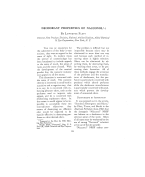
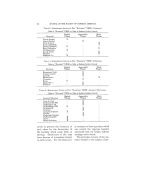
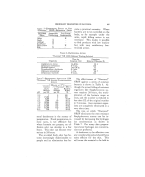
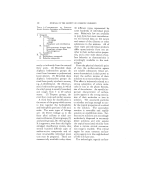
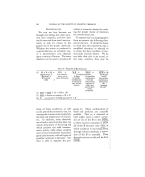
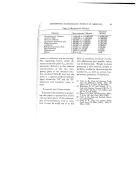
to retard the development of soap curds. Table 1 compares the trans- mirrance of 0.2 per cent soap solu- tions containing 0.02 per cent of various surface-active agents at 25øC. readings being made five minutes after making up the solu- COCO•AT• XND 0.02• DISPERSXNT I• 200 PPM. CaCO• K cocohate only ................... 66% Non-ionic ether .................... 85% Na lauryl sulfate ................... 70% Coconut fatty amide ............... 81% Non-ionic ester .................... 84% Dodecyl toluene sulfonate ........... 79% Oleic amide sulfonate ............... 84% If these solutions are allowed to stand long enough, they will even- tually all show the same low trans- mittance. One cannot, however, formulate soap and lime soap dis- petsant on the basis of these data alone. The foaming properties of (1) binary mixtures of surface-active agents are not predictable. The (2) adverse effect of soap on alkyl aryl (3) sulfonate foam is well known and (4:) has even been utilized to make non- foaming wetting agents. Lathering (5) experiments using high concentra- (6) tions of soap and alkyl aryl sul- fonate confirm the results obtained (7) at low. concentrations, although, (8) strangely enough, the defoaming effect is not picked up easily in the (9) Waring blendor test. Hand lather- (10) ing experiments also indicate that (11) the fatty amides of the Altosol (12) type enhance lather, at the same (13) time retarding precipitation of the SHAMPOO FORMULATION 361 lime soap. None of these materials has the same effect on the lathering properties of the soap in hard water that organic sequestrants have. A mixture of soap, plus lime-soap dispersant, does not show good lathering properties in hard water unless organic sequestrant is present. Considering the number of years that shampoos have been manu- factured and marketed, no one can complain that conditions in this field are static.. Shampoos today account for over 50 million dollars in sales volume. The cosmetic chemist today must search con- stantly for new possibilities. Fortu- nately, he has an untapped wealth of raw materials still available to draw on. BIB LIOGRAPH¾ Stoves, j. L., y. Soc. Leather Trades Chemists, 32, (8), 254: (1948) Nature, 157, 230 (1948). Putnam, F. W., "Advances in Protein Chemistry," Vol. 4, p. 79 (194:8). Valko, E., Atnn. of N.Y. Atcad. Sci., 4,6, 4:51 (1946). Harris, M., Textile Research y., 18, 669 (1948). Neville and Jeanson, Arm. Dyestuff Reptr., 22, 565 (1933). Steinhardt, Fugitt, and Harris (1942): y. Res. Natl. Bureau Standards, 28, 201 (1942). Steinhardt, and Fugitt, Ibid., 29, 315 (1942). Aickin, R. G., y. Soc. Dyers Colorists, 60, 60 (194{). King, y. Textile Inst., 13, 127 T (1922). Neville, H. A., and Harris, M., Arm. Dye- stuff Reptr., 2't, 312 (1935). Baker, Z., et al., y. •Exper. Med. 74, 621 (1941). Tech. Bull., Alrosept MB (Alrose Chemical Co.). Zussman, H. W., Soap & Sanitary Chem., 24, (2), 57 (1947).

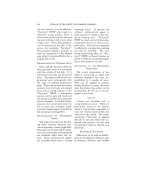
HYDROPHILIC BEESWAX DERIVATIVES By P. J. CARTER and W. C. GRiFFiN zttlas Powder Company, [4/ilmington, Del. HYDKOPHILIC BEESWAX DEKIVA- TIVES NON-IONm eMU•.S•IE•S in cosmetics have many advantages(l). However, their use has been limited to stearic acid type formulas and W/O emulsions because they did not produce good cold creams. We have developed a series of hydrophilic beeswax derivatives that overcome this deficiency. Chemically, they are a combination of polyoxyeth- ylene sorbitol and beeswax. Physi- cally, they resemble beeswax in color, feel, and odor. Because they are surface active, they may be used as the emulsifier or as a co- emulsifier in preparing soap-free or borax-type cold cream and similar products. Our study of these hydrophilic beeswax derivatives has included their formulation in cold creams and other cosmetic preparations. The emulsifier in all known cold creams, which are based on beeswax and borax, i• the sodium soap of the fatty acids contained in beeswax. By using these new beeswax deriva- tives several soap-free cold creams have been developed. • Presented at the December 8, 1949, Meet- ing, New York City. The first of these, Formula 1, is a cold cream formula (2) emulsified by one of the beeswax derivatives used in combination with poly- oxyethylene sorbitan .mønøpaImi- tate. Formula 1 Cold Cream (Soap-Free) Per Cent A Mineral Oil .................. 50 Beeswax .................... 7 Tween 40' .................. 2 G-1726 ..................... 8 B H20 ........................ 33 Preserva tire C Perfume The preparation of this type cream differs 'only slightly from that of a beeswax-borax cream in which the water phase is added to the oil phase. Best results are obtained with this type preparation when the oil phase, including the emulsifier and beeswax derivative, is melted and mixed and then added to the hot water. The creams should be hot-poured. This formula produces a soft, high gloss cream which is very smooth textured. It "peaks" well and liquefies very readily when ap- plied. It has better elevated tem- perature stability than several com- merciai creams. 362
Purchased for the exclusive use of nofirst nolast (unknown)
From: SCC Media Library & Resource Center (library.scconline.org)